

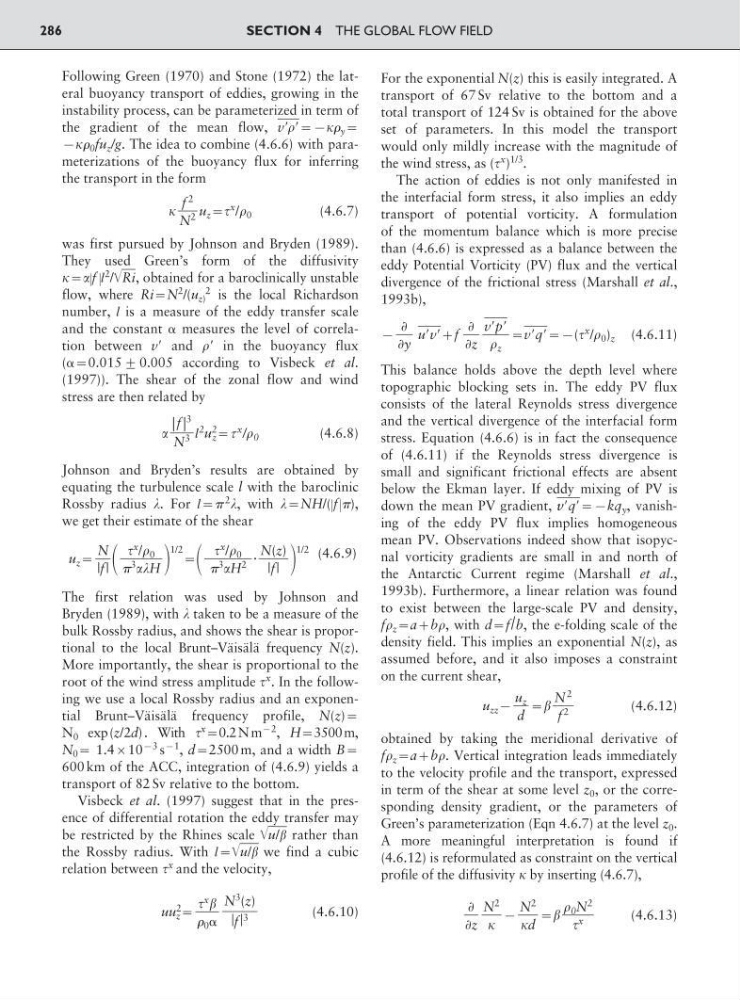
Following Green (1970) and Stone (1972) the lateral buoyancy transport of eddies, growing in the
instability process, can be parameterized in term of
the gradient of the mean flow, v
ෆЈ ෆ ෆЈ ෆ:9 y :
9 0 fu z /g. The idea to combine (4.6.6) with parameterizations of the buoyancy flux for inferring
the transport in the form
u z :
x
/ 0
(4.6.7)
was first pursued by Johnson and Bryden (1989).
They used Green’s form of the diffusivity
:Ϳf Ϳl
2
/͙R ෆi ෆ, obtained for a baroclinically unstable
flow, where Ri:N
2
/(u z)
2 is the local Richardson
number, l is a measure of the eddy transfer scale
and the constant ␣ measures the level of correlation between vЈ and Ј in the buoyancy flux
(␣:0.015 < 0.005 according to Visbeck et al.
(1997)). The shear of the zonal flow and wind
stress are then related by
l
2 u
2
z :
x / 0
(4.6.8)
Johnson and Bryden’s results are obtained by
equating the turbulence scale l with the baroclinic
Rossby radius . For l:
2
, with :NH/(ͿfͿ),
we get their estimate of the shear
u z :
1/2 :
.
1/2 (4.6.9)
The first relation was used by Johnson and
Bryden (1989), with taken to be a measure of the
bulk Rossby radius, and shows the shear is proportional to the local Brunt–Väisälä frequency N(z).
More importantly, the shear is proportional to the
root of the wind stress amplitude
x
. In the following we use a local Rossby radius and an exponential Brunt–Väisälä frequency profile, N(z):
N 0 exp (z/2d) . With
x
:0.2 N m
92
, H:3500 m,
N 0 : 1.410
93 s
91 , d:2500 m, and a width B:
600 km of the ACC, integration of (4.6.9) yields a
transport of 82 Sv relative to the bottom.
Visbeck et al. (1997) suggest that in the presence of differential rotation the eddy transfer may
be restricted by the Rhines scale ͙u ෆ/ ෆ rather than
the Rossby radius. With l:͙u ෆ/ ෆ we find a cubic
relation between
x and the velocity,
uu
2
z :
(4.6.10)
For the exponential N(z) this is easily integrated. A
transport of 67 Sv relative to the bottom and a
total transport of 124 Sv is obtained for the above
set of parameters. In this model the transport
would only mildly increase with the magnitude of
the wind stress, as (
x )
1/3 .
The action of eddies is not only manifested in
the interfacial form stress, it also implies an eddy
transport of potential vorticity. A formulation
of the momentum balance which is more precise
than (4.6.6) is expressed as a balance between the
eddy Potential Vorticity (PV) flux and the vertical
divergence of the frictional stress (Marshall et al.,
1993b),
9
u
ෆЈ ෆv ෆЈ ෆ;f
:v ෆЈ ෆq ෆЈ ෆ:9(
x
/ 0 ) z (4.6.11)
This balance holds above the depth level where
topographic blocking sets in. The eddy PV flux
consists of the lateral Reynolds stress divergence
and the vertical divergence of the interfacial form
stress. Equation (4.6.6) is in fact the consequence
of (4.6.11) if the Reynolds stress divergence is
small and significant frictional effects are absent
below the Ekman layer. If eddy mixing of PV is
down the mean PV gradient, v v
ෆЈ ෆq ෆЈ ෆ:9kq y , vanishing of the eddy PV flux implies homogeneous
mean PV. Observations indeed show that isopycnal vorticity gradients are small in and north of
the Antarctic Current regime (Marshall et al.,
1993b). Furthermore, a linear relation was found
to exist between the large-scale PV and density,
f z :a;b, with d:f/b, the e-folding scale of the
density field. This implies an exponential N(z), as
assumed before, and it also imposes a constraint
on the current shear,
u zz 9 :
(4.6.12)
obtained by taking the meridional derivative of
f z :a;b. Vertical integration leads immediately
to the velocity profile and the transport, expressed
in term of the shear at some level z 0 , or the corresponding density gradient, or the parameters of
Green’s parameterization (Eqn 4.6.7) at the level z 0 .
A more meaningful interpretation is found if
(4.6.12) is reformulated as constraint on the vertical
profile of the diffusivity by inserting (4.6.7),
9
:
(4.6.13)
0 N
2
ᎏ
x
N
2
ᎏ
d
N
2
ᎏ
Ѩ
ᎏ
Ѩz
N
2
ᎏ
f
2
u z
ᎏ
d
v ෆЈ ෆp ෆЈ ෆ
ᎏ
z
Ѩ
ᎏ
Ѩz
Ѩ
ᎏ
Ѩy
N
3
(z)
ᎏ
|f |
3
x
ᎏ
0 ␣
N(z)
ᎏ
|f|
x
/ 0
ᎏ
3
H
2
x / 0
ᎏ
3
H
N
ᎏ
|f|
| f |
3
ᎏ
N
3
f
2
ᎏ
N
2
SECTION 4 THE GLOBAL FLOW FIELD
286
instability process, can be parameterized in term of
the gradient of the mean flow, v
ෆЈ ෆ ෆЈ ෆ:9 y :
9 0 fu z /g. The idea to combine (4.6.6) with parameterizations of the buoyancy flux for inferring
the transport in the form
u z :
x
/ 0
(4.6.7)
was first pursued by Johnson and Bryden (1989).
They used Green’s form of the diffusivity
:Ϳf Ϳl
2
/͙R ෆi ෆ, obtained for a baroclinically unstable
flow, where Ri:N
2
/(u z)
2 is the local Richardson
number, l is a measure of the eddy transfer scale
and the constant ␣ measures the level of correlation between vЈ and Ј in the buoyancy flux
(␣:0.015 < 0.005 according to Visbeck et al.
(1997)). The shear of the zonal flow and wind
stress are then related by
l
2 u
2
z :
x / 0
(4.6.8)
Johnson and Bryden’s results are obtained by
equating the turbulence scale l with the baroclinic
Rossby radius . For l:
2
, with :NH/(ͿfͿ),
we get their estimate of the shear
u z :
1/2 :
.
1/2 (4.6.9)
The first relation was used by Johnson and
Bryden (1989), with taken to be a measure of the
bulk Rossby radius, and shows the shear is proportional to the local Brunt–Väisälä frequency N(z).
More importantly, the shear is proportional to the
root of the wind stress amplitude
x
. In the following we use a local Rossby radius and an exponential Brunt–Väisälä frequency profile, N(z):
N 0 exp (z/2d) . With
x
:0.2 N m
92
, H:3500 m,
N 0 : 1.410
93 s
91 , d:2500 m, and a width B:
600 km of the ACC, integration of (4.6.9) yields a
transport of 82 Sv relative to the bottom.
Visbeck et al. (1997) suggest that in the presence of differential rotation the eddy transfer may
be restricted by the Rhines scale ͙u ෆ/ ෆ rather than
the Rossby radius. With l:͙u ෆ/ ෆ we find a cubic
relation between
x and the velocity,
uu
2
z :
(4.6.10)
For the exponential N(z) this is easily integrated. A
transport of 67 Sv relative to the bottom and a
total transport of 124 Sv is obtained for the above
set of parameters. In this model the transport
would only mildly increase with the magnitude of
the wind stress, as (
x )
1/3 .
The action of eddies is not only manifested in
the interfacial form stress, it also implies an eddy
transport of potential vorticity. A formulation
of the momentum balance which is more precise
than (4.6.6) is expressed as a balance between the
eddy Potential Vorticity (PV) flux and the vertical
divergence of the frictional stress (Marshall et al.,
1993b),
9
u
ෆЈ ෆv ෆЈ ෆ;f
:v ෆЈ ෆq ෆЈ ෆ:9(
x
/ 0 ) z (4.6.11)
This balance holds above the depth level where
topographic blocking sets in. The eddy PV flux
consists of the lateral Reynolds stress divergence
and the vertical divergence of the interfacial form
stress. Equation (4.6.6) is in fact the consequence
of (4.6.11) if the Reynolds stress divergence is
small and significant frictional effects are absent
below the Ekman layer. If eddy mixing of PV is
down the mean PV gradient, v v
ෆЈ ෆq ෆЈ ෆ:9kq y , vanishing of the eddy PV flux implies homogeneous
mean PV. Observations indeed show that isopycnal vorticity gradients are small in and north of
the Antarctic Current regime (Marshall et al.,
1993b). Furthermore, a linear relation was found
to exist between the large-scale PV and density,
f z :a;b, with d:f/b, the e-folding scale of the
density field. This implies an exponential N(z), as
assumed before, and it also imposes a constraint
on the current shear,
u zz 9 :
(4.6.12)
obtained by taking the meridional derivative of
f z :a;b. Vertical integration leads immediately
to the velocity profile and the transport, expressed
in term of the shear at some level z 0 , or the corresponding density gradient, or the parameters of
Green’s parameterization (Eqn 4.6.7) at the level z 0 .
A more meaningful interpretation is found if
(4.6.12) is reformulated as constraint on the vertical
profile of the diffusivity by inserting (4.6.7),
9
:
(4.6.13)
0 N
2
ᎏ
x
N
2
ᎏ
d
N
2
ᎏ
Ѩ
ᎏ
Ѩz
N
2
ᎏ
f
2
u z
ᎏ
d
v ෆЈ ෆp ෆЈ ෆ
ᎏ
z
Ѩ
ᎏ
Ѩz
Ѩ
ᎏ
Ѩy
N
3
(z)
ᎏ
|f |
3
x
ᎏ
0 ␣
N(z)
ᎏ
|f|
x
/ 0
ᎏ
3
H
2
x / 0
ᎏ
3
H
N
ᎏ
|f|
| f |
3
ᎏ
N
3
f
2
ᎏ
N
2
SECTION 4 THE GLOBAL FLOW FIELD
286