

scenario is the QG picture with only a few density layers, as in the models referred to above.
With no flux between layers, all the Ekman flux
returns to the south in the top layer, and isopycnal averaging shows no overturning, whereas
level averaging shows an overturning cell reaching the bottom layer, which is the only layer
containing topography.
¥ Case II. The southward return flow is all in
density surfaces that intersect topography. This
scenario requires a feedback mechanism between
the wind stress and thermohaline forcing, so that
the diapycnal flux into and out of these deep
layers to the north and south of the chosen
latitude can balance the northward Ekman flux.
Consider the balance of zonal momentum, integrated zonally and over two layers (which may be
stratified), separated by an isopycnal. The upper
layer of thickness h includes the Ekman layer,
the lower one reaches from z:9h to the ocean
bottom. Writing the depth-integrated northward
volume flux in each layer as V i , i:1, 2, the steadystate balances read
9 0 f V
ෆ ෆ 1 ෆ:9h ෆЈ ෆp ෆЈ ෆ x ෆ; ෆ
x
ෆ
(4.6.4)
9 0 f V
ෆ ෆ ෆ 2 ෆ:h ෆЈ ෆp ෆЈ ෆ x ෆ9H ෆ ෆp ෆෆ ෆ b ෆ x ෆ
(4.6.5)
where the overbar denotes time and zonal mean
(see Fig. 4.6.9 for a schematic showing the relationship between geostrophic meridional flow and
interfacial form stresses on an arbitrary layer). In
case I, with the Ekman flux all returning above the
isopycnal at z:9h, we have V
ෆ 1
ෆ:V ෆ 2
ෆ:0. Friction
and Reynolds stress are generally negligible and the
only remaining terms are wind stress and the pressure forces on the boundaries: interfacial form stress
and bottom stress. Thus, for case I, the wind stress
and bottom stress are in balance, and are equal to
the interfacial form stress at any isopycnal below
the Ekman return flow and above the bottom. Some
dynamical mechanism, such as stationary waves
excited by topography in an eastward current, or
SECTION 4 THE GLOBAL FLOW FIELD
284
=
N
E
Down
Pressure
Low
High
Density surface
N
N
S
S
W
E
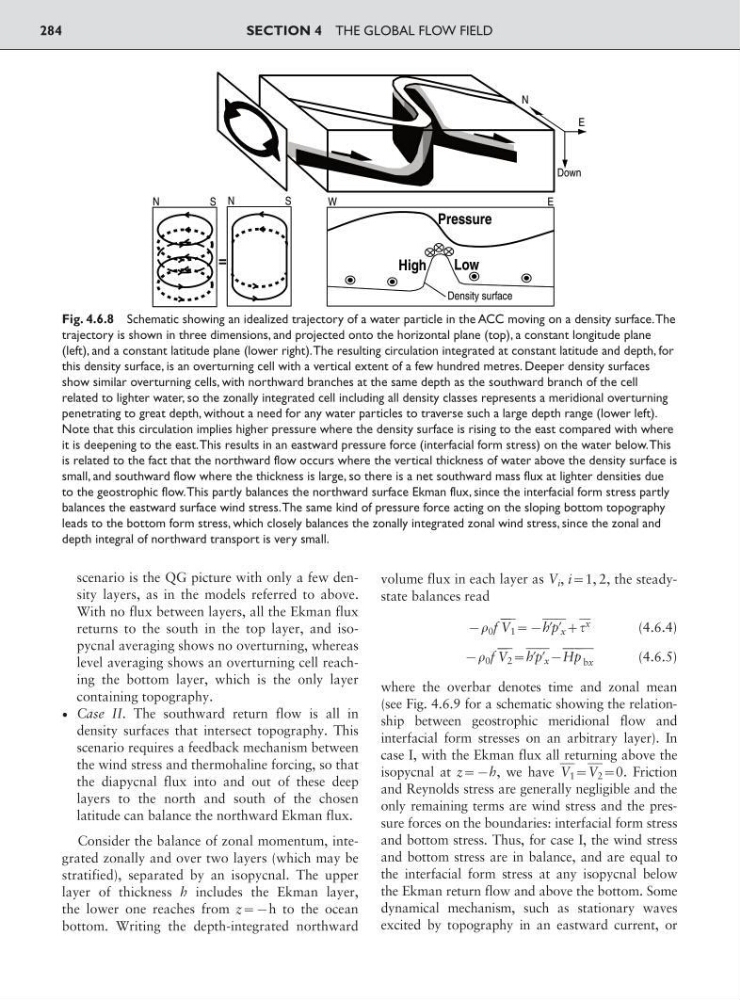
Fig. 4.6.8 Schematic showing an idealized trajectory of a water particle in the ACC moving on a density surface.The
trajectory is shown in three dimensions, and projected onto the horizontal plane (top), a constant longitude plane
(left), and a constant latitude plane (lower right).The resulting circulation integrated at constant latitude and depth, for
this density surface, is an overturning cell with a vertical extent of a few hundred metres. Deeper density surfaces
show similar overturning cells, with northward branches at the same depth as the southward branch of the cell
related to lighter water, so the zonally integrated cell including all density classes represents a meridional overturning
penetrating to great depth, without a need for any water particles to traverse such a large depth range (lower left).
Note that this circulation implies higher pressure where the density surface is rising to the east compared with where
it is deepening to the east.This results in an eastward pressure force (interfacial form stress) on the water below.This
is related to the fact that the northward flow occurs where the vertical thickness of water above the density surface is
small, and southward flow where the thickness is large, so there is a net southward mass flux at lighter densities due
to the geostrophic flow.This partly balances the northward surface Ekman flux, since the interfacial form stress partly
balances the eastward surface wind stress.The same kind of pressure force acting on the sloping bottom topography
leads to the bottom form stress, which closely balances the zonally integrated zonal wind stress, since the zonal and
depth integral of northward transport is very small.
With no flux between layers, all the Ekman flux
returns to the south in the top layer, and isopycnal averaging shows no overturning, whereas
level averaging shows an overturning cell reaching the bottom layer, which is the only layer
containing topography.
¥ Case II. The southward return flow is all in
density surfaces that intersect topography. This
scenario requires a feedback mechanism between
the wind stress and thermohaline forcing, so that
the diapycnal flux into and out of these deep
layers to the north and south of the chosen
latitude can balance the northward Ekman flux.
Consider the balance of zonal momentum, integrated zonally and over two layers (which may be
stratified), separated by an isopycnal. The upper
layer of thickness h includes the Ekman layer,
the lower one reaches from z:9h to the ocean
bottom. Writing the depth-integrated northward
volume flux in each layer as V i , i:1, 2, the steadystate balances read
9 0 f V
ෆ ෆ 1 ෆ:9h ෆЈ ෆp ෆЈ ෆ x ෆ; ෆ
x
ෆ
(4.6.4)
9 0 f V
ෆ ෆ ෆ 2 ෆ:h ෆЈ ෆp ෆЈ ෆ x ෆ9H ෆ ෆp ෆෆ ෆ b ෆ x ෆ
(4.6.5)
where the overbar denotes time and zonal mean
(see Fig. 4.6.9 for a schematic showing the relationship between geostrophic meridional flow and
interfacial form stresses on an arbitrary layer). In
case I, with the Ekman flux all returning above the
isopycnal at z:9h, we have V
ෆ 1
ෆ:V ෆ 2
ෆ:0. Friction
and Reynolds stress are generally negligible and the
only remaining terms are wind stress and the pressure forces on the boundaries: interfacial form stress
and bottom stress. Thus, for case I, the wind stress
and bottom stress are in balance, and are equal to
the interfacial form stress at any isopycnal below
the Ekman return flow and above the bottom. Some
dynamical mechanism, such as stationary waves
excited by topography in an eastward current, or
SECTION 4 THE GLOBAL FLOW FIELD
284
=
N
E
Down
Pressure
Low
High
Density surface
N
N
S
S
W
E
Fig. 4.6.8 Schematic showing an idealized trajectory of a water particle in the ACC moving on a density surface.The
trajectory is shown in three dimensions, and projected onto the horizontal plane (top), a constant longitude plane
(left), and a constant latitude plane (lower right).The resulting circulation integrated at constant latitude and depth, for
this density surface, is an overturning cell with a vertical extent of a few hundred metres. Deeper density surfaces
show similar overturning cells, with northward branches at the same depth as the southward branch of the cell
related to lighter water, so the zonally integrated cell including all density classes represents a meridional overturning
penetrating to great depth, without a need for any water particles to traverse such a large depth range (lower left).
Note that this circulation implies higher pressure where the density surface is rising to the east compared with where
it is deepening to the east.This results in an eastward pressure force (interfacial form stress) on the water below.This
is related to the fact that the northward flow occurs where the vertical thickness of water above the density surface is
small, and southward flow where the thickness is large, so there is a net southward mass flux at lighter densities due
to the geostrophic flow.This partly balances the northward surface Ekman flux, since the interfacial form stress partly
balances the eastward surface wind stress.The same kind of pressure force acting on the sloping bottom topography
leads to the bottom form stress, which closely balances the zonally integrated zonal wind stress, since the zonal and
depth integral of northward transport is very small.