

of the momentum balance in the different model
types is given in Olbers (1998).
In terms of the meridional overturning (the zonally integrated flow at fixed depths), this balance is
equivalent to saying that the northward Ekman
flux returns in a geostrophic southward flow, supported by zonal pressure differences across topography. The only difference from the situation
in other oceans is that, at the latitudes of Drake
Passage, the topography does not reach the surface,
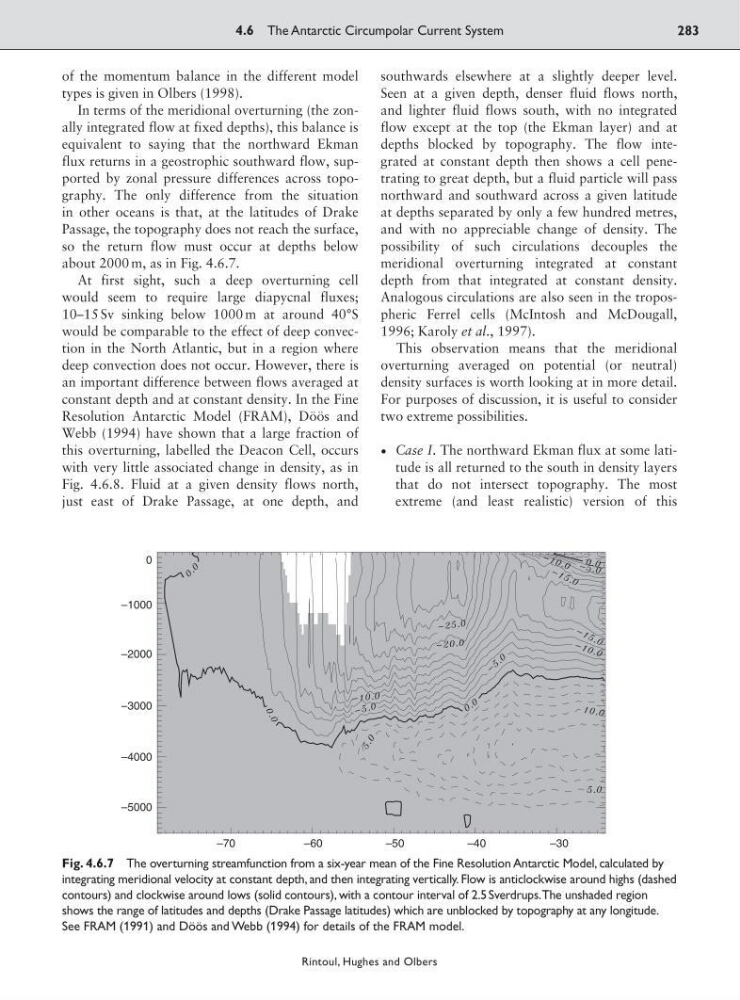
so the return flow must occur at depths below
about 2000 m, as in Fig. 4.6.7.
At first sight, such a deep overturning cell
would seem to require large diapycnal fluxes;
10–15 Sv sinking below 1000 m at around 40°S
would be comparable to the effect of deep convection in the North Atlantic, but in a region where
deep convection does not occur. However, there is
an important difference between flows averaged at
constant depth and at constant density. In the Fine
Resolution Antarctic Model (FRAM), Döös and
Webb (1994) have shown that a large fraction of
this overturning, labelled the Deacon Cell, occurs
with very little associated change in density, as in
Fig. 4.6.8. Fluid at a given density flows north,
just east of Drake Passage, at one depth, and
southwards elsewhere at a slightly deeper level.
Seen at a given depth, denser fluid flows north,
and lighter fluid flows south, with no integrated
flow except at the top (the Ekman layer) and at
depths blocked by topography. The flow integrated at constant depth then shows a cell penetrating to great depth, but a fluid particle will pass
northward and southward across a given latitude
at depths separated by only a few hundred metres,
and with no appreciable change of density. The
possibility of such circulations decouples the
meridional overturning integrated at constant
depth from that integrated at constant density.
Analogous circulations are also seen in the tropospheric Ferrel cells (McIntosh and McDougall,
1996; Karoly et al., 1997).
This observation means that the meridional
overturning averaged on potential (or neutral)
density surfaces is worth looking at in more detail.
For purposes of discussion, it is useful to consider
two extreme possibilities.
¥ Case I. The northward Ekman flux at some latitude is all returned to the south in density layers
that do not intersect topography. The most
extreme (and least realistic) version of this
4.6 The Antarctic Circumpolar Current System
283
Rintoul, Hughes and Olbers
–70
–60
–50
–40
–30
–5000
–4000
–3000
–2000
–1000
0
Fig. 4.6.7 The overturning streamfunction from a six-year mean of the Fine Resolution Antarctic Model, calculated by
integrating meridional velocity at constant depth, and then integrating vertically. Flow is anticlockwise around highs (dashed
contours) and clockwise around lows (solid contours), with a contour interval of 2.5 Sverdrups.The unshaded region
shows the range of latitudes and depths (Drake Passage latitudes) which are unblocked by topography at any longitude.
See FRAM (1991) and Döös and Webb (1994) for details of the FRAM model.
types is given in Olbers (1998).
In terms of the meridional overturning (the zonally integrated flow at fixed depths), this balance is
equivalent to saying that the northward Ekman
flux returns in a geostrophic southward flow, supported by zonal pressure differences across topography. The only difference from the situation
in other oceans is that, at the latitudes of Drake
Passage, the topography does not reach the surface,
so the return flow must occur at depths below
about 2000 m, as in Fig. 4.6.7.
At first sight, such a deep overturning cell
would seem to require large diapycnal fluxes;
10–15 Sv sinking below 1000 m at around 40°S
would be comparable to the effect of deep convection in the North Atlantic, but in a region where
deep convection does not occur. However, there is
an important difference between flows averaged at
constant depth and at constant density. In the Fine
Resolution Antarctic Model (FRAM), Döös and
Webb (1994) have shown that a large fraction of
this overturning, labelled the Deacon Cell, occurs
with very little associated change in density, as in
Fig. 4.6.8. Fluid at a given density flows north,
just east of Drake Passage, at one depth, and
southwards elsewhere at a slightly deeper level.
Seen at a given depth, denser fluid flows north,
and lighter fluid flows south, with no integrated
flow except at the top (the Ekman layer) and at
depths blocked by topography. The flow integrated at constant depth then shows a cell penetrating to great depth, but a fluid particle will pass
northward and southward across a given latitude
at depths separated by only a few hundred metres,
and with no appreciable change of density. The
possibility of such circulations decouples the
meridional overturning integrated at constant
depth from that integrated at constant density.
Analogous circulations are also seen in the tropospheric Ferrel cells (McIntosh and McDougall,
1996; Karoly et al., 1997).
This observation means that the meridional
overturning averaged on potential (or neutral)
density surfaces is worth looking at in more detail.
For purposes of discussion, it is useful to consider
two extreme possibilities.
¥ Case I. The northward Ekman flux at some latitude is all returned to the south in density layers
that do not intersect topography. The most
extreme (and least realistic) version of this
4.6 The Antarctic Circumpolar Current System
283
Rintoul, Hughes and Olbers
–70
–60
–50
–40
–30
–5000
–4000
–3000
–2000
–1000
0
Fig. 4.6.7 The overturning streamfunction from a six-year mean of the Fine Resolution Antarctic Model, calculated by
integrating meridional velocity at constant depth, and then integrating vertically. Flow is anticlockwise around highs (dashed
contours) and clockwise around lows (solid contours), with a contour interval of 2.5 Sverdrups.The unshaded region
shows the range of latitudes and depths (Drake Passage latitudes) which are unblocked by topography at any longitude.
See FRAM (1991) and Döös and Webb (1994) for details of the FRAM model.