

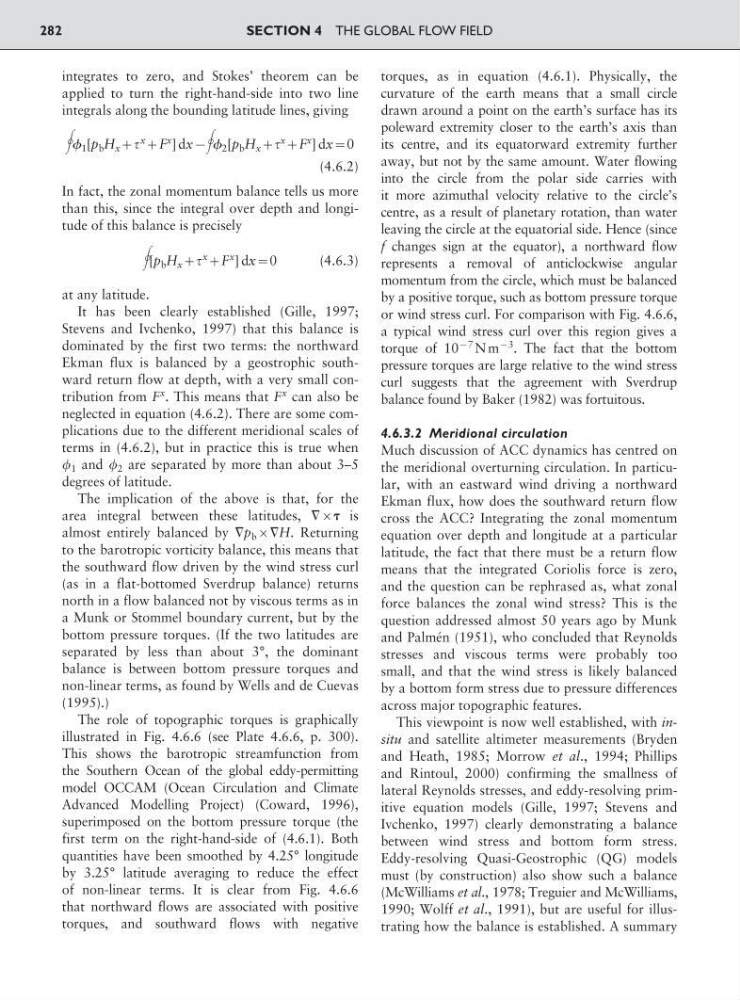
integrates to zero, and Stokes’ theorem can be
applied to turn the right-hand-side into two line
integrals along the bounding latitude lines, giving
Ώ 1 [p b H x ;
x
;F
x
] dx9Ώ 2 [p b H x ;
x
;F
x
] dx:0
(4.6.2)
In fact, the zonal momentum balance tells us more
than this, since the integral over depth and longitude of this balance is precisely
Ώ[p b H x ;
x
;F
x ] dx:0
(4.6.3)
at any latitude.
It has been clearly established (Gille, 1997;
Stevens and Ivchenko, 1997) that this balance is
dominated by the first two terms: the northward
Ekman flux is balanced by a geostrophic southward return flow at depth, with a very small contribution from F
x
. This means that F
x can also be
neglected in equation (4.6.2). There are some complications due to the different meridional scales of
terms in (4.6.2), but in practice this is true when
1 and 2 are separated by more than about 3–5
degrees of latitude.
The implication of the above is that, for the
area integral between these latitudes, ٌ is
almost entirely balanced by ٌp b ٌH. Returning
to the barotropic vorticity balance, this means that
the southward flow driven by the wind stress curl
(as in a flat-bottomed Sverdrup balance) returns
north in a flow balanced not by viscous terms as in
a Munk or Stommel boundary current, but by the
bottom pressure torques. (If the two latitudes are
separated by less than about 3°, the dominant
balance is between bottom pressure torques and
non-linear terms, as found by Wells and de Cuevas
(1995).)
The role of topographic torques is graphically
illustrated in Fig. 4.6.6 (see Plate 4.6.6, p. 300).
This shows the barotropic streamfunction from
the Southern Ocean of the global eddy-permitting
model OCCAM (Ocean Circulation and Climate
Advanced Modelling Project) (Coward, 1996),
superimposed on the bottom pressure torque (the
first term on the right-hand-side of (4.6.1). Both
quantities have been smoothed by 4.25° longitude
by 3.25° latitude averaging to reduce the effect
of non-linear terms. It is clear from Fig. 4.6.6
that northward flows are associated with positive
torques, and southward flows with negative
torques, as in equation (4.6.1). Physically, the
curvature of the earth means that a small circle
drawn around a point on the earth’s surface has its
poleward extremity closer to the earth’s axis than
its centre, and its equatorward extremity further
away, but not by the same amount. Water flowing
into the circle from the polar side carries with
it more azimuthal velocity relative to the circle’s
centre, as a result of planetary rotation, than water
leaving the circle at the equatorial side. Hence (since
f changes sign at the equator), a northward flow
represents a removal of anticlockwise angular
momentum from the circle, which must be balanced
by a positive torque, such as bottom pressure torque
or wind stress curl. For comparison with Fig. 4.6.6,
a typical wind stress curl over this region gives a
torque of 10
97 N m
93
. The fact that the bottom
pressure torques are large relative to the wind stress
curl suggests that the agreement with Sverdrup
balance found by Baker (1982) was fortuitous.
4.6.3.2 Meridional circulation
Much discussion of ACC dynamics has centred on
the meridional overturning circulation. In particular, with an eastward wind driving a northward
Ekman flux, how does the southward return flow
cross the ACC? Integrating the zonal momentum
equation over depth and longitude at a particular
latitude, the fact that there must be a return flow
means that the integrated Coriolis force is zero,
and the question can be rephrased as, what zonal
force balances the zonal wind stress? This is the
question addressed almost 50 years ago by Munk
and Palmén (1951), who concluded that Reynolds
stresses and viscous terms were probably too
small, and that the wind stress is likely balanced
by a bottom form stress due to pressure differences
across major topographic features.
This viewpoint is now well established, with insitu and satellite altimeter measurements (Bryden
and Heath, 1985; Morrow et al., 1994; Phillips
and Rintoul, 2000) confirming the smallness of
lateral Reynolds stresses, and eddy-resolving primitive equation models (Gille, 1997; Stevens and
Ivchenko, 1997) clearly demonstrating a balance
between wind stress and bottom form stress.
Eddy-resolving Quasi-Geostrophic (QG) models
must (by construction) also show such a balance
(McWilliams et al., 1978; Treguier and McWilliams,
1990; Wolff et al., 1991), but are useful for illustrating how the balance is established. A summary
SECTION 4 THE GLOBAL FLOW FIELD
282
applied to turn the right-hand-side into two line
integrals along the bounding latitude lines, giving
Ώ 1 [p b H x ;
x
;F
x
] dx9Ώ 2 [p b H x ;
x
;F
x
] dx:0
(4.6.2)
In fact, the zonal momentum balance tells us more
than this, since the integral over depth and longitude of this balance is precisely
Ώ[p b H x ;
x
;F
x ] dx:0
(4.6.3)
at any latitude.
It has been clearly established (Gille, 1997;
Stevens and Ivchenko, 1997) that this balance is
dominated by the first two terms: the northward
Ekman flux is balanced by a geostrophic southward return flow at depth, with a very small contribution from F
x
. This means that F
x can also be
neglected in equation (4.6.2). There are some complications due to the different meridional scales of
terms in (4.6.2), but in practice this is true when
1 and 2 are separated by more than about 3–5
degrees of latitude.
The implication of the above is that, for the
area integral between these latitudes, ٌ is
almost entirely balanced by ٌp b ٌH. Returning
to the barotropic vorticity balance, this means that
the southward flow driven by the wind stress curl
(as in a flat-bottomed Sverdrup balance) returns
north in a flow balanced not by viscous terms as in
a Munk or Stommel boundary current, but by the
bottom pressure torques. (If the two latitudes are
separated by less than about 3°, the dominant
balance is between bottom pressure torques and
non-linear terms, as found by Wells and de Cuevas
(1995).)
The role of topographic torques is graphically
illustrated in Fig. 4.6.6 (see Plate 4.6.6, p. 300).
This shows the barotropic streamfunction from
the Southern Ocean of the global eddy-permitting
model OCCAM (Ocean Circulation and Climate
Advanced Modelling Project) (Coward, 1996),
superimposed on the bottom pressure torque (the
first term on the right-hand-side of (4.6.1). Both
quantities have been smoothed by 4.25° longitude
by 3.25° latitude averaging to reduce the effect
of non-linear terms. It is clear from Fig. 4.6.6
that northward flows are associated with positive
torques, and southward flows with negative
torques, as in equation (4.6.1). Physically, the
curvature of the earth means that a small circle
drawn around a point on the earth’s surface has its
poleward extremity closer to the earth’s axis than
its centre, and its equatorward extremity further
away, but not by the same amount. Water flowing
into the circle from the polar side carries with
it more azimuthal velocity relative to the circle’s
centre, as a result of planetary rotation, than water
leaving the circle at the equatorial side. Hence (since
f changes sign at the equator), a northward flow
represents a removal of anticlockwise angular
momentum from the circle, which must be balanced
by a positive torque, such as bottom pressure torque
or wind stress curl. For comparison with Fig. 4.6.6,
a typical wind stress curl over this region gives a
torque of 10
97 N m
93
. The fact that the bottom
pressure torques are large relative to the wind stress
curl suggests that the agreement with Sverdrup
balance found by Baker (1982) was fortuitous.
4.6.3.2 Meridional circulation
Much discussion of ACC dynamics has centred on
the meridional overturning circulation. In particular, with an eastward wind driving a northward
Ekman flux, how does the southward return flow
cross the ACC? Integrating the zonal momentum
equation over depth and longitude at a particular
latitude, the fact that there must be a return flow
means that the integrated Coriolis force is zero,
and the question can be rephrased as, what zonal
force balances the zonal wind stress? This is the
question addressed almost 50 years ago by Munk
and Palmén (1951), who concluded that Reynolds
stresses and viscous terms were probably too
small, and that the wind stress is likely balanced
by a bottom form stress due to pressure differences
across major topographic features.
This viewpoint is now well established, with insitu and satellite altimeter measurements (Bryden
and Heath, 1985; Morrow et al., 1994; Phillips
and Rintoul, 2000) confirming the smallness of
lateral Reynolds stresses, and eddy-resolving primitive equation models (Gille, 1997; Stevens and
Ivchenko, 1997) clearly demonstrating a balance
between wind stress and bottom form stress.
Eddy-resolving Quasi-Geostrophic (QG) models
must (by construction) also show such a balance
(McWilliams et al., 1978; Treguier and McWilliams,
1990; Wolff et al., 1991), but are useful for illustrating how the balance is established. A summary
SECTION 4 THE GLOBAL FLOW FIELD
282