

eastward in the North Equatorial Subsurface
Countercurrent – contributing to the equatorial
Intermediate Water. The rest of the water either
continues northward along the eastern Mindanao
Coast (Tsuchiya, 1991; Bingham and Lukas, 1995),
or leaks out to the Celebes Sea (Fine et al., 1994).
Although there is at present no theory for the
dynamics of the Intermediate Water, recent numerical experiments capture some of its principal features. Figure 4.4.9 shows the velocity field of these
waters in the third layer of the 3.5-layer Pacific
model of Lu et al. (1998). This model is forced
with the observed winds and, in addition, imposes
the transport of 10 Sv of Intermediate Water across
35°S, and the export of the same volume of water,
in the thermocline and surface layers, through the
Indonesian Straits. The Intermediate Water is seen
to participate in a gyre: the flow is first eastward,
then westward, before turning equatorward in a
western boundary current. Some of the water joins
the deep, eastward equatorial currents, providing
one-third of the transport of the Equatorial Undercurrent. The remainder crosses the equator and
either joins the North Equatorial Countercurrent,
or proceeds northward in the Mindanao Coastal
Current. The six-layer ocean model of Shriver and
Hurlburt (1997) has similar pathways.
The Intermediate Water pathway seems to be
influenced by both wind and buoyancy forcings.
The effect of the wind forcing in the subtropical
gyres is reflected in the anticyclonic circulation in
the interior ocean, as evident in Figs 4.4.7 and
4.4.9. This aspect is absent from the strictly buoyancy-driven abyssal flow (Stommel and Arons,
1960a,b), in which the deep convection induces
waters that simply flow westward before they feed
into the deep western boundary current. On the
other hand, the intermediate water circulation also
differs from the wind-driven thermocline circulation in the subtropics, with the formation in the
subpolar region, with a much broader vertical
structure and a much slower speed. In the equatorial region, unlike the thermocline water, whose
eastward penetration is confined within the
Equatorial Undercurrent, the Intermediate Water
can flow eastward in deeper eastward currents such
as the North and South Subsurface Countercurrents. During the course of their eastward penetration, these two subsurface countercurrents diverge
from the equator (McPhaden, 1984; Johnson and
Moore, 1997), confining the equatorward pathway
in the western boundary (Johnson and McPhaden,
1999). These topics need further study, given the
importance of this circulation to the maintenance of
the equatorial thermocline.
4.4.4 Summary and further issues
Over the past two decades, observational and
modelling studies of the exchanges of tropical and
extratropical waters have shed much light on the
circulations that maintain the tropical thermocline.
SECTION 4 THE GLOBAL FLOW FIELD
254
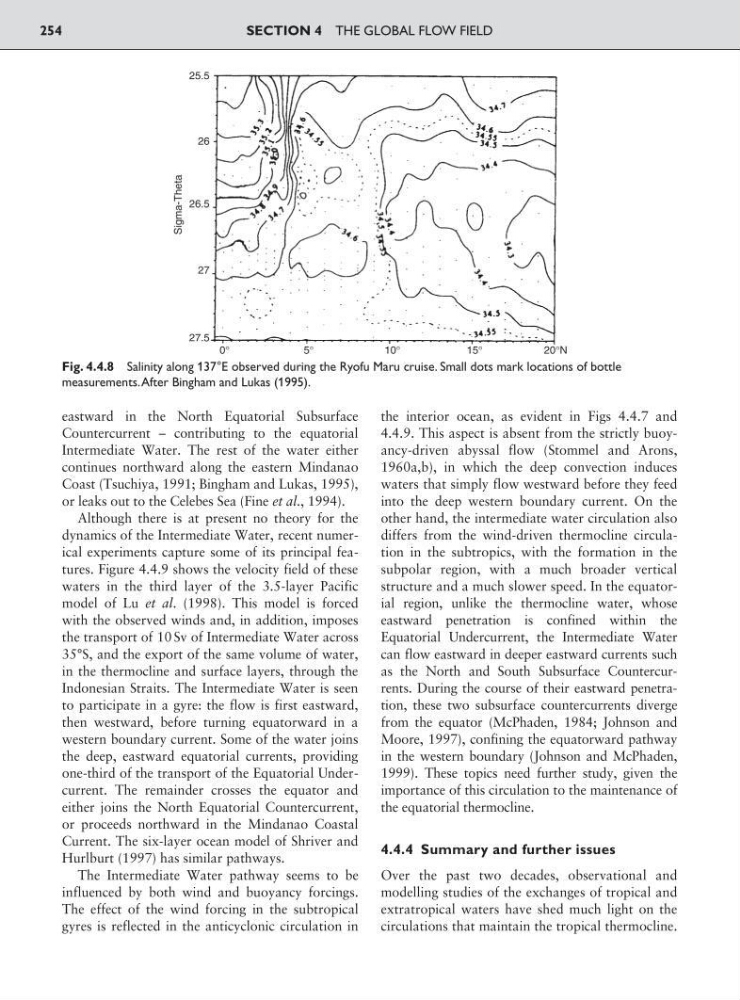
Fig. 4.4.8 Salinity along 137°E observed during the Ryofu Maru cruise. Small dots mark locations of bottle
measurements.After Bingham and Lukas (1995).
Countercurrent – contributing to the equatorial
Intermediate Water. The rest of the water either
continues northward along the eastern Mindanao
Coast (Tsuchiya, 1991; Bingham and Lukas, 1995),
or leaks out to the Celebes Sea (Fine et al., 1994).
Although there is at present no theory for the
dynamics of the Intermediate Water, recent numerical experiments capture some of its principal features. Figure 4.4.9 shows the velocity field of these
waters in the third layer of the 3.5-layer Pacific
model of Lu et al. (1998). This model is forced
with the observed winds and, in addition, imposes
the transport of 10 Sv of Intermediate Water across
35°S, and the export of the same volume of water,
in the thermocline and surface layers, through the
Indonesian Straits. The Intermediate Water is seen
to participate in a gyre: the flow is first eastward,
then westward, before turning equatorward in a
western boundary current. Some of the water joins
the deep, eastward equatorial currents, providing
one-third of the transport of the Equatorial Undercurrent. The remainder crosses the equator and
either joins the North Equatorial Countercurrent,
or proceeds northward in the Mindanao Coastal
Current. The six-layer ocean model of Shriver and
Hurlburt (1997) has similar pathways.
The Intermediate Water pathway seems to be
influenced by both wind and buoyancy forcings.
The effect of the wind forcing in the subtropical
gyres is reflected in the anticyclonic circulation in
the interior ocean, as evident in Figs 4.4.7 and
4.4.9. This aspect is absent from the strictly buoyancy-driven abyssal flow (Stommel and Arons,
1960a,b), in which the deep convection induces
waters that simply flow westward before they feed
into the deep western boundary current. On the
other hand, the intermediate water circulation also
differs from the wind-driven thermocline circulation in the subtropics, with the formation in the
subpolar region, with a much broader vertical
structure and a much slower speed. In the equatorial region, unlike the thermocline water, whose
eastward penetration is confined within the
Equatorial Undercurrent, the Intermediate Water
can flow eastward in deeper eastward currents such
as the North and South Subsurface Countercurrents. During the course of their eastward penetration, these two subsurface countercurrents diverge
from the equator (McPhaden, 1984; Johnson and
Moore, 1997), confining the equatorward pathway
in the western boundary (Johnson and McPhaden,
1999). These topics need further study, given the
importance of this circulation to the maintenance of
the equatorial thermocline.
4.4.4 Summary and further issues
Over the past two decades, observational and
modelling studies of the exchanges of tropical and
extratropical waters have shed much light on the
circulations that maintain the tropical thermocline.
SECTION 4 THE GLOBAL FLOW FIELD
254
Fig. 4.4.8 Salinity along 137°E observed during the Ryofu Maru cruise. Small dots mark locations of bottle
measurements.After Bingham and Lukas (1995).