

Both interior and western boundary pathways are
available for water that subducts in the subtropics
to reach the equator. The journey takes on the
order of a decade. Asymmetries, relative to the
equator, of the surface winds (the Intertropical
Convergence Zone), is mainly north of the equator; this translates into a reduction in the amount
of water that follows the interior pathway in the
northern Pacific. As a result, the Equatorial Undercurrent receives more thermocline waters from the
south than from the north downstream. Meridional recirculation in a narrow equatorial cell that
is only a few degrees latitude wide is far more
intense than the tropical–extratropical exchange so
that, to a first approximation, the intensity of the
Equatorial Undercurrent is determined by the
winds along the equator.
The waters below the equatorial thermocline
originate mainly in the subantarctic region of the
southern Pacific. (Intermediate Water from the
northern Pacific never reaches the equator but
ultimately flows into the Indian Ocean.) Tracer
observations indicate, and models corroborate,
that the pathways for Intermediate Water to the
equator involves western boundary currents.
(Weiss et al., 1985, and Kawase and Sarmiento,
1986, established this for the Atlantic.) How this
Intermediate Water, once it is advected in the
subsurface countercurrents into the thermostad
below the equatorial thermocline (McPhaden,
1984; Johnson and Moore, 1997), gets mixed with
shallower, warmer water is unclear. The matter
needs attention because it could prove a crucial
aspect of the processes that maintain the equatorial thermocline.
How the flow of upper ocean waters through
the Indonesian Straits into the Indian Ocean
affects the tropical–extratropical exchanges in the
Pacific needs clarification. Gordon (1986) and
Ffield and Gordon (1992) find that the thermocline waters in the Indonesian Seas come mainly
from the northern Pacific. Fine (1985) reaches a
similar conclusion on the basis of tritium data.
However, Godfrey et al. (1993) argue that the
southern Pacific contributes to the Indonesian
throughflow. Fine et al. (1994) suggest that waters
from both hemispheres mix in the Mindinao Current before proceeding to the Indian Ocean.
The Indian Ocean is intriguingly different from
the Pacific and Atlantic Oceans because a steady
westward trade wind, and in turn the equatorial
upwelling, is essentially absent in the Indian Ocean.
4.4 Tropical–Extratropical Oceanic Exchange Pathways
255
Liu and Philander
2 (cm s
–1 )
1/2
V 3 (cm s
–1 )
1/2
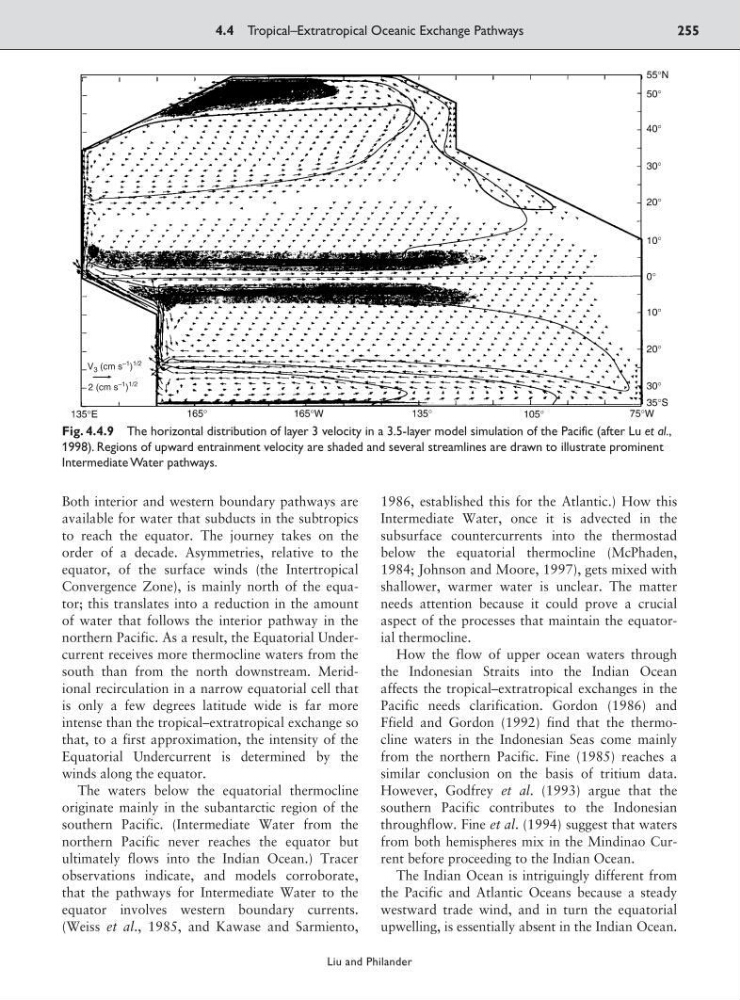
Fig. 4.4.9 The horizontal distribution of layer 3 velocity in a 3.5-layer model simulation of the Pacific (after Lu et al.,
1998). Regions of upward entrainment velocity are shaded and several streamlines are drawn to illustrate prominent
Intermediate Water pathways.
available for water that subducts in the subtropics
to reach the equator. The journey takes on the
order of a decade. Asymmetries, relative to the
equator, of the surface winds (the Intertropical
Convergence Zone), is mainly north of the equator; this translates into a reduction in the amount
of water that follows the interior pathway in the
northern Pacific. As a result, the Equatorial Undercurrent receives more thermocline waters from the
south than from the north downstream. Meridional recirculation in a narrow equatorial cell that
is only a few degrees latitude wide is far more
intense than the tropical–extratropical exchange so
that, to a first approximation, the intensity of the
Equatorial Undercurrent is determined by the
winds along the equator.
The waters below the equatorial thermocline
originate mainly in the subantarctic region of the
southern Pacific. (Intermediate Water from the
northern Pacific never reaches the equator but
ultimately flows into the Indian Ocean.) Tracer
observations indicate, and models corroborate,
that the pathways for Intermediate Water to the
equator involves western boundary currents.
(Weiss et al., 1985, and Kawase and Sarmiento,
1986, established this for the Atlantic.) How this
Intermediate Water, once it is advected in the
subsurface countercurrents into the thermostad
below the equatorial thermocline (McPhaden,
1984; Johnson and Moore, 1997), gets mixed with
shallower, warmer water is unclear. The matter
needs attention because it could prove a crucial
aspect of the processes that maintain the equatorial thermocline.
How the flow of upper ocean waters through
the Indonesian Straits into the Indian Ocean
affects the tropical–extratropical exchanges in the
Pacific needs clarification. Gordon (1986) and
Ffield and Gordon (1992) find that the thermocline waters in the Indonesian Seas come mainly
from the northern Pacific. Fine (1985) reaches a
similar conclusion on the basis of tritium data.
However, Godfrey et al. (1993) argue that the
southern Pacific contributes to the Indonesian
throughflow. Fine et al. (1994) suggest that waters
from both hemispheres mix in the Mindinao Current before proceeding to the Indian Ocean.
The Indian Ocean is intriguingly different from
the Pacific and Atlantic Oceans because a steady
westward trade wind, and in turn the equatorial
upwelling, is essentially absent in the Indian Ocean.
4.4 Tropical–Extratropical Oceanic Exchange Pathways
255
Liu and Philander
2 (cm s
–1 )
1/2
V 3 (cm s
–1 )
1/2
Fig. 4.4.9 The horizontal distribution of layer 3 velocity in a 3.5-layer model simulation of the Pacific (after Lu et al.,
1998). Regions of upward entrainment velocity are shaded and several streamlines are drawn to illustrate prominent
Intermediate Water pathways.