

suggests a ventilation pathway that starts in the
eastern subtropical North Pacific, continues southwestward in the North Equatorial Current, and
then proceeds southeastward in the North Equatorial Countercurrent. Observations also show additional pathways to the Equatorial Undercurrent.
Some of the water in that current passes through
low-latitude western boundary currents (Tsuchiya
et al., 1989) such as the Mindanao Current (Lukas
et al., 1991; Fine et al., 1994; Bingham and Lukas,
1995), the New Guinea Coastal Undercurrent
(Lindstrom et al., 1987) and the New Ireland
Coastal Undercurrent (Butt and Lindstrom, 1994;
Fine et al., 1994). The western boundary pathway
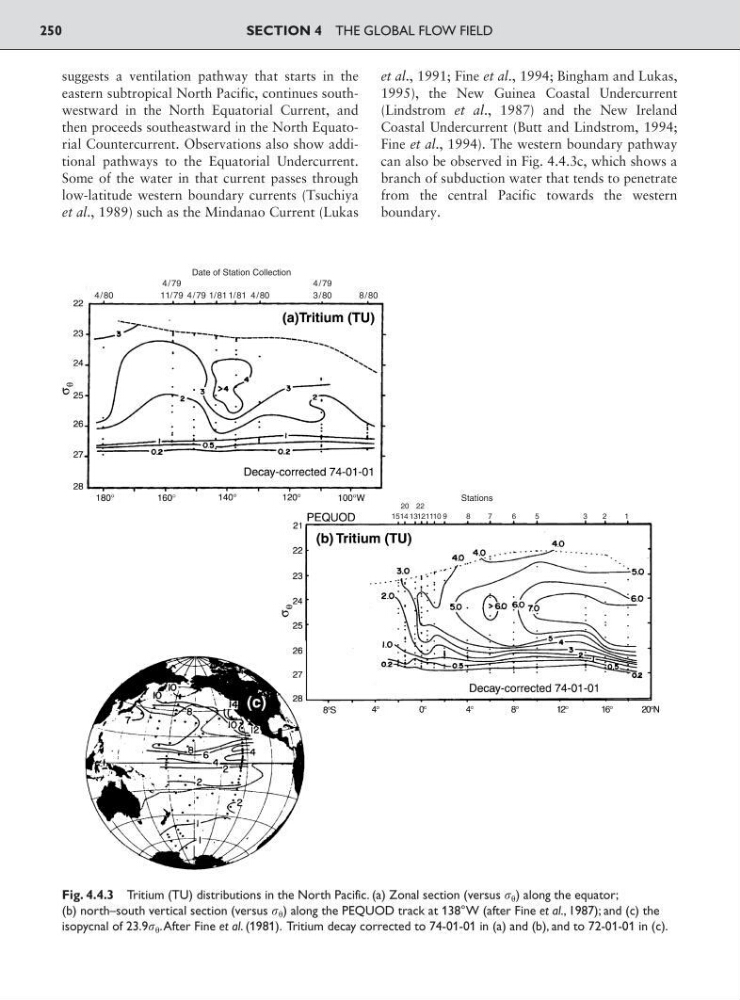
can also be observed in Fig. 4.4.3c, which shows a
branch of subduction water that tends to penetrate
from the central Pacific towards the western
boundary.
SECTION 4 THE GLOBAL FLOW FIELD
250
Date of Station Collection
4 / 80
11/ 79
4/79
4/79
4/79 1/81 1/81
3/80
8/80
4/80
Stations
1514
20 22
13121110 9
8
7
6
5
3
2
1
Fig. 4.4.3 Tritium (TU) distributions in the North Pacific. (a) Zonal section (versus ) along the equator;
(b) north–south vertical section (versus ) along the PEQUOD track at 138°W (after Fine et al., 1987); and (c) the
isopycnal of 23.9 .After Fine et al. (1981). Tritium decay corrected to 74-01-01 in (a) and (b), and to 72-01-01 in (c).
eastern subtropical North Pacific, continues southwestward in the North Equatorial Current, and
then proceeds southeastward in the North Equatorial Countercurrent. Observations also show additional pathways to the Equatorial Undercurrent.
Some of the water in that current passes through
low-latitude western boundary currents (Tsuchiya
et al., 1989) such as the Mindanao Current (Lukas
et al., 1991; Fine et al., 1994; Bingham and Lukas,
1995), the New Guinea Coastal Undercurrent
(Lindstrom et al., 1987) and the New Ireland
Coastal Undercurrent (Butt and Lindstrom, 1994;
Fine et al., 1994). The western boundary pathway
can also be observed in Fig. 4.4.3c, which shows a
branch of subduction water that tends to penetrate
from the central Pacific towards the western
boundary.
SECTION 4 THE GLOBAL FLOW FIELD
250
Date of Station Collection
4 / 80
11/ 79
4/79
4/79
4/79 1/81 1/81
3/80
8/80
4/80
Stations
1514
20 22
13121110 9
8
7
6
5
3
2
1
Fig. 4.4.3 Tritium (TU) distributions in the North Pacific. (a) Zonal section (versus ) along the equator;
(b) north–south vertical section (versus ) along the PEQUOD track at 138°W (after Fine et al., 1987); and (c) the
isopycnal of 23.9 .After Fine et al. (1981). Tritium decay corrected to 74-01-01 in (a) and (b), and to 72-01-01 in (c).