

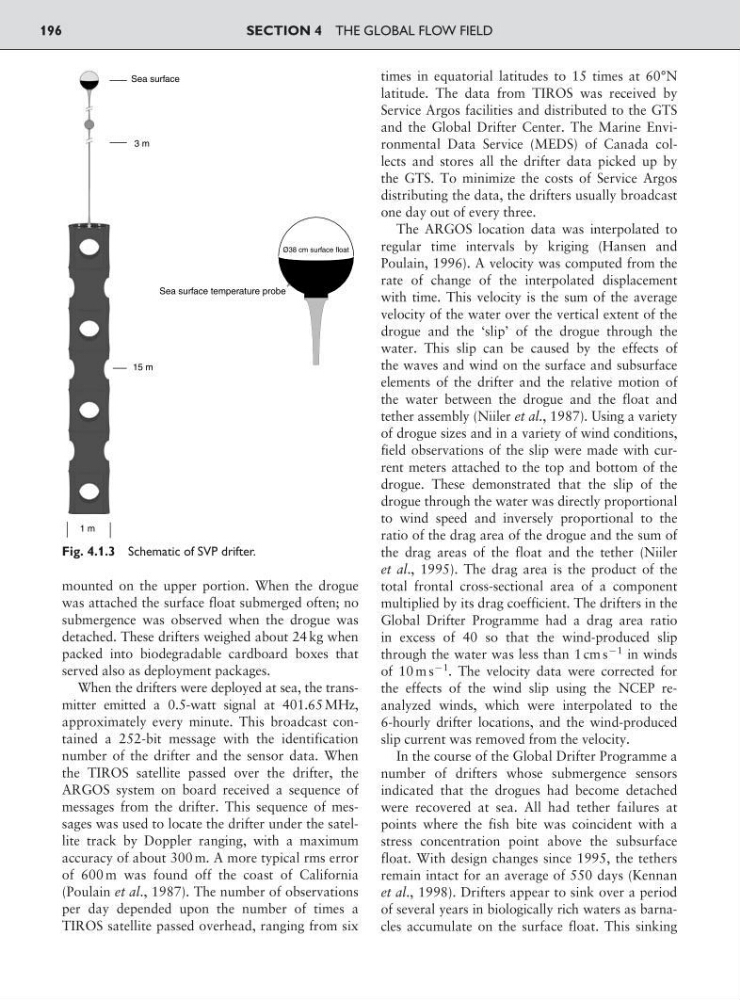
mounted on the upper portion. When the drogue
was attached the surface float submerged often; no
submergence was observed when the drogue was
detached. These drifters weighed about 24 kg when
packed into biodegradable cardboard boxes that
served also as deployment packages.
When the drifters were deployed at sea, the transmitter emitted a 0.5-watt signal at 401.65 MHz,
approximately every minute. This broadcast contained a 252-bit message with the identification
number of the drifter and the sensor data. When
the TIROS satellite passed over the drifter, the
ARGOS system on board received a sequence of
messages from the drifter. This sequence of messages was used to locate the drifter under the satellite track by Doppler ranging, with a maximum
accuracy of about 300 m. A more typical rms error
of 600 m was found off the coast of California
(Poulain et al., 1987). The number of observations
per day depended upon the number of times a
TIROS satellite passed overhead, ranging from six
times in equatorial latitudes to 15 times at 60°N
latitude. The data from TIROS was received by
Service Argos facilities and distributed to the GTS
and the Global Drifter Center. The Marine Environmental Data Service (MEDS) of Canada collects and stores all the drifter data picked up by
the GTS. To minimize the costs of Service Argos
distributing the data, the drifters usually broadcast
one day out of every three.
The ARGOS location data was interpolated to
regular time intervals by kriging (Hansen and
Poulain, 1996). A velocity was computed from the
rate of change of the interpolated displacement
with time. This velocity is the sum of the average
velocity of the water over the vertical extent of the
drogue and the ‘slip’ of the drogue through the
water. This slip can be caused by the effects of
the waves and wind on the surface and subsurface
elements of the drifter and the relative motion of
the water between the drogue and the float and
tether assembly (Niiler et al., 1987). Using a variety
of drogue sizes and in a variety of wind conditions,
field observations of the slip were made with current meters attached to the top and bottom of the
drogue. These demonstrated that the slip of the
drogue through the water was directly proportional
to wind speed and inversely proportional to the
ratio of the drag area of the drogue and the sum of
the drag areas of the float and the tether (Niiler
et al., 1995). The drag area is the product of the
total frontal cross-sectional area of a component
multiplied by its drag coefficient. The drifters in the
Global Drifter Programme had a drag area ratio
in excess of 40 so that the wind-produced slip
through the water was less than 1 cm s
91 in winds
of 10 m s
91
. The velocity data were corrected for
the effects of the wind slip using the NCEP reanalyzed winds, which were interpolated to the
6-hourly drifter locations, and the wind-produced
slip current was removed from the velocity.
In the course of the Global Drifter Programme a
number of drifters whose submergence sensors
indicated that the drogues had become detached
were recovered at sea. All had tether failures at
points where the fish bite was coincident with a
stress concentration point above the subsurface
float. With design changes since 1995, the tethers
remain intact for an average of 550 days (Kennan
et al., 1998). Drifters appear to sink over a period
of several years in biologically rich waters as barnacles accumulate on the surface float. This sinking
SECTION 4 THE GLOBAL FLOW FIELD
196
15 m
3 m
Sea surface
1 m
Ø38 cm surface float
Sea surface temperature probe
Fig. 4.1.3 Schematic of SVP drifter.
was attached the surface float submerged often; no
submergence was observed when the drogue was
detached. These drifters weighed about 24 kg when
packed into biodegradable cardboard boxes that
served also as deployment packages.
When the drifters were deployed at sea, the transmitter emitted a 0.5-watt signal at 401.65 MHz,
approximately every minute. This broadcast contained a 252-bit message with the identification
number of the drifter and the sensor data. When
the TIROS satellite passed over the drifter, the
ARGOS system on board received a sequence of
messages from the drifter. This sequence of messages was used to locate the drifter under the satellite track by Doppler ranging, with a maximum
accuracy of about 300 m. A more typical rms error
of 600 m was found off the coast of California
(Poulain et al., 1987). The number of observations
per day depended upon the number of times a
TIROS satellite passed overhead, ranging from six
times in equatorial latitudes to 15 times at 60°N
latitude. The data from TIROS was received by
Service Argos facilities and distributed to the GTS
and the Global Drifter Center. The Marine Environmental Data Service (MEDS) of Canada collects and stores all the drifter data picked up by
the GTS. To minimize the costs of Service Argos
distributing the data, the drifters usually broadcast
one day out of every three.
The ARGOS location data was interpolated to
regular time intervals by kriging (Hansen and
Poulain, 1996). A velocity was computed from the
rate of change of the interpolated displacement
with time. This velocity is the sum of the average
velocity of the water over the vertical extent of the
drogue and the ‘slip’ of the drogue through the
water. This slip can be caused by the effects of
the waves and wind on the surface and subsurface
elements of the drifter and the relative motion of
the water between the drogue and the float and
tether assembly (Niiler et al., 1987). Using a variety
of drogue sizes and in a variety of wind conditions,
field observations of the slip were made with current meters attached to the top and bottom of the
drogue. These demonstrated that the slip of the
drogue through the water was directly proportional
to wind speed and inversely proportional to the
ratio of the drag area of the drogue and the sum of
the drag areas of the float and the tether (Niiler
et al., 1995). The drag area is the product of the
total frontal cross-sectional area of a component
multiplied by its drag coefficient. The drifters in the
Global Drifter Programme had a drag area ratio
in excess of 40 so that the wind-produced slip
through the water was less than 1 cm s
91 in winds
of 10 m s
91
. The velocity data were corrected for
the effects of the wind slip using the NCEP reanalyzed winds, which were interpolated to the
6-hourly drifter locations, and the wind-produced
slip current was removed from the velocity.
In the course of the Global Drifter Programme a
number of drifters whose submergence sensors
indicated that the drogues had become detached
were recovered at sea. All had tether failures at
points where the fish bite was coincident with a
stress concentration point above the subsurface
float. With design changes since 1995, the tethers
remain intact for an average of 550 days (Kennan
et al., 1998). Drifters appear to sink over a period
of several years in biologically rich waters as barnacles accumulate on the surface float. This sinking
SECTION 4 THE GLOBAL FLOW FIELD
196
15 m
3 m
Sea surface
1 m
Ø38 cm surface float
Sea surface temperature probe
Fig. 4.1.3 Schematic of SVP drifter.