

observations and the calculations with that data
that were the objectives of WOCE. In particular,
the mean circulation, the eddy energy distribution
and the wind-driven, or Ekman currents are discussed. The richness of this global data set is
revealed in the extensive literature listed at the
aforementioned web site.
Section 4.1.2 discusses how low-cost, rugged,
satellite-fixed drifters were made and the methods
of deriving a map of ocean currents from drifter
data in a wind- and wave-tossed ocean. Besides the
data obtained during the observational period of
WOCE, in the period 1978–94 meteorologists
deployed over 800 drifting buoys of the First
Global GARP Experiment design (FGGE-type)
into the Southern Oceans for the purpose of measuring sea level atmospheric pressure. These FGGE
drifters usually did not have drogues attached and
their motion was corrected for the effects of wind
relative to the drifters deployed in the Global
Drifter Programme. Section 4.1.3 presents the
maps of the mean circulation, its uncertainty and
the eddy energy on the spatial resolution set out in
WOCE plans. Section 4.1.4 discusses the interpretation of the observed circulation in terms of the
local wind-driven or Ekman currents. In Section
4.1.5, the future of the drifter observations is
briefly discussed. The Global Drifter Programme,
or Surface Velocity Programme (SVP) drifters, now
serve as platforms to which sensors are attached
for observing winds, salinity, temperature, ocean
colour and atmospheric pressure.
4.1.2 Methodology
Since the WOCE surface circulation data were
obtained with a new instrumental methodology, it
is essential to discuss it at length. It represents an
important development in the instrumental technology of ocean current observations. A number of
different drifter designs were used in the Global
Drifter Programme. A complete description of
each drifter is maintained in a ‘meta’ file at the
Global Drifter Data Center. Since 1991, nearly all
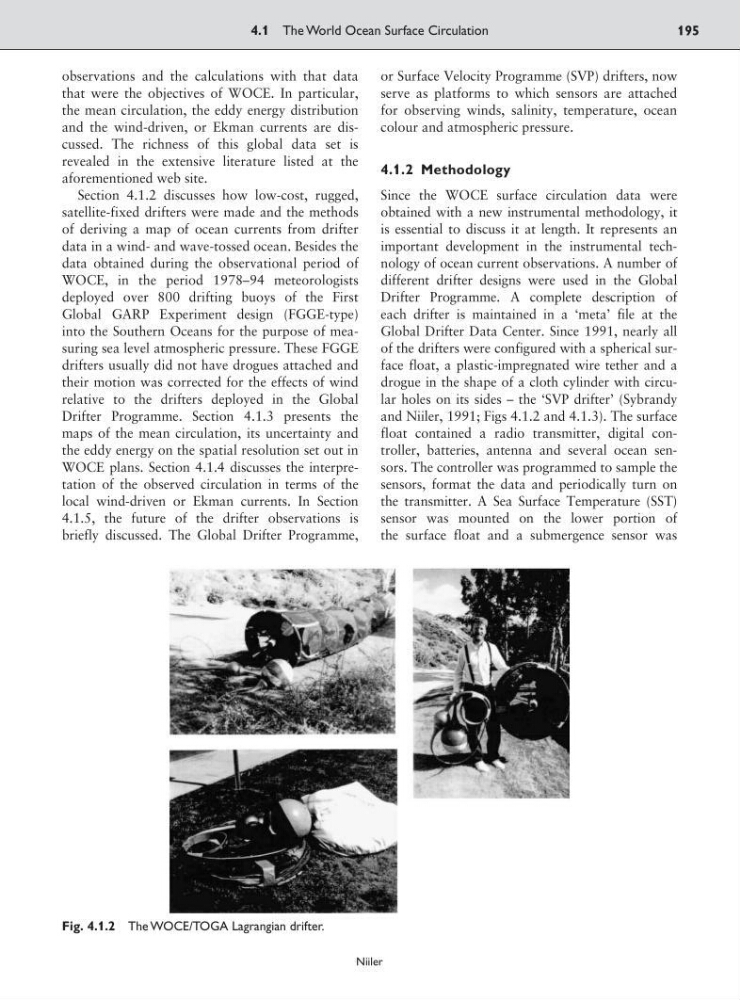
of the drifters were configured with a spherical surface float, a plastic-impregnated wire tether and a
drogue in the shape of a cloth cylinder with circular holes on its sides – the ‘SVP drifter’ (Sybrandy
and Niiler, 1991; Figs 4.1.2 and 4.1.3). The surface
float contained a radio transmitter, digital controller, batteries, antenna and several ocean sensors. The controller was programmed to sample the
sensors, format the data and periodically turn on
the transmitter. A Sea Surface Temperature (SST)
sensor was mounted on the lower portion of
the surface float and a submergence sensor was
4.1 The World Ocean Surface Circulation
195
Niiler
Fig. 4.1.2 The WOCE/TOGA Lagrangian drifter.
that were the objectives of WOCE. In particular,
the mean circulation, the eddy energy distribution
and the wind-driven, or Ekman currents are discussed. The richness of this global data set is
revealed in the extensive literature listed at the
aforementioned web site.
Section 4.1.2 discusses how low-cost, rugged,
satellite-fixed drifters were made and the methods
of deriving a map of ocean currents from drifter
data in a wind- and wave-tossed ocean. Besides the
data obtained during the observational period of
WOCE, in the period 1978–94 meteorologists
deployed over 800 drifting buoys of the First
Global GARP Experiment design (FGGE-type)
into the Southern Oceans for the purpose of measuring sea level atmospheric pressure. These FGGE
drifters usually did not have drogues attached and
their motion was corrected for the effects of wind
relative to the drifters deployed in the Global
Drifter Programme. Section 4.1.3 presents the
maps of the mean circulation, its uncertainty and
the eddy energy on the spatial resolution set out in
WOCE plans. Section 4.1.4 discusses the interpretation of the observed circulation in terms of the
local wind-driven or Ekman currents. In Section
4.1.5, the future of the drifter observations is
briefly discussed. The Global Drifter Programme,
or Surface Velocity Programme (SVP) drifters, now
serve as platforms to which sensors are attached
for observing winds, salinity, temperature, ocean
colour and atmospheric pressure.
4.1.2 Methodology
Since the WOCE surface circulation data were
obtained with a new instrumental methodology, it
is essential to discuss it at length. It represents an
important development in the instrumental technology of ocean current observations. A number of
different drifter designs were used in the Global
Drifter Programme. A complete description of
each drifter is maintained in a ‘meta’ file at the
Global Drifter Data Center. Since 1991, nearly all
of the drifters were configured with a spherical surface float, a plastic-impregnated wire tether and a
drogue in the shape of a cloth cylinder with circular holes on its sides – the ‘SVP drifter’ (Sybrandy
and Niiler, 1991; Figs 4.1.2 and 4.1.3). The surface
float contained a radio transmitter, digital controller, batteries, antenna and several ocean sensors. The controller was programmed to sample the
sensors, format the data and periodically turn on
the transmitter. A Sea Surface Temperature (SST)
sensor was mounted on the lower portion of
the surface float and a submergence sensor was
4.1 The World Ocean Surface Circulation
195
Niiler
Fig. 4.1.2 The WOCE/TOGA Lagrangian drifter.