

under the keel of a research vessel within a range
of about 200 m.
Five years later Swallow and Hamon (1960)
summarized their first experiences during the
International Geophysical Year (IGY). They had
observed deep currents of order 0–5 cm s
91 with
time scales of weeks and spatial scales of a few tens
of miles. It was explicitly noted that a ‘level of no
motion’ could not be detected in the eastern North
Atlantic. Swallow and Hamon’s observations of the
wide range of variability, including the lack of a
reference layer for geostrophic current calculation,
were confirmed and extended later by joint British/
US (Aries) observations 350 km west of Bermuda
(Crease, 1962). In this frequently referenced article,
Crease comes to two basic observational results:
1 float trajectories are ‘contrary to the widely held
view that the deep ocean is relatively quiescent
with velocities of order 1 cm s
91 ; and
2 the new observations ‘raise the question of
just how important the … mean circulation
is … compared with the eddy transport of
properties …’
The discovery that the interior ocean was not
quiescent led to the internationally coordinated
Mid-Ocean Dynamics Experiment (MODE) during
the early 1970s (MODE Gap, 1978). MODE, and
its successor POLYMODE, gave impetus to development of a new float technology that fulfilled
Stommel’s dream of long-range tracking. Rossby
and Webb (1970) developed a new generation
employing large low-frequency sound projectors
capable of being tracked in the SOFAR channel at
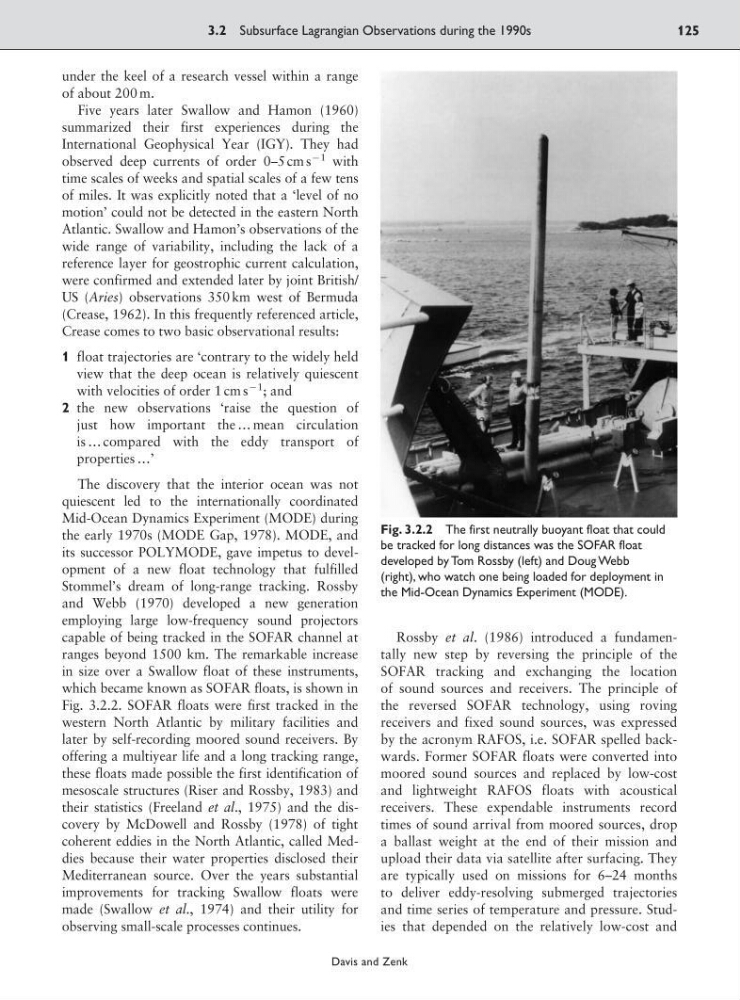
ranges beyond 1500 km. The remarkable increase
in size over a Swallow float of these instruments,
which became known as SOFAR floats, is shown in
Fig. 3.2.2. SOFAR floats were first tracked in the
western North Atlantic by military facilities and
later by self-recording moored sound receivers. By
offering a multiyear life and a long tracking range,
these floats made possible the first identification of
mesoscale structures (Riser and Rossby, 1983) and
their statistics (Freeland et al., 1975) and the discovery by McDowell and Rossby (1978) of tight
coherent eddies in the North Atlantic, called Meddies because their water properties disclosed their
Mediterranean source. Over the years substantial
improvements for tracking Swallow floats were
made (Swallow et al., 1974) and their utility for
observing small-scale processes continues.
Rossby et al. (1986) introduced a fundamentally new step by reversing the principle of the
SOFAR tracking and exchanging the location
of sound sources and receivers. The principle of
the reversed SOFAR technology, using roving
receivers and fixed sound sources, was expressed
by the acronym RAFOS, i.e. SOFAR spelled backwards. Former SOFAR floats were converted into
moored sound sources and replaced by low-cost
and lightweight RAFOS floats with acoustical
receivers. These expendable instruments record
times of sound arrival from moored sources, drop
a ballast weight at the end of their mission and
upload their data via satellite after surfacing. They
are typically used on missions for 6–24 months
to deliver eddy-resolving submerged trajectories
and time series of temperature and pressure. Studies that depended on the relatively low-cost and
3.2 Subsurface Lagrangian Observations during the 1990s
125
Davis and Zenk
Fig. 3.2.2 The first neutrally buoyant float that could
be tracked for long distances was the SOFAR float
developed by Tom Rossby (left) and Doug Webb
(right), who watch one being loaded for deployment in
the Mid-Ocean Dynamics Experiment (MODE).
of about 200 m.
Five years later Swallow and Hamon (1960)
summarized their first experiences during the
International Geophysical Year (IGY). They had
observed deep currents of order 0–5 cm s
91 with
time scales of weeks and spatial scales of a few tens
of miles. It was explicitly noted that a ‘level of no
motion’ could not be detected in the eastern North
Atlantic. Swallow and Hamon’s observations of the
wide range of variability, including the lack of a
reference layer for geostrophic current calculation,
were confirmed and extended later by joint British/
US (Aries) observations 350 km west of Bermuda
(Crease, 1962). In this frequently referenced article,
Crease comes to two basic observational results:
1 float trajectories are ‘contrary to the widely held
view that the deep ocean is relatively quiescent
with velocities of order 1 cm s
91 ; and
2 the new observations ‘raise the question of
just how important the … mean circulation
is … compared with the eddy transport of
properties …’
The discovery that the interior ocean was not
quiescent led to the internationally coordinated
Mid-Ocean Dynamics Experiment (MODE) during
the early 1970s (MODE Gap, 1978). MODE, and
its successor POLYMODE, gave impetus to development of a new float technology that fulfilled
Stommel’s dream of long-range tracking. Rossby
and Webb (1970) developed a new generation
employing large low-frequency sound projectors
capable of being tracked in the SOFAR channel at
ranges beyond 1500 km. The remarkable increase
in size over a Swallow float of these instruments,
which became known as SOFAR floats, is shown in
Fig. 3.2.2. SOFAR floats were first tracked in the
western North Atlantic by military facilities and
later by self-recording moored sound receivers. By
offering a multiyear life and a long tracking range,
these floats made possible the first identification of
mesoscale structures (Riser and Rossby, 1983) and
their statistics (Freeland et al., 1975) and the discovery by McDowell and Rossby (1978) of tight
coherent eddies in the North Atlantic, called Meddies because their water properties disclosed their
Mediterranean source. Over the years substantial
improvements for tracking Swallow floats were
made (Swallow et al., 1974) and their utility for
observing small-scale processes continues.
Rossby et al. (1986) introduced a fundamentally new step by reversing the principle of the
SOFAR tracking and exchanging the location
of sound sources and receivers. The principle of
the reversed SOFAR technology, using roving
receivers and fixed sound sources, was expressed
by the acronym RAFOS, i.e. SOFAR spelled backwards. Former SOFAR floats were converted into
moored sound sources and replaced by low-cost
and lightweight RAFOS floats with acoustical
receivers. These expendable instruments record
times of sound arrival from moored sources, drop
a ballast weight at the end of their mission and
upload their data via satellite after surfacing. They
are typically used on missions for 6–24 months
to deliver eddy-resolving submerged trajectories
and time series of temperature and pressure. Studies that depended on the relatively low-cost and
3.2 Subsurface Lagrangian Observations during the 1990s
125
Davis and Zenk
Fig. 3.2.2 The first neutrally buoyant float that could
be tracked for long distances was the SOFAR float
developed by Tom Rossby (left) and Doug Webb
(right), who watch one being loaded for deployment in
the Mid-Ocean Dynamics Experiment (MODE).