

well-resolved trajectories of RAFOS floats include
the description of the transport of water across the
axis of the Gulf Stream by Bower and Rossby
(1989) and many studies discussed below.
In some studies a high premium is placed on
using floats to represent fluid-parcel trajectories.
This dictated the uninterrupted current following
that can be achieved only with acoustic tracking. It
also requires a float with approximately the same
compressibility as seawater, which can follow
water parcels as they change depth. A technique
for increasing a float’s compressibility to approximate that of seawater by adding a spring-backed
piston was developed by Rossby et al. (1985) and
is used in many studies where quasi-Lagrangian
properties are primary.
In a sense the idea of autonomous (i.e. not
requiring an acoustic tracking network) floats traces
to Stommel’s idea of current-followers that are
located only occasionally. The first autonomous
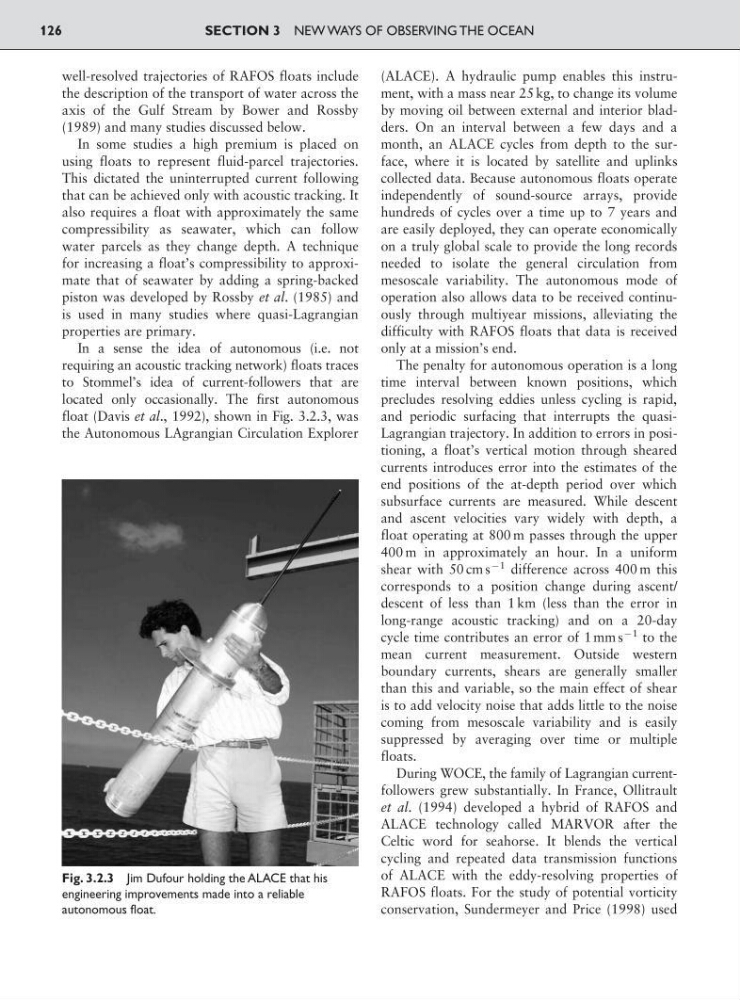
float (Davis et al., 1992), shown in Fig. 3.2.3, was
the Autonomous LAgrangian Circulation Explorer
(ALACE). A hydraulic pump enables this instrument, with a mass near 25 kg, to change its volume
by moving oil between external and interior bladders. On an interval between a few days and a
month, an ALACE cycles from depth to the surface, where it is located by satellite and uplinks
collected data. Because autonomous floats operate
independently of sound-source arrays, provide
hundreds of cycles over a time up to 7 years and
are easily deployed, they can operate economically
on a truly global scale to provide the long records
needed to isolate the general circulation from
mesoscale variability. The autonomous mode of
operation also allows data to be received continuously through multiyear missions, alleviating the
difficulty with RAFOS floats that data is received
only at a mission’s end.
The penalty for autonomous operation is a long
time interval between known positions, which
precludes resolving eddies unless cycling is rapid,
and periodic surfacing that interrupts the quasiLagrangian trajectory. In addition to errors in positioning, a float’s vertical motion through sheared
currents introduces error into the estimates of the
end positions of the at-depth period over which
subsurface currents are measured. While descent
and ascent velocities vary widely with depth, a
float operating at 800 m passes through the upper
400 m in approximately an hour. In a uniform
shear with 50 cm s
91 difference across 400 m this
corresponds to a position change during ascent/
descent of less than 1 km (less than the error in
long-range acoustic tracking) and on a 20-day
cycle time contributes an error of 1 mm s
91 to the
mean current measurement. Outside western
boundary currents, shears are generally smaller
than this and variable, so the main effect of shear
is to add velocity noise that adds little to the noise
coming from mesoscale variability and is easily
suppressed by averaging over time or multiple
floats.
During WOCE, the family of Lagrangian currentfollowers grew substantially. In France, Ollitrault
et al. (1994) developed a hybrid of RAFOS and
ALACE technology called MARVOR after the
Celtic word for seahorse. It blends the vertical
cycling and repeated data transmission functions
of ALACE with the eddy-resolving properties of
RAFOS floats. For the study of potential vorticity
conservation, Sundermeyer and Price (1998) used
SECTION 3 NEW WAYS OF OBSERVING THE OCEAN
126
Fig. 3.2.3 Jim Dufour holding the ALACE that his
engineering improvements made into a reliable
autonomous float.
the description of the transport of water across the
axis of the Gulf Stream by Bower and Rossby
(1989) and many studies discussed below.
In some studies a high premium is placed on
using floats to represent fluid-parcel trajectories.
This dictated the uninterrupted current following
that can be achieved only with acoustic tracking. It
also requires a float with approximately the same
compressibility as seawater, which can follow
water parcels as they change depth. A technique
for increasing a float’s compressibility to approximate that of seawater by adding a spring-backed
piston was developed by Rossby et al. (1985) and
is used in many studies where quasi-Lagrangian
properties are primary.
In a sense the idea of autonomous (i.e. not
requiring an acoustic tracking network) floats traces
to Stommel’s idea of current-followers that are
located only occasionally. The first autonomous
float (Davis et al., 1992), shown in Fig. 3.2.3, was
the Autonomous LAgrangian Circulation Explorer
(ALACE). A hydraulic pump enables this instrument, with a mass near 25 kg, to change its volume
by moving oil between external and interior bladders. On an interval between a few days and a
month, an ALACE cycles from depth to the surface, where it is located by satellite and uplinks
collected data. Because autonomous floats operate
independently of sound-source arrays, provide
hundreds of cycles over a time up to 7 years and
are easily deployed, they can operate economically
on a truly global scale to provide the long records
needed to isolate the general circulation from
mesoscale variability. The autonomous mode of
operation also allows data to be received continuously through multiyear missions, alleviating the
difficulty with RAFOS floats that data is received
only at a mission’s end.
The penalty for autonomous operation is a long
time interval between known positions, which
precludes resolving eddies unless cycling is rapid,
and periodic surfacing that interrupts the quasiLagrangian trajectory. In addition to errors in positioning, a float’s vertical motion through sheared
currents introduces error into the estimates of the
end positions of the at-depth period over which
subsurface currents are measured. While descent
and ascent velocities vary widely with depth, a
float operating at 800 m passes through the upper
400 m in approximately an hour. In a uniform
shear with 50 cm s
91 difference across 400 m this
corresponds to a position change during ascent/
descent of less than 1 km (less than the error in
long-range acoustic tracking) and on a 20-day
cycle time contributes an error of 1 mm s
91 to the
mean current measurement. Outside western
boundary currents, shears are generally smaller
than this and variable, so the main effect of shear
is to add velocity noise that adds little to the noise
coming from mesoscale variability and is easily
suppressed by averaging over time or multiple
floats.
During WOCE, the family of Lagrangian currentfollowers grew substantially. In France, Ollitrault
et al. (1994) developed a hybrid of RAFOS and
ALACE technology called MARVOR after the
Celtic word for seahorse. It blends the vertical
cycling and repeated data transmission functions
of ALACE with the eddy-resolving properties of
RAFOS floats. For the study of potential vorticity
conservation, Sundermeyer and Price (1998) used
SECTION 3 NEW WAYS OF OBSERVING THE OCEAN
126
Fig. 3.2.3 Jim Dufour holding the ALACE that his
engineering improvements made into a reliable
autonomous float.