

in-situ current measurements. At the time, direct
current observations in the deep ocean were very
limited, being restricted to about 20 locations in
the Atlantic. Most were made by recording instruments suspended from anchored ships for durations between several hours and a few days.
Bowden concluded there was great ‘need for continuing the measurements at one station for a
period of the order of a week … to derive a satisfactory value for the mean current’.
In a Letter to the Editor, Henry Stommel (1955)
suggested the visionary construction of Lagrangian
alternatives to the Eulerian current measurements favoured by Bowden. Two devices came to
Stommel’s mind: (1) floats that sink to a predetermined depth where they ‘keep in “trim” in the
manner of a submarine’ and (2) the more elegant
species of ‘buoyant floats of a material less compressible than water … without any power-driven
control’. Stommel imagined locating his freely drifting floats a single time using the time of arrival of
explosive sound waves at three shore-based SOFAR
(Sound Fixing And Ranging) stations. By expecting that ‘currents as slow as 10
92 cm s
91 could be
detected’ he rated these current observations to be
much more precise than the state-of-the-art vesselbased measurements.
Stommel’s plea for Lagrangian in-situ observations marks the birth date of a completely new
generation of oceanic instruments. Practically all
elements of Stommel’s vision have become reality
since his 1 -page paper appeared in 1955: floats
with active depth control and passive pre-ballasting have been constructed; oceanographers have
learnt to utilize the acoustical transparency of the
SOFAR channel for locating and data transmission; floats have been used in quantity to map
ocean circulation and its fluctuations. The only
thing missing is that Stommel’s ‘SOFAR time
bombs’ have been replaced by more peaceful and
long-lived piezoelectric devices and sophisticated
electronic instrumentation.
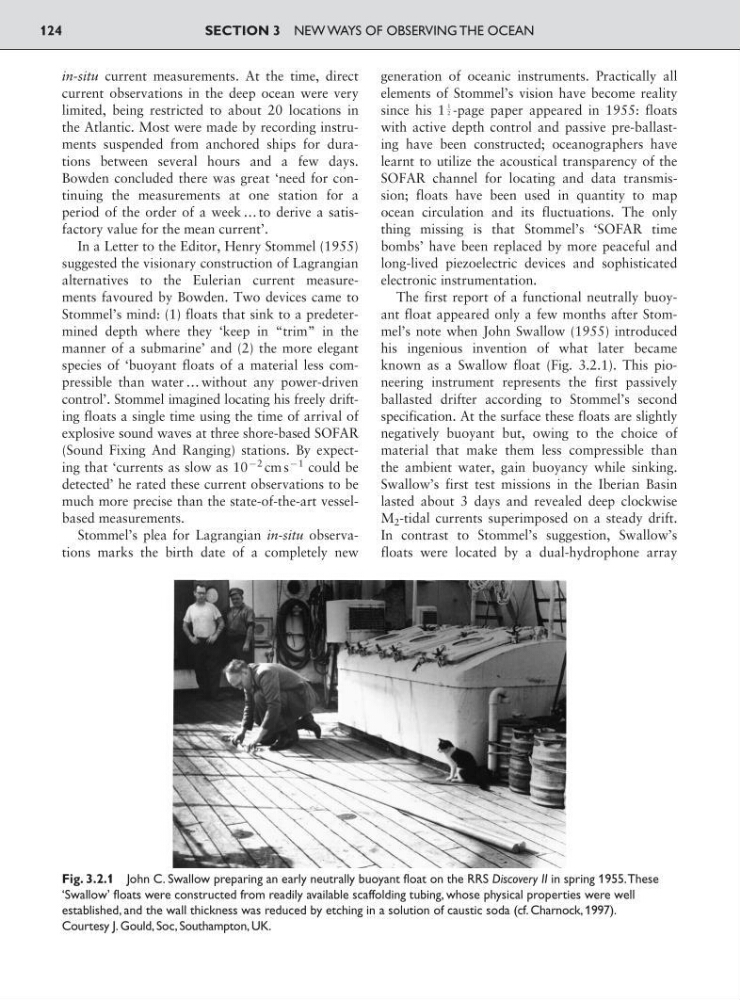
The first report of a functional neutrally buoyant float appeared only a few months after Stommel’s note when John Swallow (1955) introduced
his ingenious invention of what later became
known as a Swallow float (Fig. 3.2.1). This pioneering instrument represents the first passively
ballasted drifter according to Stommel’s second
specification. At the surface these floats are slightly
negatively buoyant but, owing to the choice of
material that make them less compressible than
the ambient water, gain buoyancy while sinking.
Swallow’s first test missions in the Iberian Basin
lasted about 3 days and revealed deep clockwise
M 2 -tidal currents superimposed on a steady drift.
In contrast to Stommel’s suggestion, Swallow’s
floats were located by a dual-hydrophone array
1
ᎏ
2
SECTION 3 NEW WAYS OF OBSERVING THE OCEAN
124
Fig. 3.2.1 John C. Swallow preparing an early neutrally buoyant float on the RRS Discovery II in spring 1955.These
‘Swallow’ floats were constructed from readily available scaffolding tubing, whose physical properties were well
established, and the wall thickness was reduced by etching in a solution of caustic soda (cf. Charnock, 1997).
Courtesy J. Gould, Soc, Southampton, UK.
current observations in the deep ocean were very
limited, being restricted to about 20 locations in
the Atlantic. Most were made by recording instruments suspended from anchored ships for durations between several hours and a few days.
Bowden concluded there was great ‘need for continuing the measurements at one station for a
period of the order of a week … to derive a satisfactory value for the mean current’.
In a Letter to the Editor, Henry Stommel (1955)
suggested the visionary construction of Lagrangian
alternatives to the Eulerian current measurements favoured by Bowden. Two devices came to
Stommel’s mind: (1) floats that sink to a predetermined depth where they ‘keep in “trim” in the
manner of a submarine’ and (2) the more elegant
species of ‘buoyant floats of a material less compressible than water … without any power-driven
control’. Stommel imagined locating his freely drifting floats a single time using the time of arrival of
explosive sound waves at three shore-based SOFAR
(Sound Fixing And Ranging) stations. By expecting that ‘currents as slow as 10
92 cm s
91 could be
detected’ he rated these current observations to be
much more precise than the state-of-the-art vesselbased measurements.
Stommel’s plea for Lagrangian in-situ observations marks the birth date of a completely new
generation of oceanic instruments. Practically all
elements of Stommel’s vision have become reality
since his 1 -page paper appeared in 1955: floats
with active depth control and passive pre-ballasting have been constructed; oceanographers have
learnt to utilize the acoustical transparency of the
SOFAR channel for locating and data transmission; floats have been used in quantity to map
ocean circulation and its fluctuations. The only
thing missing is that Stommel’s ‘SOFAR time
bombs’ have been replaced by more peaceful and
long-lived piezoelectric devices and sophisticated
electronic instrumentation.
The first report of a functional neutrally buoyant float appeared only a few months after Stommel’s note when John Swallow (1955) introduced
his ingenious invention of what later became
known as a Swallow float (Fig. 3.2.1). This pioneering instrument represents the first passively
ballasted drifter according to Stommel’s second
specification. At the surface these floats are slightly
negatively buoyant but, owing to the choice of
material that make them less compressible than
the ambient water, gain buoyancy while sinking.
Swallow’s first test missions in the Iberian Basin
lasted about 3 days and revealed deep clockwise
M 2 -tidal currents superimposed on a steady drift.
In contrast to Stommel’s suggestion, Swallow’s
floats were located by a dual-hydrophone array
1
ᎏ
2
SECTION 3 NEW WAYS OF OBSERVING THE OCEAN
124
Fig. 3.2.1 John C. Swallow preparing an early neutrally buoyant float on the RRS Discovery II in spring 1955.These
‘Swallow’ floats were constructed from readily available scaffolding tubing, whose physical properties were well
established, and the wall thickness was reduced by etching in a solution of caustic soda (cf. Charnock, 1997).
Courtesy J. Gould, Soc, Southampton, UK.