

complexation showed little agreement between values for ligand concentrations, conditional stability
constants, and the extent to which copper was organically complexed, which ranged from 0 to 100%.
Organic speciation work on copper, zinc, and iron
shows that the organically complexed fraction
dominates the dissolved speciation of these metals in
oceanic surface waters and is critically important in
controlling the free metal ion concentrations of these
metals. Although the chemical nature and complete
chemical characteristics of the complexing ligands
remains unknown, preliminary investigations have
shown that the ligands are generally hydrophillic and
of low molecular weight.
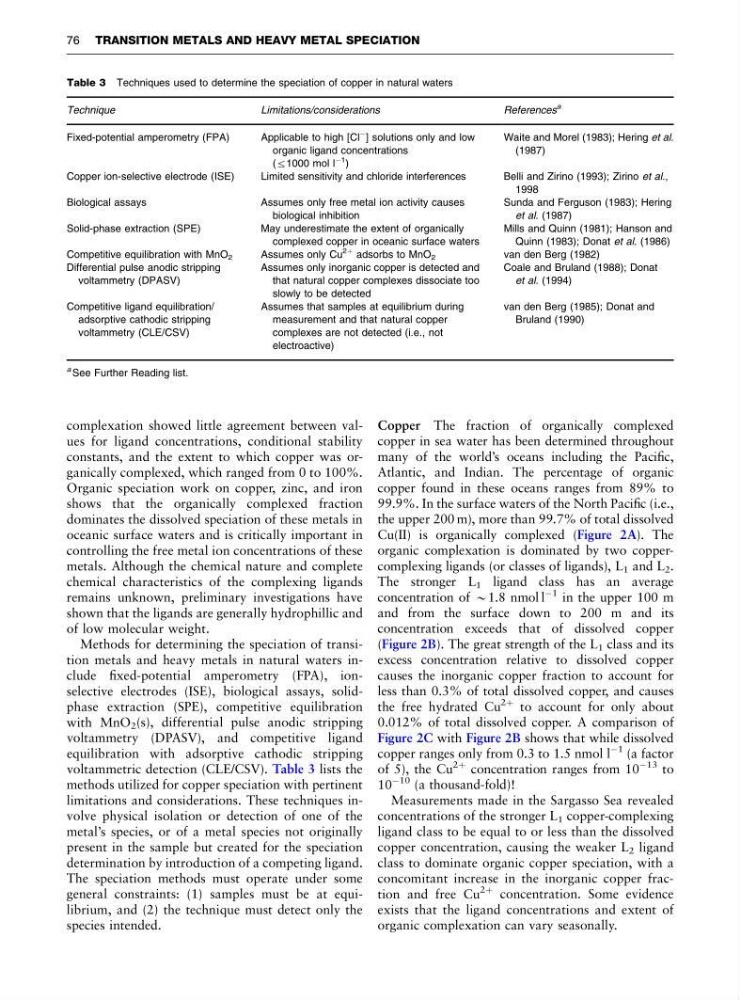
Methods for determining the speciation of transition metals and heavy metals in natural waters include fixed-potential amperometry (FPA), ionselective electrodes (ISE), biological assays, solidphase extraction (SPE), competitive equilibration
with MnO 2 (s), differential pulse anodic stripping
voltammetry (DPASV), and competitive ligand
equilibration with adsorptive cathodic stripping
voltammetric detection (CLE/CSV). Table 3 lists the
methods utilized for copper speciation with pertinent
limitations and considerations. These techniques involve physical isolation or detection of one of the
metal’s species, or of a metal species not originally
present in the sample but created for the speciation
determination by introduction of a competing ligand.
The speciation methods must operate under some
general constraints: (1) samples must be at equilibrium, and (2) the technique must detect only the
species intended.
Copper The fraction of organically complexed
copper in sea water has been determined throughout
many of the world’s oceans including the Pacific,
Atlantic, and Indian. The percentage of organic
copper found in these oceans ranges from 89% to
99.9%. In the surface waters of the North Pacific (i.e.,
the upper 200 m), more than 99.7% of total dissolved
Cu(II) is organically complexed (Figure 2A). The
organic complexation is dominated by two coppercomplexing ligands (or classes of ligands), L 1 and L 2 .
The stronger L 1 ligand class has an average
concentration of B1.8 nmol l
À1 in the upper 100 m
and from the surface down to 200 m and its
concentration exceeds that of dissolved copper
(Figure 2B). The great strength of the L 1 class and its
excess concentration relative to dissolved copper
causes the inorganic copper fraction to account for
less than 0.3% of total dissolved copper, and causes
the free hydrated Cu
2þ to account for only about
0.012% of total dissolved copper. A comparison of
Figure 2C with Figure 2B shows that while dissolved
copper ranges only from 0.3 to 1.5 nmol l
À1 (a factor
of 5), the Cu
2þ concentration ranges from 10
À13 to
10
À10 (a thousand-fold)!
Measurements made in the Sargasso Sea revealed
concentrations of the stronger L 1 copper-complexing
ligand class to be equal to or less than the dissolved
copper concentration, causing the weaker L 2 ligand
class to dominate organic copper speciation, with a
concomitant increase in the inorganic copper fraction and free Cu
2þ concentration. Some evidence
exists that the ligand concentrations and extent of
organic complexation can vary seasonally.
Table 3 Techniques used to determine the speciation of copper in natural waters
Technique
Limitations/considerations
References
a
Fixed-potential amperometry (FPA)
Applicable to high [Cl
À
] solutions only and low
organic ligand concentrations
(r1000 mol l
À1 )
Waite and Morel (1983); Hering et al.
(1987)
Copper ion-selective electrode (ISE)
Limited sensitivity and chloride interferences
Belli and Zirino (1993); Zirino et al.,
1998
Biological assays
Assumes only free metal ion activity causes
biological inhibition
Sunda and Ferguson (1983); Hering
et al. (1987)
Solid-phase extraction (SPE)
May underestimate the extent of organically
complexed copper in oceanic surface waters
Mills and Quinn (1981); Hanson and
Quinn (1983); Donat et al. (1986)
Competitive equilibration with MnO 2
Assumes only Cu
2þ adsorbs to MnO 2
van den Berg (1982)
Differential pulse anodic stripping
voltammetry (DPASV)
Assumes only inorganic copper is detected and
that natural copper complexes dissociate too
slowly to be detected
Coale and Bruland (1988); Donat
et al. (1994)
Competitive ligand equilibration/
adsorptive cathodic stripping
voltammetry (CLE/CSV)
Assumes that samples at equilibrium during
measurement and that natural copper
complexes are not detected (i.e., not
electroactive)
van den Berg (1985); Donat and
Bruland (1990)
a See Further Reading list.
76 TRANSITION METALS AND HEAVY METAL SPECIATION
constants, and the extent to which copper was organically complexed, which ranged from 0 to 100%.
Organic speciation work on copper, zinc, and iron
shows that the organically complexed fraction
dominates the dissolved speciation of these metals in
oceanic surface waters and is critically important in
controlling the free metal ion concentrations of these
metals. Although the chemical nature and complete
chemical characteristics of the complexing ligands
remains unknown, preliminary investigations have
shown that the ligands are generally hydrophillic and
of low molecular weight.
Methods for determining the speciation of transition metals and heavy metals in natural waters include fixed-potential amperometry (FPA), ionselective electrodes (ISE), biological assays, solidphase extraction (SPE), competitive equilibration
with MnO 2 (s), differential pulse anodic stripping
voltammetry (DPASV), and competitive ligand
equilibration with adsorptive cathodic stripping
voltammetric detection (CLE/CSV). Table 3 lists the
methods utilized for copper speciation with pertinent
limitations and considerations. These techniques involve physical isolation or detection of one of the
metal’s species, or of a metal species not originally
present in the sample but created for the speciation
determination by introduction of a competing ligand.
The speciation methods must operate under some
general constraints: (1) samples must be at equilibrium, and (2) the technique must detect only the
species intended.
Copper The fraction of organically complexed
copper in sea water has been determined throughout
many of the world’s oceans including the Pacific,
Atlantic, and Indian. The percentage of organic
copper found in these oceans ranges from 89% to
99.9%. In the surface waters of the North Pacific (i.e.,
the upper 200 m), more than 99.7% of total dissolved
Cu(II) is organically complexed (Figure 2A). The
organic complexation is dominated by two coppercomplexing ligands (or classes of ligands), L 1 and L 2 .
The stronger L 1 ligand class has an average
concentration of B1.8 nmol l
À1 in the upper 100 m
and from the surface down to 200 m and its
concentration exceeds that of dissolved copper
(Figure 2B). The great strength of the L 1 class and its
excess concentration relative to dissolved copper
causes the inorganic copper fraction to account for
less than 0.3% of total dissolved copper, and causes
the free hydrated Cu
2þ to account for only about
0.012% of total dissolved copper. A comparison of
Figure 2C with Figure 2B shows that while dissolved
copper ranges only from 0.3 to 1.5 nmol l
À1 (a factor
of 5), the Cu
2þ concentration ranges from 10
À13 to
10
À10 (a thousand-fold)!
Measurements made in the Sargasso Sea revealed
concentrations of the stronger L 1 copper-complexing
ligand class to be equal to or less than the dissolved
copper concentration, causing the weaker L 2 ligand
class to dominate organic copper speciation, with a
concomitant increase in the inorganic copper fraction and free Cu
2þ concentration. Some evidence
exists that the ligand concentrations and extent of
organic complexation can vary seasonally.
Table 3 Techniques used to determine the speciation of copper in natural waters
Technique
Limitations/considerations
References
a
Fixed-potential amperometry (FPA)
Applicable to high [Cl
À
] solutions only and low
organic ligand concentrations
(r1000 mol l
À1 )
Waite and Morel (1983); Hering et al.
(1987)
Copper ion-selective electrode (ISE)
Limited sensitivity and chloride interferences
Belli and Zirino (1993); Zirino et al.,
1998
Biological assays
Assumes only free metal ion activity causes
biological inhibition
Sunda and Ferguson (1983); Hering
et al. (1987)
Solid-phase extraction (SPE)
May underestimate the extent of organically
complexed copper in oceanic surface waters
Mills and Quinn (1981); Hanson and
Quinn (1983); Donat et al. (1986)
Competitive equilibration with MnO 2
Assumes only Cu
2þ adsorbs to MnO 2
van den Berg (1982)
Differential pulse anodic stripping
voltammetry (DPASV)
Assumes only inorganic copper is detected and
that natural copper complexes dissociate too
slowly to be detected
Coale and Bruland (1988); Donat
et al. (1994)
Competitive ligand equilibration/
adsorptive cathodic stripping
voltammetry (CLE/CSV)
Assumes that samples at equilibrium during
measurement and that natural copper
complexes are not detected (i.e., not
electroactive)
van den Berg (1985); Donat and
Bruland (1990)
a See Further Reading list.
76 TRANSITION METALS AND HEAVY METAL SPECIATION