

the importance of speciation information for fully
understanding a metal’s oceanic biogeochemical
cycle.
Inorganic Speciation
Inorganic forms of the transition metals and heavy
metals in sea water include hydrated metal ions,
complexes with inorganic ligands, and species with
different oxidation states. Transition metals and
heavy metals with different oxidation states can exist
in sea water when the potential required to change
valence states falls within the range of the sea water’s
oxidizing/reducing potentials. Examples of transition
metals and heavy metals having multiple oxidation
states in sea water include Fe(II)/Fe(III), Mn(II)/
Mn(IV), Cr(III)/Cr(VI), and Cu(I)/Cu(II). In oxygenated sea water, the thermodynamically stable
form is usually the higher of the two oxidation states.
However, species whose existence is thermodynamically unfavorable (i.e., usually the lower
oxidation states) can be produced biochemically
(e.g., by photosynthesis) and/or chemically (e.g., by
photochemistry), as a result of the input of solar
energy.
Calculational estimates of the inorganic speciation
of many of the transition metals and heavy metals in
sea water have been given in two landmark papers by
Turner et al. and Byrne et al. (see Further Reading).
The extent to which a metal is complexed by inorganic ligands is expressed by the inorganic sidereaction coefficient, a. This, in turn, is calculated
from eqn[1] where b is the overall conditional stability constant for the inorganic complex MX i of the
transition or heavy metal M with the inorganic ligand X i , and X½
0
i is the concentration of uncomplexed
X i .
a ¼ 1 þ
X
i
b MXi X
0
i
 Ã
½1
The inorganic side-reaction coefficient, a, is also
equal to the ratio of the sum of the concentrations of
all inorganic species of the metal Mð½M
0 Þ to the
concentration of its free hydrated cation M ½M
nþ
(eqn [2]).
a ¼
M
0
½
M
nþ
Â
Ã
½2
For zinc and the first transition series metals
manganese, iron, cobalt, and nickel, the free hydrated divalent cation form dominates the dissolved
inorganic speciation. The trivalent metal cations
Al
3þ , Ga
3þ
, Tl
3þ , Fe
3þ , and Bi
3þ are strongly
hydrolyzed (i.e., they form strong complexes with
OH
À ). With respect to complexation by OH
À , the
inorganic side-reaction coefficients of the strongly
hydrolyzed metals range from 10
5.76 for Al
3þ to
10
20.4 for Tl
3þ
, and their inorganic speciation is
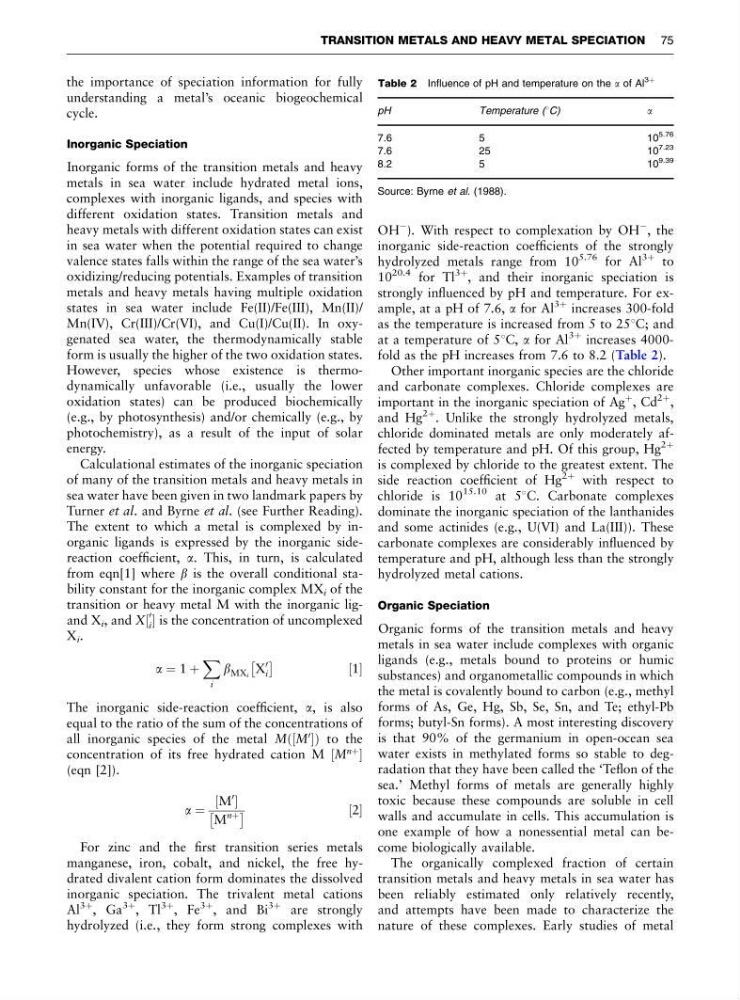
strongly influenced by pH and temperature. For example, at a pH of 7.6, a for Al
3þ increases 300-fold
as the temperature is increased from 5 to 251C; and
at a temperature of 51C, a for Al
3þ increases 4000fold as the pH increases from 7.6 to 8.2 (Table 2).
Other important inorganic species are the chloride
and carbonate complexes. Chloride complexes are
important in the inorganic speciation of Ag
þ , Cd
2þ ,
and Hg
2þ . Unlike the strongly hydrolyzed metals,
chloride dominated metals are only moderately affected by temperature and pH. Of this group, Hg
2þ
is complexed by chloride to the greatest extent. The
side reaction coefficient of Hg
2þ with respect to
chloride is 10
15.10 at 51C. Carbonate complexes
dominate the inorganic speciation of the lanthanides
and some actinides (e.g., U(VI) and La(III)). These
carbonate complexes are considerably influenced by
temperature and pH, although less than the strongly
hydrolyzed metal cations.
Organic Speciation
Organic forms of the transition metals and heavy
metals in sea water include complexes with organic
ligands (e.g., metals bound to proteins or humic
substances) and organometallic compounds in which
the metal is covalently bound to carbon (e.g., methyl
forms of As, Ge, Hg, Sb, Se, Sn, and Te; ethyl-Pb
forms; butyl-Sn forms). A most interesting discovery
is that 90% of the germanium in open-ocean sea
water exists in methylated forms so stable to degradation that they have been called the ‘Teflon of the
sea.’ Methyl forms of metals are generally highly
toxic because these compounds are soluble in cell
walls and accumulate in cells. This accumulation is
one example of how a nonessential metal can become biologically available.
The organically complexed fraction of certain
transition metals and heavy metals in sea water has
been reliably estimated only relatively recently,
and attempts have been made to characterize the
nature of these complexes. Early studies of metal
Table 2 Influence of pH and temperature on the a of Al
3þ
pH
Temperature (1C)
a
7.6
5
10
5.76
7.6
25
10
7.23
8.2
5
10
9.39
Source: Byrne et al. (1988).
TRANSITION METALS AND HEAVY METAL SPECIATION 75
understanding a metal’s oceanic biogeochemical
cycle.
Inorganic Speciation
Inorganic forms of the transition metals and heavy
metals in sea water include hydrated metal ions,
complexes with inorganic ligands, and species with
different oxidation states. Transition metals and
heavy metals with different oxidation states can exist
in sea water when the potential required to change
valence states falls within the range of the sea water’s
oxidizing/reducing potentials. Examples of transition
metals and heavy metals having multiple oxidation
states in sea water include Fe(II)/Fe(III), Mn(II)/
Mn(IV), Cr(III)/Cr(VI), and Cu(I)/Cu(II). In oxygenated sea water, the thermodynamically stable
form is usually the higher of the two oxidation states.
However, species whose existence is thermodynamically unfavorable (i.e., usually the lower
oxidation states) can be produced biochemically
(e.g., by photosynthesis) and/or chemically (e.g., by
photochemistry), as a result of the input of solar
energy.
Calculational estimates of the inorganic speciation
of many of the transition metals and heavy metals in
sea water have been given in two landmark papers by
Turner et al. and Byrne et al. (see Further Reading).
The extent to which a metal is complexed by inorganic ligands is expressed by the inorganic sidereaction coefficient, a. This, in turn, is calculated
from eqn[1] where b is the overall conditional stability constant for the inorganic complex MX i of the
transition or heavy metal M with the inorganic ligand X i , and X½
0
i is the concentration of uncomplexed
X i .
a ¼ 1 þ
X
i
b MXi X
0
i
 Ã
½1
The inorganic side-reaction coefficient, a, is also
equal to the ratio of the sum of the concentrations of
all inorganic species of the metal Mð½M
0 Þ to the
concentration of its free hydrated cation M ½M
nþ
(eqn [2]).
a ¼
M
0
½
M
nþ
Â
Ã
½2
For zinc and the first transition series metals
manganese, iron, cobalt, and nickel, the free hydrated divalent cation form dominates the dissolved
inorganic speciation. The trivalent metal cations
Al
3þ , Ga
3þ
, Tl
3þ , Fe
3þ , and Bi
3þ are strongly
hydrolyzed (i.e., they form strong complexes with
OH
À ). With respect to complexation by OH
À , the
inorganic side-reaction coefficients of the strongly
hydrolyzed metals range from 10
5.76 for Al
3þ to
10
20.4 for Tl
3þ
, and their inorganic speciation is
strongly influenced by pH and temperature. For example, at a pH of 7.6, a for Al
3þ increases 300-fold
as the temperature is increased from 5 to 251C; and
at a temperature of 51C, a for Al
3þ increases 4000fold as the pH increases from 7.6 to 8.2 (Table 2).
Other important inorganic species are the chloride
and carbonate complexes. Chloride complexes are
important in the inorganic speciation of Ag
þ , Cd
2þ ,
and Hg
2þ . Unlike the strongly hydrolyzed metals,
chloride dominated metals are only moderately affected by temperature and pH. Of this group, Hg
2þ
is complexed by chloride to the greatest extent. The
side reaction coefficient of Hg
2þ with respect to
chloride is 10
15.10 at 51C. Carbonate complexes
dominate the inorganic speciation of the lanthanides
and some actinides (e.g., U(VI) and La(III)). These
carbonate complexes are considerably influenced by
temperature and pH, although less than the strongly
hydrolyzed metal cations.
Organic Speciation
Organic forms of the transition metals and heavy
metals in sea water include complexes with organic
ligands (e.g., metals bound to proteins or humic
substances) and organometallic compounds in which
the metal is covalently bound to carbon (e.g., methyl
forms of As, Ge, Hg, Sb, Se, Sn, and Te; ethyl-Pb
forms; butyl-Sn forms). A most interesting discovery
is that 90% of the germanium in open-ocean sea
water exists in methylated forms so stable to degradation that they have been called the ‘Teflon of the
sea.’ Methyl forms of metals are generally highly
toxic because these compounds are soluble in cell
walls and accumulate in cells. This accumulation is
one example of how a nonessential metal can become biologically available.
The organically complexed fraction of certain
transition metals and heavy metals in sea water has
been reliably estimated only relatively recently,
and attempts have been made to characterize the
nature of these complexes. Early studies of metal
Table 2 Influence of pH and temperature on the a of Al
3þ
pH
Temperature (1C)
a
7.6
5
10
5.76
7.6
25
10
7.23
8.2
5
10
9.39
Source: Byrne et al. (1988).
TRANSITION METALS AND HEAVY METAL SPECIATION 75