

phosphate; this is consistent with their chemistries
and biochemistries. In surface waters, biologically
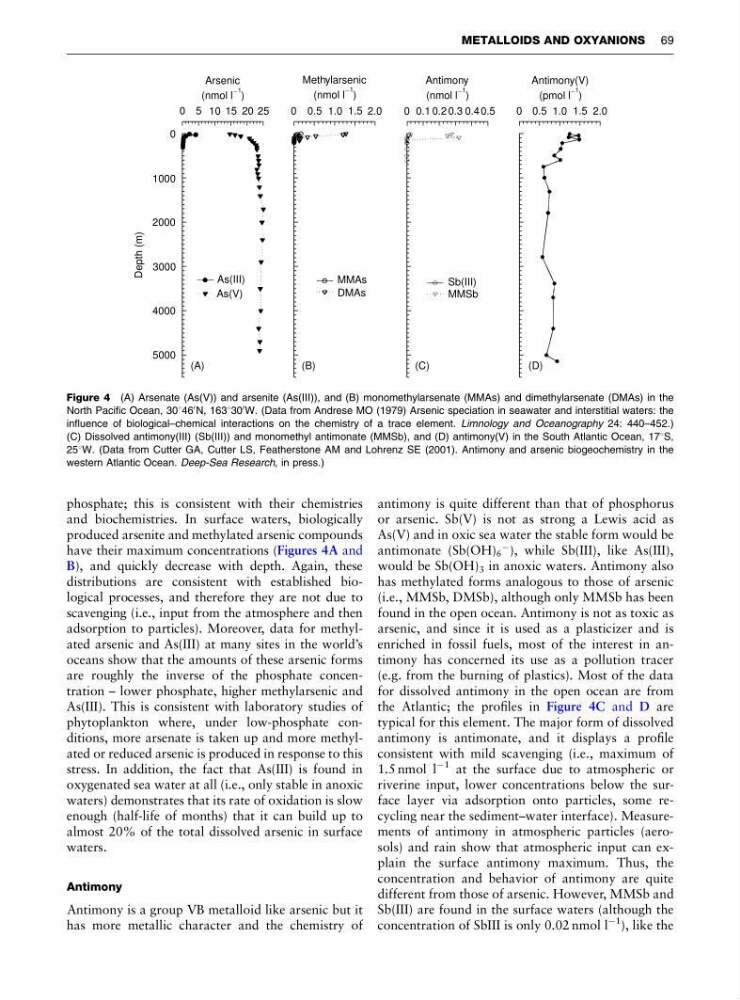
produced arsenite and methylated arsenic compounds
have their maximum concentrations (Figures 4A and
B), and quickly decrease with depth. Again, these
distributions are consistent with established biological processes, and therefore they are not due to
scavenging (i.e., input from the atmosphere and then
adsorption to particles). Moreover, data for methylated arsenic and As(III) at many sites in the world’s
oceans show that the amounts of these arsenic forms
are roughly the inverse of the phosphate concentration – lower phosphate, higher methylarsenic and
As(III). This is consistent with laboratory studies of
phytoplankton where, under low-phosphate conditions, more arsenate is taken up and more methylated or reduced arsenic is produced in response to this
stress. In addition, the fact that As(III) is found in
oxygenated sea water at all (i.e., only stable in anoxic
waters) demonstrates that its rate of oxidation is slow
enough (half-life of months) that it can build up to
almost 20% of the total dissolved arsenic in surface
waters.
Antimony
Antimony is a group VB metalloid like arsenic but it
has more metallic character and the chemistry of
antimony is quite different than that of phosphorus
or arsenic. Sb(V) is not as strong a Lewis acid as
As(V) and in oxic sea water the stable form would be
antimonate (Sb(OH) 6
À ), while Sb(III), like As(III),
would be Sb(OH) 3 in anoxic waters. Antimony also
has methylated forms analogous to those of arsenic
(i.e., MMSb, DMSb), although only MMSb has been
found in the open ocean. Antimony is not as toxic as
arsenic, and since it is used as a plasticizer and is
enriched in fossil fuels, most of the interest in antimony has concerned its use as a pollution tracer
(e.g. from the burning of plastics). Most of the data
for dissolved antimony in the open ocean are from
the Atlantic; the profiles in Figure 4C and D are
typical for this element. The major form of dissolved
antimony is antimonate, and it displays a profile
consistent with mild scavenging (i.e., maximum of
1.5 nmol l
À1 at the surface due to atmospheric or
riverine input, lower concentrations below the surface layer via adsorption onto particles, some recycling near the sediment–water interface). Measurements of antimony in atmospheric particles (aerosols) and rain show that atmospheric input can explain the surface antimony maximum. Thus, the
concentration and behavior of antimony are quite
different from those of arsenic. However, MMSb and
Sb(III) are found in the surface waters (although the
concentration of SbIII is only 0.02 nmol l
À1
), like the
0 5 10 15 20 25
0 0.5 1.0 1.5 2.0
0 0.1 0.2 0.3 0.4 0.5
0
1000
2000
3000
4000
5000
0 0.5 1.0 1.5 2.0
Arsenic
(nmol l )
_ 1
Antimony
(nmol l )
_ 1
Antimony(V)
(pmol l )
_ 1
Methylarsenic
(nmol l )
_ 1
Depth (m)
MMAs
DMAs
(A)
(B)
(C)
(D)
As(III)
As(V)
Sb(III)
MMSb
Figure 4 (A) Arsenate (As(V)) and arsenite (As(III)), and (B) monomethylarsenate (MMAs) and dimethylarsenate (DMAs) in the
North Pacific Ocean, 30146
0 N, 163130
0 W. (Data from Andrese MO (1979) Arsenic speciation in seawater and interstitial waters: the
influence of biological–chemical interactions on the chemistry of a trace element. Limnology and Oceanography 24: 440–452.)
(C) Dissolved antimony(III) (Sb(III)) and monomethyl antimonate (MMSb), and (D) antimony(V) in the South Atlantic Ocean, 171S,
251W. (Data from Cutter GA, Cutter LS, Featherstone AM and Lohrenz SE (2001). Antimony and arsenic biogeochemistry in the
western Atlantic Ocean. Deep-Sea Research, in press.)
METALLOIDS AND OXYANIONS 69
and biochemistries. In surface waters, biologically
produced arsenite and methylated arsenic compounds
have their maximum concentrations (Figures 4A and
B), and quickly decrease with depth. Again, these
distributions are consistent with established biological processes, and therefore they are not due to
scavenging (i.e., input from the atmosphere and then
adsorption to particles). Moreover, data for methylated arsenic and As(III) at many sites in the world’s
oceans show that the amounts of these arsenic forms
are roughly the inverse of the phosphate concentration – lower phosphate, higher methylarsenic and
As(III). This is consistent with laboratory studies of
phytoplankton where, under low-phosphate conditions, more arsenate is taken up and more methylated or reduced arsenic is produced in response to this
stress. In addition, the fact that As(III) is found in
oxygenated sea water at all (i.e., only stable in anoxic
waters) demonstrates that its rate of oxidation is slow
enough (half-life of months) that it can build up to
almost 20% of the total dissolved arsenic in surface
waters.
Antimony
Antimony is a group VB metalloid like arsenic but it
has more metallic character and the chemistry of
antimony is quite different than that of phosphorus
or arsenic. Sb(V) is not as strong a Lewis acid as
As(V) and in oxic sea water the stable form would be
antimonate (Sb(OH) 6
À ), while Sb(III), like As(III),
would be Sb(OH) 3 in anoxic waters. Antimony also
has methylated forms analogous to those of arsenic
(i.e., MMSb, DMSb), although only MMSb has been
found in the open ocean. Antimony is not as toxic as
arsenic, and since it is used as a plasticizer and is
enriched in fossil fuels, most of the interest in antimony has concerned its use as a pollution tracer
(e.g. from the burning of plastics). Most of the data
for dissolved antimony in the open ocean are from
the Atlantic; the profiles in Figure 4C and D are
typical for this element. The major form of dissolved
antimony is antimonate, and it displays a profile
consistent with mild scavenging (i.e., maximum of
1.5 nmol l
À1 at the surface due to atmospheric or
riverine input, lower concentrations below the surface layer via adsorption onto particles, some recycling near the sediment–water interface). Measurements of antimony in atmospheric particles (aerosols) and rain show that atmospheric input can explain the surface antimony maximum. Thus, the
concentration and behavior of antimony are quite
different from those of arsenic. However, MMSb and
Sb(III) are found in the surface waters (although the
concentration of SbIII is only 0.02 nmol l
À1
), like the
0 5 10 15 20 25
0 0.5 1.0 1.5 2.0
0 0.1 0.2 0.3 0.4 0.5
0
1000
2000
3000
4000
5000
0 0.5 1.0 1.5 2.0
Arsenic
(nmol l )
_ 1
Antimony
(nmol l )
_ 1
Antimony(V)
(pmol l )
_ 1
Methylarsenic
(nmol l )
_ 1
Depth (m)
MMAs
DMAs
(A)
(B)
(C)
(D)
As(III)
As(V)
Sb(III)
MMSb
Figure 4 (A) Arsenate (As(V)) and arsenite (As(III)), and (B) monomethylarsenate (MMAs) and dimethylarsenate (DMAs) in the
North Pacific Ocean, 30146
0 N, 163130
0 W. (Data from Andrese MO (1979) Arsenic speciation in seawater and interstitial waters: the
influence of biological–chemical interactions on the chemistry of a trace element. Limnology and Oceanography 24: 440–452.)
(C) Dissolved antimony(III) (Sb(III)) and monomethyl antimonate (MMSb), and (D) antimony(V) in the South Atlantic Ocean, 171S,
251W. (Data from Cutter GA, Cutter LS, Featherstone AM and Lohrenz SE (2001). Antimony and arsenic biogeochemistry in the
western Atlantic Ocean. Deep-Sea Research, in press.)
METALLOIDS AND OXYANIONS 69