

that it is only carried along in the organic matter
cycle.
Germanium
Germanium is a group IVB metalloid, and therefore
chemically quite different from the transition metals
we have been considering so far. Being directly below
silicon in the periodic table, germanium has quite
similar chemistry and early studies of phytoplankton
that make up their structural skeletons (‘tests’) of
biogenic silica (e.g., diatoms), showed that they take
up germanium along with silicon in a relatively
constant atomic Ge : Si ratio of 10
À6 : 1, a value that
is nearly identical to the ratio in crustal rocks. Dissolved germanium exists as germanic (H 3 GeO 4 ) in
sea water just as silicon is found as silicic acid
(H 3 SiO 4 ). The depth profile of dissolved inorganic
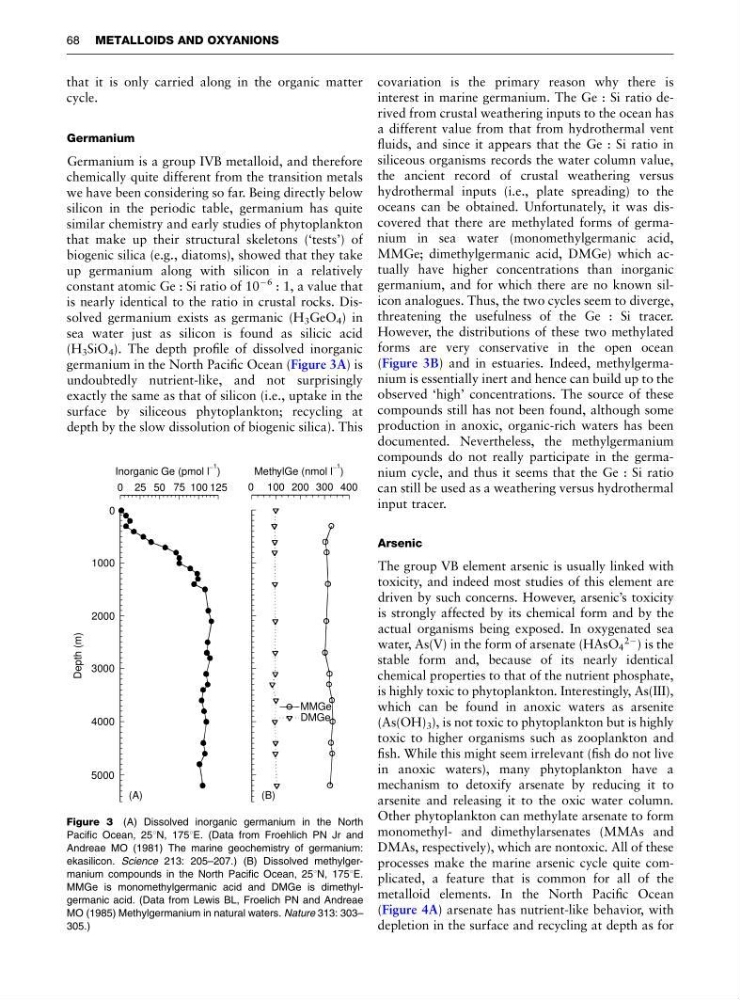
germanium in the North Pacific Ocean (Figure 3A) is
undoubtedly nutrient-like, and not surprisingly
exactly the same as that of silicon (i.e., uptake in the
surface by siliceous phytoplankton; recycling at
depth by the slow dissolution of biogenic silica). This
covariation is the primary reason why there is
interest in marine germanium. The Ge : Si ratio derived from crustal weathering inputs to the ocean has
a different value from that from hydrothermal vent
fluids, and since it appears that the Ge : Si ratio in
siliceous organisms records the water column value,
the ancient record of crustal weathering versus
hydrothermal inputs (i.e., plate spreading) to the
oceans can be obtained. Unfortunately, it was discovered that there are methylated forms of germanium in sea water (monomethylgermanic acid,
MMGe; dimethylgermanic acid, DMGe) which actually have higher concentrations than inorganic
germanium, and for which there are no known silicon analogues. Thus, the two cycles seem to diverge,
threatening the usefulness of the Ge : Si tracer.
However, the distributions of these two methylated
forms are very conservative in the open ocean
(Figure 3B) and in estuaries. Indeed, methylgermanium is essentially inert and hence can build up to the
observed ‘high’ concentrations. The source of these
compounds still has not been found, although some
production in anoxic, organic-rich waters has been
documented. Nevertheless, the methylgermanium
compounds do not really participate in the germanium cycle, and thus it seems that the Ge : Si ratio
can still be used as a weathering versus hydrothermal
input tracer.
Arsenic
The group VB element arsenic is usually linked with
toxicity, and indeed most studies of this element are
driven by such concerns. However, arsenic’s toxicity
is strongly affected by its chemical form and by the
actual organisms being exposed. In oxygenated sea
water, As(V) in the form of arsenate (HAsO 4
2À ) is the
stable form and, because of its nearly identical
chemical properties to that of the nutrient phosphate,
is highly toxic to phytoplankton. Interestingly, As(III),
which can be found in anoxic waters as arsenite
(As(OH) 3 ), is not toxic to phytoplankton but is highly
toxic to higher organisms such as zooplankton and
fish. While this might seem irrelevant (fish do not live
in anoxic waters), many phytoplankton have a
mechanism to detoxify arsenate by reducing it to
arsenite and releasing it to the oxic water column.
Other phytoplankton can methylate arsenate to form
monomethyl- and dimethylarsenates (MMAs and
DMAs, respectively), which are nontoxic. All of these
processes make the marine arsenic cycle quite complicated, a feature that is common for all of the
metalloid elements. In the North Pacific Ocean
(Figure 4A) arsenate has nutrient-like behavior, with
depletion in the surface and recycling at depth as for
0 25 50 75 100 125
0
1000
2000
3000
4000
5000
(A)
Depth (m)
(B)
MMGe
DMGe
0 100 200 300 400
MethylGe (nmol l )
_ 1
Inorganic Ge (pmol l )
_ 1
Figure 3 (A) Dissolved inorganic germanium in the North
Pacific Ocean, 251N, 1751E. (Data from Froehlich PN Jr and
Andreae MO (1981) The marine geochemistry of germanium:
ekasilicon. Science 213: 205–207.) (B) Dissolved methylgermanium compounds in the North Pacific Ocean, 251N, 1751E.
MMGe is monomethylgermanic acid and DMGe is dimethylgermanic acid. (Data from Lewis BL, Froelich PN and Andreae
MO (1985) Methylgermanium in natural waters. Nature 313: 303–
305.)
68 METALLOIDS AND OXYANIONS
cycle.
Germanium
Germanium is a group IVB metalloid, and therefore
chemically quite different from the transition metals
we have been considering so far. Being directly below
silicon in the periodic table, germanium has quite
similar chemistry and early studies of phytoplankton
that make up their structural skeletons (‘tests’) of
biogenic silica (e.g., diatoms), showed that they take
up germanium along with silicon in a relatively
constant atomic Ge : Si ratio of 10
À6 : 1, a value that
is nearly identical to the ratio in crustal rocks. Dissolved germanium exists as germanic (H 3 GeO 4 ) in
sea water just as silicon is found as silicic acid
(H 3 SiO 4 ). The depth profile of dissolved inorganic
germanium in the North Pacific Ocean (Figure 3A) is
undoubtedly nutrient-like, and not surprisingly
exactly the same as that of silicon (i.e., uptake in the
surface by siliceous phytoplankton; recycling at
depth by the slow dissolution of biogenic silica). This
covariation is the primary reason why there is
interest in marine germanium. The Ge : Si ratio derived from crustal weathering inputs to the ocean has
a different value from that from hydrothermal vent
fluids, and since it appears that the Ge : Si ratio in
siliceous organisms records the water column value,
the ancient record of crustal weathering versus
hydrothermal inputs (i.e., plate spreading) to the
oceans can be obtained. Unfortunately, it was discovered that there are methylated forms of germanium in sea water (monomethylgermanic acid,
MMGe; dimethylgermanic acid, DMGe) which actually have higher concentrations than inorganic
germanium, and for which there are no known silicon analogues. Thus, the two cycles seem to diverge,
threatening the usefulness of the Ge : Si tracer.
However, the distributions of these two methylated
forms are very conservative in the open ocean
(Figure 3B) and in estuaries. Indeed, methylgermanium is essentially inert and hence can build up to the
observed ‘high’ concentrations. The source of these
compounds still has not been found, although some
production in anoxic, organic-rich waters has been
documented. Nevertheless, the methylgermanium
compounds do not really participate in the germanium cycle, and thus it seems that the Ge : Si ratio
can still be used as a weathering versus hydrothermal
input tracer.
Arsenic
The group VB element arsenic is usually linked with
toxicity, and indeed most studies of this element are
driven by such concerns. However, arsenic’s toxicity
is strongly affected by its chemical form and by the
actual organisms being exposed. In oxygenated sea
water, As(V) in the form of arsenate (HAsO 4
2À ) is the
stable form and, because of its nearly identical
chemical properties to that of the nutrient phosphate,
is highly toxic to phytoplankton. Interestingly, As(III),
which can be found in anoxic waters as arsenite
(As(OH) 3 ), is not toxic to phytoplankton but is highly
toxic to higher organisms such as zooplankton and
fish. While this might seem irrelevant (fish do not live
in anoxic waters), many phytoplankton have a
mechanism to detoxify arsenate by reducing it to
arsenite and releasing it to the oxic water column.
Other phytoplankton can methylate arsenate to form
monomethyl- and dimethylarsenates (MMAs and
DMAs, respectively), which are nontoxic. All of these
processes make the marine arsenic cycle quite complicated, a feature that is common for all of the
metalloid elements. In the North Pacific Ocean
(Figure 4A) arsenate has nutrient-like behavior, with
depletion in the surface and recycling at depth as for
0 25 50 75 100 125
0
1000
2000
3000
4000
5000
(A)
Depth (m)
(B)
MMGe
DMGe
0 100 200 300 400
MethylGe (nmol l )
_ 1
Inorganic Ge (pmol l )
_ 1
Figure 3 (A) Dissolved inorganic germanium in the North
Pacific Ocean, 251N, 1751E. (Data from Froehlich PN Jr and
Andreae MO (1981) The marine geochemistry of germanium:
ekasilicon. Science 213: 205–207.) (B) Dissolved methylgermanium compounds in the North Pacific Ocean, 251N, 1751E.
MMGe is monomethylgermanic acid and DMGe is dimethylgermanic acid. (Data from Lewis BL, Froelich PN and Andreae
MO (1985) Methylgermanium in natural waters. Nature 313: 303–
305.)
68 METALLOIDS AND OXYANIONS