

equivalent arsenic forms, but their concentrations do
not negatively correlate with the concentration of
phosphate (i.e., do not appear to be a result of detoxification reactions). Indeed, it is not clear what
mechanisms are producing these forms of dissolved
antimony, and bacterial production of MMSb (bacteria are good methylators) and the photochemical
reduction of Sb(V) to Sb(III) cannot be ruled out.
Selenium
Selenium is a group VIB metalloid just below sulfur
in the periodic table, and its chemistry and biochemistry is very similar to those of sulfur. The
interest in this element is based on the fact that this
trace element is both essential (e.g., a cofactor in
antioxidant enzymes) and toxic, with the chemical
form of the element strongly influencing its beneficial
or toxic properties. As for sulfur, the most stable
oxidation state in oxygenated sea water is Se(VI) as
selenate (SeO 4
2À ), while under suboxic conditions
selenite (HSeO 3
À ) would predominate. Selenium
forms insoluble elemental Se(0) in anoxic waters,
whereas sulfur exists as sulfide (S(II)). Nevertheless,
there are numerous organic forms of selenide (Se(-II))
such as selenomethionine, that could be bound in
soluble peptides (to be referred to as ‘organic selenide’). There have also been recent measurements of
the dissolved gas dimethylselenide ((CH 3 ) 2 Se) in
surface ocean, which results in a natural selenium
input to the atmosphere. Laboratory and field studies
have shown that selenite appears to be the most
biologically preferred form of dissolved selenium by
phytoplankton, while selenate is only taken up in the
absence of selenite; data on the bioavailability of
organic selenides suggest that these forms are the
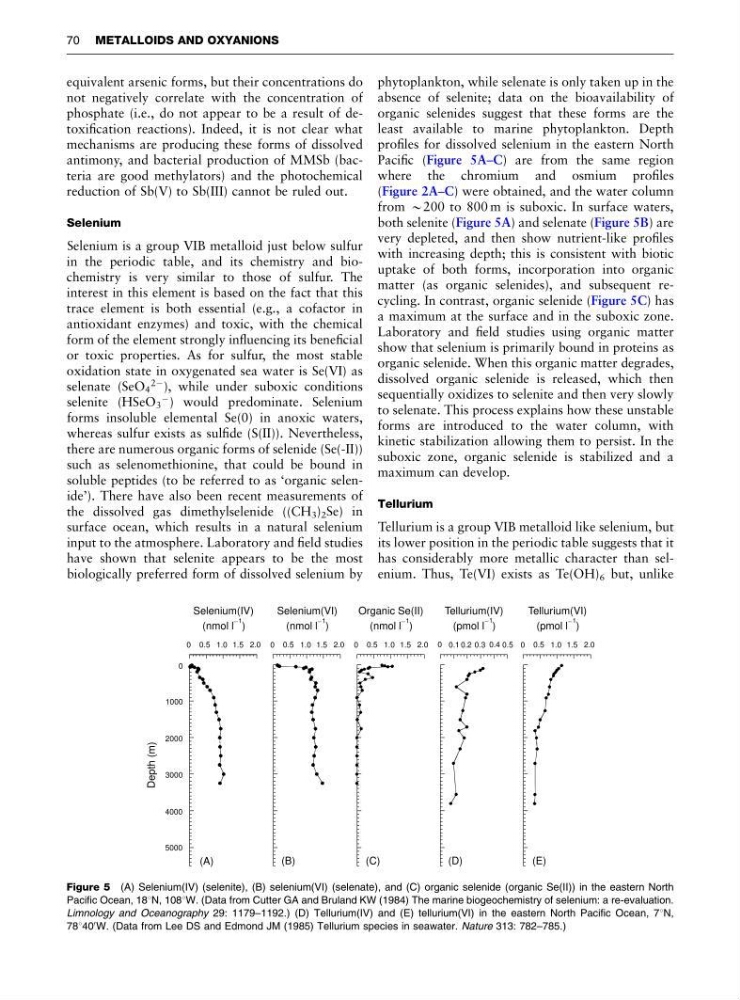
least available to marine phytoplankton. Depth
profiles for dissolved selenium in the eastern North
Pacific (Figure 5A–C) are from the same region
where the chromium and osmium profiles
(Figure 2A–C) were obtained, and the water column
from B200 to 800 m is suboxic. In surface waters,
both selenite (Figure 5A) and selenate (Figure 5B) are
very depleted, and then show nutrient-like profiles
with increasing depth; this is consistent with biotic
uptake of both forms, incorporation into organic
matter (as organic selenides), and subsequent recycling. In contrast, organic selenide (Figure 5C) has
a maximum at the surface and in the suboxic zone.
Laboratory and field studies using organic matter
show that selenium is primarily bound in proteins as
organic selenide. When this organic matter degrades,
dissolved organic selenide is released, which then
sequentially oxidizes to selenite and then very slowly
to selenate. This process explains how these unstable
forms are introduced to the water column, with
kinetic stabilization allowing them to persist. In the
suboxic zone, organic selenide is stabilized and a
maximum can develop.
Tellurium
Tellurium is a group VIB metalloid like selenium, but
its lower position in the periodic table suggests that it
has considerably more metallic character than selenium. Thus, Te(VI) exists as Te(OH) 6 but, unlike
0 0.5 1.0 1.5 2.0
Selenium(IV)
(nmol l )
_ 1
0
0.2
0 0.5 1.0 1.5 2.0
Selenium(VI)
(nmol l )
_ 1
0 0.5 1.0 1.5 2.0
Organic Se(II)
(nmol l )
_ 1
0 0.5 1.0 1.5 2.0
Tellurium(VI)
(pmol l )
_ 1
Tellurium(IV)
(pmol l )
_ 1
0
1000
2000
3000
4000
5000
(A)
(B)
(C)
(D)
Depth (m)
(E)
0.1
0.3
0.5
0.4
Figure 5 (A) Selenium(IV) (selenite), (B) selenium(VI) (selenate), and (C) organic selenide (organic Se(II)) in the eastern North
Pacific Ocean, 181N, 1081W. (Data from Cutter GA and Bruland KW (1984) The marine biogeochemistry of selenium: a re-evaluation.
Limnology and Oceanography 29: 1179–1192.) (D) Tellurium(IV) and (E) tellurium(VI) in the eastern North Pacific Ocean, 71N,
78140
0 W. (Data from Lee DS and Edmond JM (1985) Tellurium species in seawater. Nature 313: 782–785.)
70 METALLOIDS AND OXYANIONS
not negatively correlate with the concentration of
phosphate (i.e., do not appear to be a result of detoxification reactions). Indeed, it is not clear what
mechanisms are producing these forms of dissolved
antimony, and bacterial production of MMSb (bacteria are good methylators) and the photochemical
reduction of Sb(V) to Sb(III) cannot be ruled out.
Selenium
Selenium is a group VIB metalloid just below sulfur
in the periodic table, and its chemistry and biochemistry is very similar to those of sulfur. The
interest in this element is based on the fact that this
trace element is both essential (e.g., a cofactor in
antioxidant enzymes) and toxic, with the chemical
form of the element strongly influencing its beneficial
or toxic properties. As for sulfur, the most stable
oxidation state in oxygenated sea water is Se(VI) as
selenate (SeO 4
2À ), while under suboxic conditions
selenite (HSeO 3
À ) would predominate. Selenium
forms insoluble elemental Se(0) in anoxic waters,
whereas sulfur exists as sulfide (S(II)). Nevertheless,
there are numerous organic forms of selenide (Se(-II))
such as selenomethionine, that could be bound in
soluble peptides (to be referred to as ‘organic selenide’). There have also been recent measurements of
the dissolved gas dimethylselenide ((CH 3 ) 2 Se) in
surface ocean, which results in a natural selenium
input to the atmosphere. Laboratory and field studies
have shown that selenite appears to be the most
biologically preferred form of dissolved selenium by
phytoplankton, while selenate is only taken up in the
absence of selenite; data on the bioavailability of
organic selenides suggest that these forms are the
least available to marine phytoplankton. Depth
profiles for dissolved selenium in the eastern North
Pacific (Figure 5A–C) are from the same region
where the chromium and osmium profiles
(Figure 2A–C) were obtained, and the water column
from B200 to 800 m is suboxic. In surface waters,
both selenite (Figure 5A) and selenate (Figure 5B) are
very depleted, and then show nutrient-like profiles
with increasing depth; this is consistent with biotic
uptake of both forms, incorporation into organic
matter (as organic selenides), and subsequent recycling. In contrast, organic selenide (Figure 5C) has
a maximum at the surface and in the suboxic zone.
Laboratory and field studies using organic matter
show that selenium is primarily bound in proteins as
organic selenide. When this organic matter degrades,
dissolved organic selenide is released, which then
sequentially oxidizes to selenite and then very slowly
to selenate. This process explains how these unstable
forms are introduced to the water column, with
kinetic stabilization allowing them to persist. In the
suboxic zone, organic selenide is stabilized and a
maximum can develop.
Tellurium
Tellurium is a group VIB metalloid like selenium, but
its lower position in the periodic table suggests that it
has considerably more metallic character than selenium. Thus, Te(VI) exists as Te(OH) 6 but, unlike
0 0.5 1.0 1.5 2.0
Selenium(IV)
(nmol l )
_ 1
0
0.2
0 0.5 1.0 1.5 2.0
Selenium(VI)
(nmol l )
_ 1
0 0.5 1.0 1.5 2.0
Organic Se(II)
(nmol l )
_ 1
0 0.5 1.0 1.5 2.0
Tellurium(VI)
(pmol l )
_ 1
Tellurium(IV)
(pmol l )
_ 1
0
1000
2000
3000
4000
5000
(A)
(B)
(C)
(D)
Depth (m)
(E)
0.1
0.3
0.5
0.4
Figure 5 (A) Selenium(IV) (selenite), (B) selenium(VI) (selenate), and (C) organic selenide (organic Se(II)) in the eastern North
Pacific Ocean, 181N, 1081W. (Data from Cutter GA and Bruland KW (1984) The marine biogeochemistry of selenium: a re-evaluation.
Limnology and Oceanography 29: 1179–1192.) (D) Tellurium(IV) and (E) tellurium(VI) in the eastern North Pacific Ocean, 71N,
78140
0 W. (Data from Lee DS and Edmond JM (1985) Tellurium species in seawater. Nature 313: 782–785.)
70 METALLOIDS AND OXYANIONS