

abundance in the Earth’s crust) do not agree particularly well for the elements discussed here. Short
residence times and low sea water/crust ratios are
observed for aluminum, iron, and thorium, while
longer residence times and higher sea water/crust
ratios are observed for gallium, zirconium, and hafnium. The rest are not in agreement, however. Bismuth and indium are both enriched and yet are
thought to be rapidly removed. Titanium is not enriched but has an estimated residence time longer
than gallium. Niobium and tantalum are not enriched as much as might be expected from their estimated residence times. It must be emphasized that
we do not have enough information to place a high
degree of confidence on the estimated residence
times, or on the validity of using sea water enrichments to infer reduced removal intensity. Differences
in the solubility of these elements from continental
materials could be significant, but there are many
other uncertainties as well.
There have been a number of theories regarding
the geochemical basis for the relative reactivity of
elements, and the factors that control their sea water
concentrations. One theory is that the differential
reactivity of strongly hydrolyzed elements may be
related to the charge of the hydroxide species that
dominates. Those that exist in an anionic form may
be less particle-reactive (i.e., they may be less likely
to adsorb on negatively charged particle surfaces)
and may therefore have longer residence times and
be relatively enriched in sea water. The elements with
the shortest estimated residence times are bismuth,
thorium, aluminum, and iron, all of which are predominantly neutral or cationic in seawater and,
with the exception of bismuth, all of which have
extremely low sea water concentrations, relative
to their abundance in the Earth’s crust. Some elements with intermediate residence times are gallium,
hafnium, and zirconium, which are predominantly
anionic and enriched in sea water. The other elements have poorly confined estimates of their residence
times and are difficult to categorize, but do not appear to follow this trend.
Conclusion
The elements described here as refractory are not
very soluble in water. They have low concentrations
in sea water relative to their abundance in the Earth’s
crust, and short oceanic residence times. They can
have extremely large concentration ranges in the
oceans. The processes controlling the marine biogeochemistry of these elements are complex, and
their distribution types vary considerably. The classic
scavenged profile showing a surface maximum is
0
1000
2000
3000
4000
5000
0
200
400
600
Bi (fmol kg
_ 1 )
Depth (m)
0
1000
2000
3000
4000
5000
0
200
400
600
800
232 Th (fmol kg
_ 1 )
Depth (m)
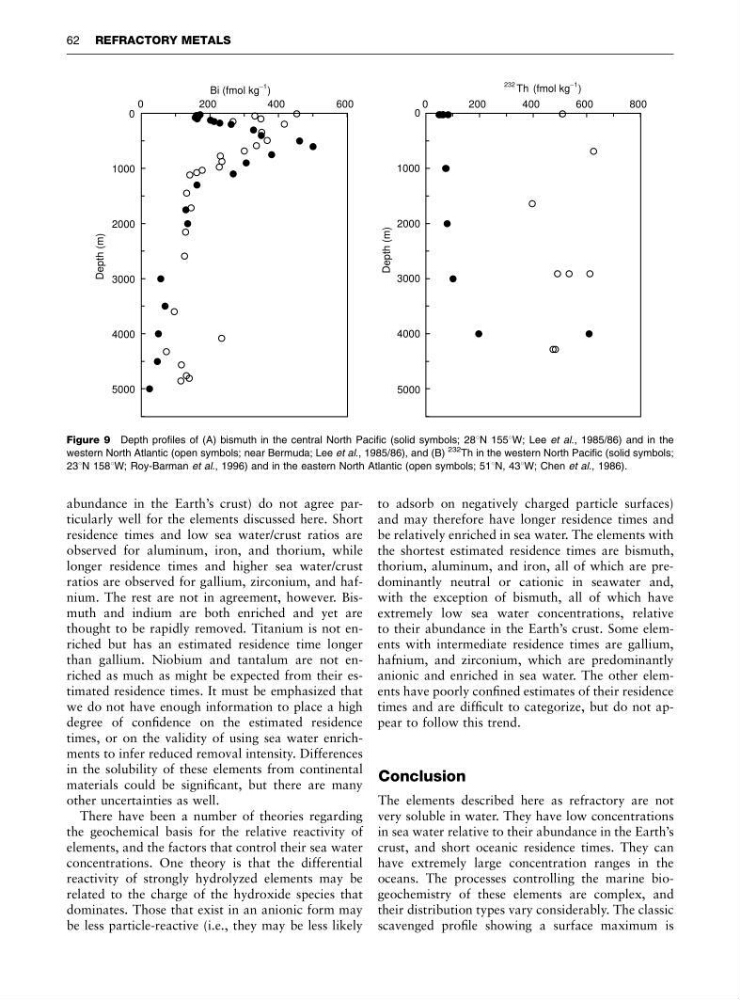
Figure 9 Depth profiles of (A) bismuth in the central North Pacific (solid symbols; 281N 1551W; Lee et al., 1985/86) and in the
western North Atlantic (open symbols; near Bermuda; Lee et al., 1985/86), and (B)
232 Th in the western North Pacific (solid symbols;
231N 1581W; Roy-Barman et al., 1996) and in the eastern North Atlantic (open symbols; 511N, 431W; Chen et al., 1986).
62 REFRACTORY METALS
residence times and low sea water/crust ratios are
observed for aluminum, iron, and thorium, while
longer residence times and higher sea water/crust
ratios are observed for gallium, zirconium, and hafnium. The rest are not in agreement, however. Bismuth and indium are both enriched and yet are
thought to be rapidly removed. Titanium is not enriched but has an estimated residence time longer
than gallium. Niobium and tantalum are not enriched as much as might be expected from their estimated residence times. It must be emphasized that
we do not have enough information to place a high
degree of confidence on the estimated residence
times, or on the validity of using sea water enrichments to infer reduced removal intensity. Differences
in the solubility of these elements from continental
materials could be significant, but there are many
other uncertainties as well.
There have been a number of theories regarding
the geochemical basis for the relative reactivity of
elements, and the factors that control their sea water
concentrations. One theory is that the differential
reactivity of strongly hydrolyzed elements may be
related to the charge of the hydroxide species that
dominates. Those that exist in an anionic form may
be less particle-reactive (i.e., they may be less likely
to adsorb on negatively charged particle surfaces)
and may therefore have longer residence times and
be relatively enriched in sea water. The elements with
the shortest estimated residence times are bismuth,
thorium, aluminum, and iron, all of which are predominantly neutral or cationic in seawater and,
with the exception of bismuth, all of which have
extremely low sea water concentrations, relative
to their abundance in the Earth’s crust. Some elements with intermediate residence times are gallium,
hafnium, and zirconium, which are predominantly
anionic and enriched in sea water. The other elements have poorly confined estimates of their residence
times and are difficult to categorize, but do not appear to follow this trend.
Conclusion
The elements described here as refractory are not
very soluble in water. They have low concentrations
in sea water relative to their abundance in the Earth’s
crust, and short oceanic residence times. They can
have extremely large concentration ranges in the
oceans. The processes controlling the marine biogeochemistry of these elements are complex, and
their distribution types vary considerably. The classic
scavenged profile showing a surface maximum is
0
1000
2000
3000
4000
5000
0
200
400
600
Bi (fmol kg
_ 1 )
Depth (m)
0
1000
2000
3000
4000
5000
0
200
400
600
800
232 Th (fmol kg
_ 1 )
Depth (m)
Figure 9 Depth profiles of (A) bismuth in the central North Pacific (solid symbols; 281N 1551W; Lee et al., 1985/86) and in the
western North Atlantic (open symbols; near Bermuda; Lee et al., 1985/86), and (B)
232 Th in the western North Pacific (solid symbols;
231N 1581W; Roy-Barman et al., 1996) and in the eastern North Atlantic (open symbols; 511N, 431W; Chen et al., 1986).
62 REFRACTORY METALS