

complex, as shown in Figure 9. They typically show
high surface water concentrations, thought to reflect
the dissolution of aerosol particles. Dissolved bismuth then decreases beneath the surface as a result of
removal via scavenging onto particles, and increases
again to a mid-depth maximum (500 fmol kg
À1 in
the Pacific; 370 fmol kg
À1 in the Atlantic) at 600 m.
Concentrations below 600 m decrease to their lowest
values at the bottom, from scavenging in deep
waters. The mid-depth maximum is roughly associated with the oxygen minimum and is possibly due to
the dissolution of manganese phases, which may
transport bismuth. In North Atlantic surface waters,
bismuth varies between 200 and 400 fmol kg
À1
, with
a distribution consistent with a major atmospheric
source. The residence time of bismuth, based on
fluvial, atmospheric, and volcanic input to the upper
ocean, is estimated to be very short – about 20 years.
This estimate seems too short in light of the large
enrichment seen for bismuth relative to aluminum in
sea water (Table 2, Figure 1). The lower deep water
concentrations in the Pacific are consistent with an
increase in scavenging as water ages.
Thorium
Thorium (Th) is a naturally occurring radioactive
element with four primary isotopes;
232 Th (t 1/2 ¼
14 Â 10
9 y),
234 Th (t 1/2 ¼ 24.1 d),
230 Th (t 1/2 ¼
75 200 y), and
228 Th (t 1/2 ¼ 1.91 y), in order of
abundance. The dominant chemical species of thorium is thought to be the neutral hydroxide,
Th(OH) 4 , but there are no data on the formation
constant of Th(OH) 5
À
. The average concentration of
thorium in sea water is 80 fmol kg
À1 and its residence time, estimated from the scavenging removal
of
230 Th in the deep sea is 45 years. The only isotope
with a primordial origin is the major isotope,
232 Th,
the others are formed by in situ decay. The primary
source for
232 Th to the oceans is believed to be dust
deposition at the sea surface. The vertical profile for
232 Th shows a surface minimum (63 fmol kg
À1
) and
a gradual increase to the bottom (200 fmol kg
À1
),
indicating a bottom source as well. Data from the
Atlantic are higher (400–600 fmol kg
À1
) and show
no discernible structure. The short residence time
and small degree of enrichment in sea water relative
to aluminum (Table 1, Figure 2) are both due to the
high particle reactivity of thorium. It is perhaps
surprising that there is any enrichment of Th/Al in
sea water.
Discussion
The two indicators of metal reactivity in the oceans
(their residence times and the degree of enrichment
observed in sea water, relative to aluminum and their
0
1000
2000
3000
4000
5000
0.2
0.4
0.6
0.8
Fe (nmol kg
_ 1 )
Depth (m)
0
1000
2000
3000
4000
5000
Depth (m)
0
0.2
0.4
0.6
0.8
Fe (nmol kg
_ 1 )
0
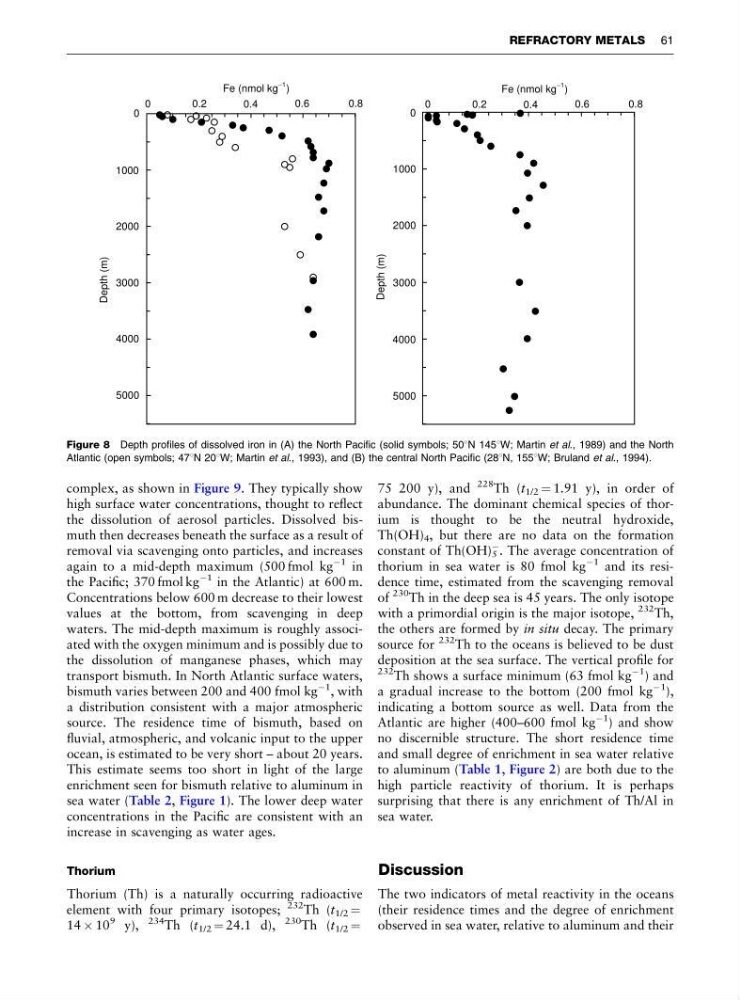
Figure 8 Depth profiles of dissolved iron in (A) the North Pacific (solid symbols; 501N 1451W; Martin et al., 1989) and the North
Atlantic (open symbols; 471N 201W; Martin et al., 1993), and (B) the central North Pacific (281N, 1551W; Bruland et al., 1994).
REFRACTORY METALS 61
high surface water concentrations, thought to reflect
the dissolution of aerosol particles. Dissolved bismuth then decreases beneath the surface as a result of
removal via scavenging onto particles, and increases
again to a mid-depth maximum (500 fmol kg
À1 in
the Pacific; 370 fmol kg
À1 in the Atlantic) at 600 m.
Concentrations below 600 m decrease to their lowest
values at the bottom, from scavenging in deep
waters. The mid-depth maximum is roughly associated with the oxygen minimum and is possibly due to
the dissolution of manganese phases, which may
transport bismuth. In North Atlantic surface waters,
bismuth varies between 200 and 400 fmol kg
À1
, with
a distribution consistent with a major atmospheric
source. The residence time of bismuth, based on
fluvial, atmospheric, and volcanic input to the upper
ocean, is estimated to be very short – about 20 years.
This estimate seems too short in light of the large
enrichment seen for bismuth relative to aluminum in
sea water (Table 2, Figure 1). The lower deep water
concentrations in the Pacific are consistent with an
increase in scavenging as water ages.
Thorium
Thorium (Th) is a naturally occurring radioactive
element with four primary isotopes;
232 Th (t 1/2 ¼
14 Â 10
9 y),
234 Th (t 1/2 ¼ 24.1 d),
230 Th (t 1/2 ¼
75 200 y), and
228 Th (t 1/2 ¼ 1.91 y), in order of
abundance. The dominant chemical species of thorium is thought to be the neutral hydroxide,
Th(OH) 4 , but there are no data on the formation
constant of Th(OH) 5
À
. The average concentration of
thorium in sea water is 80 fmol kg
À1 and its residence time, estimated from the scavenging removal
of
230 Th in the deep sea is 45 years. The only isotope
with a primordial origin is the major isotope,
232 Th,
the others are formed by in situ decay. The primary
source for
232 Th to the oceans is believed to be dust
deposition at the sea surface. The vertical profile for
232 Th shows a surface minimum (63 fmol kg
À1
) and
a gradual increase to the bottom (200 fmol kg
À1
),
indicating a bottom source as well. Data from the
Atlantic are higher (400–600 fmol kg
À1
) and show
no discernible structure. The short residence time
and small degree of enrichment in sea water relative
to aluminum (Table 1, Figure 2) are both due to the
high particle reactivity of thorium. It is perhaps
surprising that there is any enrichment of Th/Al in
sea water.
Discussion
The two indicators of metal reactivity in the oceans
(their residence times and the degree of enrichment
observed in sea water, relative to aluminum and their
0
1000
2000
3000
4000
5000
0.2
0.4
0.6
0.8
Fe (nmol kg
_ 1 )
Depth (m)
0
1000
2000
3000
4000
5000
Depth (m)
0
0.2
0.4
0.6
0.8
Fe (nmol kg
_ 1 )
0
Figure 8 Depth profiles of dissolved iron in (A) the North Pacific (solid symbols; 501N 1451W; Martin et al., 1989) and the North
Atlantic (open symbols; 471N 201W; Martin et al., 1993), and (B) the central North Pacific (281N, 1551W; Bruland et al., 1994).
REFRACTORY METALS 61