

It is also clear that eolian and riverine sources
alone are insufficient to yield such short residence
times and there must be additional sources of REEs
in the ocean. The most likely candidate of the potential REE source is remineralization of nearshore,
coastal and shelf sediments as described earlier. The
magnitude of this remineralization flux required to
balance each REE in the ocean is given in Table 3.
Those fluxes are quite large particularly for the light
REEs, whereas the relative importance of remineralization decreases and becomes somewhat comparable with the sum of eolian and riverine inputs for
the heavy REEs. This REE fractionation during
remineralization on the shelf may contribute the
different NPDW-normalized REE patterns observed
in the surface waters (Figure 9), although the mechanism is not well understood.
Summary and Conclusion
Although the oceanic distributions of rare earth
elements somewhat resemble those of nutrients, their
behaviors are clearly different in that they are not
actively taken up by photoplankton but passively
scavenged by particles. Elemental reactivity with
suspended particles, which controls, together with
sinking of particle aggregates, the mean oceanic
residence times of not only REEs but also a number
of other heavy metals, is best understood by the
competitive complexation reactions of dissolved
REEs with ligands on the surface of particles and in
solution. This yields the progressive enrichment from
the light to the heavy REEs in the shale-normalized
pattern as commonly observed in seawater. Remineralization of REEs from coastal and shelf sediments is thought to play a significant role in the
global budget of REEs and the geochemical and
isotopic consistency of Nd in the ocean. The REEs
and Nd isotopes provide novel and unique oceanographic tracers or chemical problems in studying
(1) particle scavenging processes, (2) redox sensitive
geochemical processes with Ce, and (3) identification
and modification of water masses. Applications to
the wider problems are being explored.
See also
River Inputs. Tracers of Ocean Productivity.
Further Reading
Alibo DS and Nozaki Y (1999) Rare earth elements in
seawater: particle association, shale-normalization, and
Ce oxidation. Geochimica et Cosmochimica Acta 63:
363--372.
90°N
60°N
30°N
0°
30°S
90°S
60°S
0°
60°E
120°E
180°
120°W
60°W
_ 6.0
_ 19.8
_ 9.7
_ 9.3
_ 10.0
_ 14.5
_ 7.0
_ 10.9
_ 9.9
_ 9.7
_ 11.2
_ 11.4
_ 10.6
_ 4.8
_ 5.2
_ 3.2
_ 0.1
_ 6.4
_ 8.7
_ 9.5
_ 10.2
_ 4.0
_ 4.1
_ 4.1
_ 5.6
_ 7.5
_ 11.4
_ 9.9
_ 10.4
_ 7.0
_ 5.5
_ 4.6
_ 3.9
_ 1.5
+0.3
_ 17.7
_ 9.1
_ 23.4
_ 23.1
_ 17.0
_ 17.9
_ 15.4
_ 17.1
_ 26.1
_ 9.9
_ 9.5
_ 9.6
_ 11.8
_ 12.0
_ 12.2
_ 11.4
_ 10.5
_ 11.2
_ 10.3
_ 10.7
_ 10.4
_ 8.7
Nd value in the surface water
0°
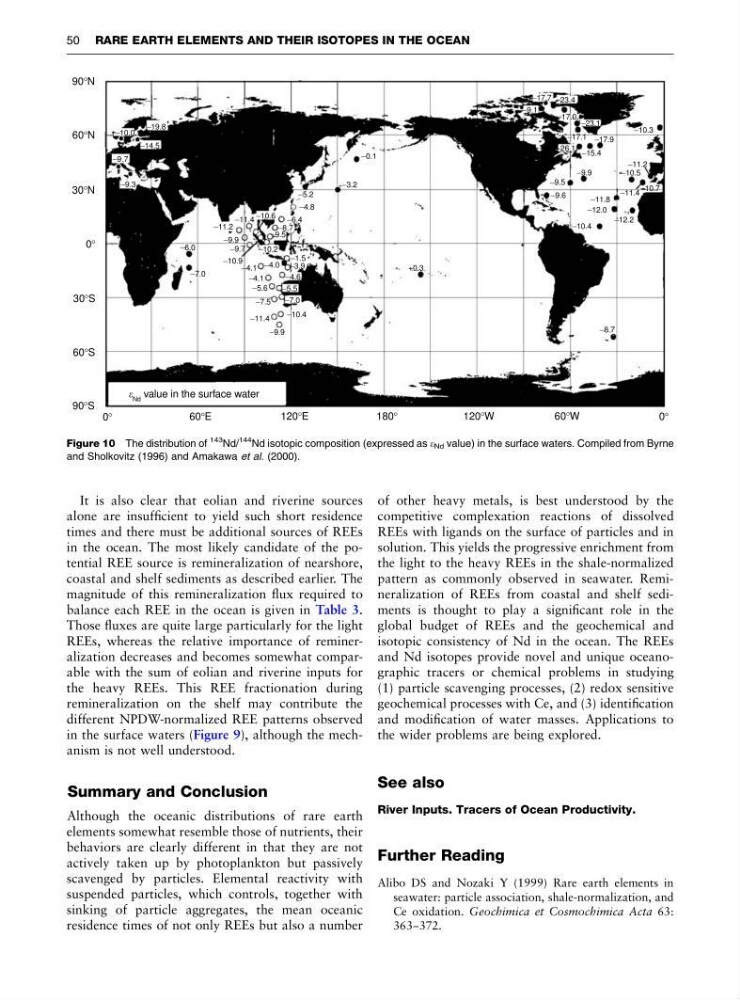
Figure 10 The distribution of
143 Nd/
144 Nd isotopic composition (expressed as e Nd value) in the surface waters. Compiled from Byrne
and Sholkovitz (1996) and Amakawa et al. (2000).
50 RARE EARTH ELEMENTS AND THEIR ISOTOPES IN THE OCEAN
alone are insufficient to yield such short residence
times and there must be additional sources of REEs
in the ocean. The most likely candidate of the potential REE source is remineralization of nearshore,
coastal and shelf sediments as described earlier. The
magnitude of this remineralization flux required to
balance each REE in the ocean is given in Table 3.
Those fluxes are quite large particularly for the light
REEs, whereas the relative importance of remineralization decreases and becomes somewhat comparable with the sum of eolian and riverine inputs for
the heavy REEs. This REE fractionation during
remineralization on the shelf may contribute the
different NPDW-normalized REE patterns observed
in the surface waters (Figure 9), although the mechanism is not well understood.
Summary and Conclusion
Although the oceanic distributions of rare earth
elements somewhat resemble those of nutrients, their
behaviors are clearly different in that they are not
actively taken up by photoplankton but passively
scavenged by particles. Elemental reactivity with
suspended particles, which controls, together with
sinking of particle aggregates, the mean oceanic
residence times of not only REEs but also a number
of other heavy metals, is best understood by the
competitive complexation reactions of dissolved
REEs with ligands on the surface of particles and in
solution. This yields the progressive enrichment from
the light to the heavy REEs in the shale-normalized
pattern as commonly observed in seawater. Remineralization of REEs from coastal and shelf sediments is thought to play a significant role in the
global budget of REEs and the geochemical and
isotopic consistency of Nd in the ocean. The REEs
and Nd isotopes provide novel and unique oceanographic tracers or chemical problems in studying
(1) particle scavenging processes, (2) redox sensitive
geochemical processes with Ce, and (3) identification
and modification of water masses. Applications to
the wider problems are being explored.
See also
River Inputs. Tracers of Ocean Productivity.
Further Reading
Alibo DS and Nozaki Y (1999) Rare earth elements in
seawater: particle association, shale-normalization, and
Ce oxidation. Geochimica et Cosmochimica Acta 63:
363--372.
90°N
60°N
30°N
0°
30°S
90°S
60°S
0°
60°E
120°E
180°
120°W
60°W
_ 6.0
_ 19.8
_ 9.7
_ 9.3
_ 10.0
_ 14.5
_ 7.0
_ 10.9
_ 9.9
_ 9.7
_ 11.2
_ 11.4
_ 10.6
_ 4.8
_ 5.2
_ 3.2
_ 0.1
_ 6.4
_ 8.7
_ 9.5
_ 10.2
_ 4.0
_ 4.1
_ 4.1
_ 5.6
_ 7.5
_ 11.4
_ 9.9
_ 10.4
_ 7.0
_ 5.5
_ 4.6
_ 3.9
_ 1.5
+0.3
_ 17.7
_ 9.1
_ 23.4
_ 23.1
_ 17.0
_ 17.9
_ 15.4
_ 17.1
_ 26.1
_ 9.9
_ 9.5
_ 9.6
_ 11.8
_ 12.0
_ 12.2
_ 11.4
_ 10.5
_ 11.2
_ 10.3
_ 10.7
_ 10.4
_ 8.7
Nd value in the surface water
0°
Figure 10 The distribution of
143 Nd/
144 Nd isotopic composition (expressed as e Nd value) in the surface waters. Compiled from Byrne
and Sholkovitz (1996) and Amakawa et al. (2000).
50 RARE EARTH ELEMENTS AND THEIR ISOTOPES IN THE OCEAN