

The principal source of dissolved CO is the abiotic
photodegradation of dissolved organic matter (DOM)
by UV-R, and CO represents one of the major photoproducts of DOM in the ocean. Quantum yields for
CO are highest in the UV-B range (280–315 nm) and
decrease with increasing wavelengths. However, the
UV-A (315–390 nm) and blue portion of the visible
spectrum contribute to marine CO production as a
greater proportion of radiation at these wavelengths
reaches the Earth’s surface. Humics represent approximately half of the DOM and account for the
majority of the chromophoric dissolved organic
matter (CDOM), the colored portion of dissolved
organic matter that absorbs light energy. The CO
photoproduction potential of humics is dependent
upon the degree of aromaticity. Terrestrial humics are
characterized by an increased prevalence of phenolic
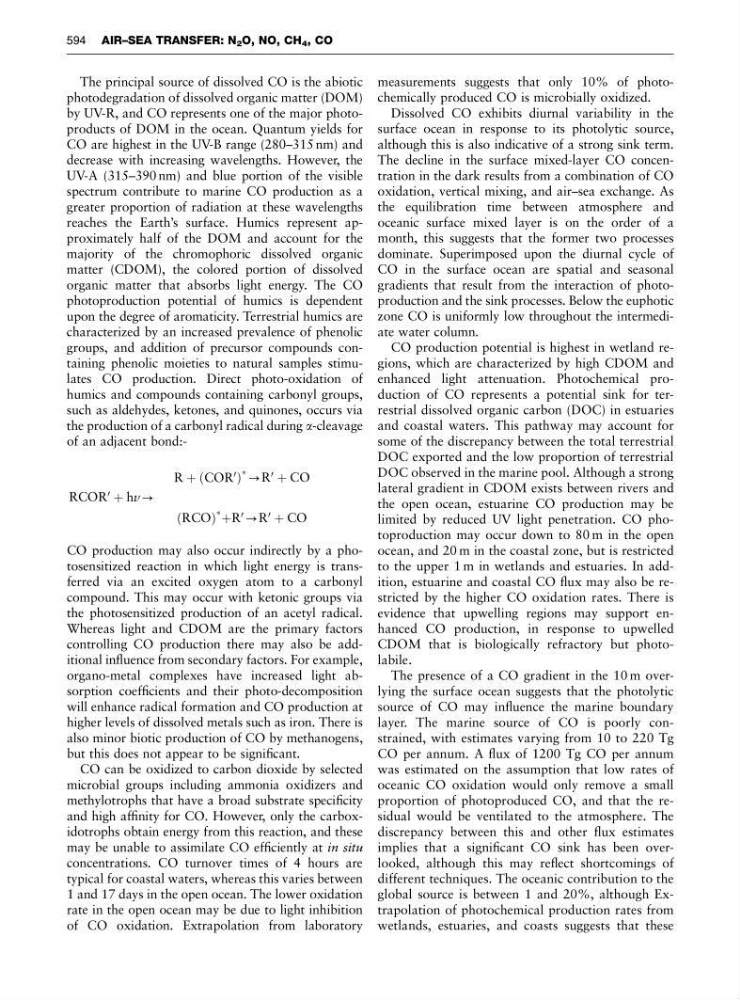
groups, and addition of precursor compounds containing phenolic moieties to natural samples stimulates CO production. Direct photo-oxidation of
humics and compounds containing carbonyl groups,
such as aldehydes, ketones, and quinones, occurs via
the production of a carbonyl radical during a-cleavage
of an adjacent bond:R þ COR
0
ð
Þ
à -R
0 þ CO
RCOR
0 þ hvRCO
ð
Þ
à þR
0
-R
0 þ CO
CO production may also occur indirectly by a photosensitized reaction in which light energy is transferred via an excited oxygen atom to a carbonyl
compound. This may occur with ketonic groups via
the photosensitized production of an acetyl radical.
Whereas light and CDOM are the primary factors
controlling CO production there may also be additional influence from secondary factors. For example,
organo-metal complexes have increased light absorption coefficients and their photo-decomposition
will enhance radical formation and CO production at
higher levels of dissolved metals such as iron. There is
also minor biotic production of CO by methanogens,
but this does not appear to be significant.
CO can be oxidized to carbon dioxide by selected
microbial groups including ammonia oxidizers and
methylotrophs that have a broad substrate specificity
and high affinity for CO. However, only the carboxidotrophs obtain energy from this reaction, and these
may be unable to assimilate CO efficiently at in situ
concentrations. CO turnover times of 4 hours are
typical for coastal waters, whereas this varies between
1 and 17 days in the open ocean. The lower oxidation
rate in the open ocean may be due to light inhibition
of CO oxidation. Extrapolation from laboratory
measurements suggests that only 10% of photochemically produced CO is microbially oxidized.
Dissolved CO exhibits diurnal variability in the
surface ocean in response to its photolytic source,
although this is also indicative of a strong sink term.
The decline in the surface mixed-layer CO concentration in the dark results from a combination of CO
oxidation, vertical mixing, and air–sea exchange. As
the equilibration time between atmosphere and
oceanic surface mixed layer is on the order of a
month, this suggests that the former two processes
dominate. Superimposed upon the diurnal cycle of
CO in the surface ocean are spatial and seasonal
gradients that result from the interaction of photoproduction and the sink processes. Below the euphotic
zone CO is uniformly low throughout the intermediate water column.
CO production potential is highest in wetland regions, which are characterized by high CDOM and
enhanced light attenuation. Photochemical production of CO represents a potential sink for terrestrial dissolved organic carbon (DOC) in estuaries
and coastal waters. This pathway may account for
some of the discrepancy between the total terrestrial
DOC exported and the low proportion of terrestrial
DOC observed in the marine pool. Although a strong
lateral gradient in CDOM exists between rivers and
the open ocean, estuarine CO production may be
limited by reduced UV light penetration. CO photoproduction may occur down to 80 m in the open
ocean, and 20 m in the coastal zone, but is restricted
to the upper 1 m in wetlands and estuaries. In addition, estuarine and coastal CO flux may also be restricted by the higher CO oxidation rates. There is
evidence that upwelling regions may support enhanced CO production, in response to upwelled
CDOM that is biologically refractory but photolabile.
The presence of a CO gradient in the 10 m overlying the surface ocean suggests that the photolytic
source of CO may influence the marine boundary
layer. The marine source of CO is poorly constrained, with estimates varying from 10 to 220 Tg
CO per annum. A flux of 1200 Tg CO per annum
was estimated on the assumption that low rates of
oceanic CO oxidation would only remove a small
proportion of photoproduced CO, and that the residual would be ventilated to the atmosphere. The
discrepancy between this and other flux estimates
implies that a significant CO sink has been overlooked, although this may reflect shortcomings of
different techniques. The oceanic contribution to the
global source is between 1 and 20%, although Extrapolation of photochemical production rates from
wetlands, estuaries, and coasts suggests that these
594 AIR–SEA TRANSFER: N 2 O, NO, CH 4 , CO