

CH 4 production is characteristic of regions with
high input of labile organic carbon such as wetlands
and sediments, but is usually restricted to below the
zone of sulfate depletion. The oceanic CH 4 source is
dominated by coastal regions, which exhibit high
CH 4 fluxes as a result of bubble ebullition from anoxic carbon-rich sediments, and also riverine and
estuarine input. Some seasonality may result in
temperate regions due to increased methanogenesis
at higher temperatures. The predominant water column source in shelf seas and the open ocean is CH 4
production at the base of the euphotic zone. This
may arise from lateral advection from sedimentary
sources, and in situ CH 4 production. The latter is
accomplished by oxygen-tolerant methanogens that
utilize methylamines or methylated sulfur compounds in anoxic microsites within detrital particles
and the guts of zooplankton and fish. Lateral advection and in situ production may be greater in
upwelling regions, as suggested by the increased
CH 4 supersaturation in surface waters in these regions. Oceanic CH 4 concentration profiles generally
exhibit a decrease below 250 m due to oxidation.
Methanogenesis is elevated in anoxic water columns,
although these are not significant sources of atmospheric CH 4 due to limited ventilation and high oxidation rates. Other sources include CH 4 seeps in
shelf regions from which CH 4 is transferred directly
to the atmosphere by bubble ebullition, although
their contribution is difficult to quantify. Abiotic
CH 4 originating from high-temperature fluids at
hydrothermal vents also elevates CH 4 in the deep
and intermediate waters in the locality of oceanic
ridges. A significant proportion is oxidized and although the contribution to the atmospheric CH 4
pool may be significant in localized regions this
has yet to be constrained. Hydrates are crystalline
solids in which methane gas is trapped within a
cage of water molecules. These form at high pressures and low temperatures in seafloor sediments
generally at depths below 500 m. Although CH 4 release from hydrates is only considered from anthropogenic activities in current budgets, there is
evidence of catastrophic releases in the geological
past due to temperature-induced hydrate dissociation. Although oceanic hydrate reservoirs contain
14 000 Gt CH 4 , there is currently no evidence of
significant warming of deep waters which would preempt release.
Other aquatic systems such as rivers and wetlands
are more important sources than the marine environment. Shelf regions are the dominant source of
CH 4 from the ocean (14(11–18) Tg CH 4 per annum),
accounting for 75% of the ocean flux (Table 2). The
ocean is not a major contributor to the atmospheric
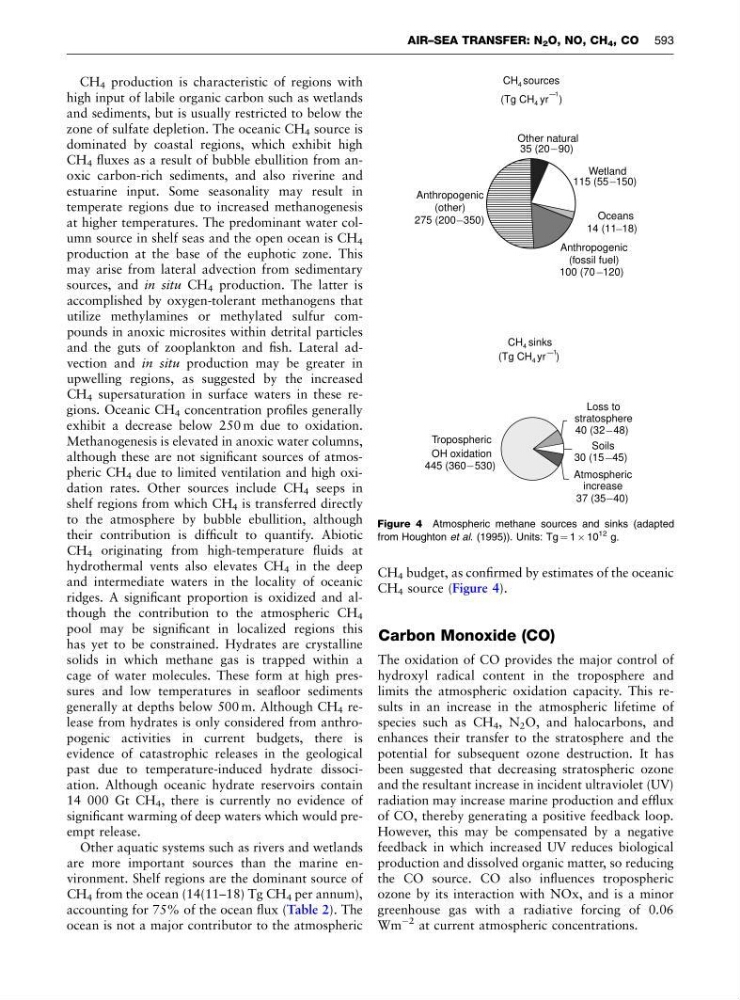
CH 4 budget, as confirmed by estimates of the oceanic
CH 4 source (Figure 4).
Carbon Monoxide (CO)
The oxidation of CO provides the major control of
hydroxyl radical content in the troposphere and
limits the atmospheric oxidation capacity. This results in an increase in the atmospheric lifetime of
species such as CH 4 , N 2 O, and halocarbons, and
enhances their transfer to the stratosphere and the
potential for subsequent ozone destruction. It has
been suggested that decreasing stratospheric ozone
and the resultant increase in incident ultraviolet (UV)
radiation may increase marine production and efflux
of CO, thereby generating a positive feedback loop.
However, this may be compensated by a negative
feedback in which increased UV reduces biological
production and dissolved organic matter, so reducing
the CO source. CO also influences tropospheric
ozone by its interaction with NOx, and is a minor
greenhouse gas with a radiative forcing of 0.06
Wm
À2 at current atmospheric concentrations.
Other natural
35 (20 _ 90)
Wetland
115 (55 _ 150)
Anthropogenic
(fossil fuel)
100 (70 _ 120)
Tropospheric
OH oxidation
445 (360 _ 530)
CH sinks
(Tg CH yr
_
)
4
4
1
Loss to
stratosphere
40 (32 _ 48)
Soils
30 (15 _ 45)
Atmospheric
increase
37 (35 _ 40)
CH sources
4
Anthropogenic
(other)
275 (200 _ 350)
Oceans
14 (11 _ 18)
(Tg CH yr
_
)
4
1
Figure 4 Atmospheric methane sources and sinks (adapted
from Houghton et al. (1995)). Units: Tg ¼ 1 Â 10
12 g.
AIR–SEA TRANSFER: N 2 O, NO, CH 4 , CO 593