

As with N 2 O, NO may also be produced as a byproduct or intermediate of denitrification and nitrification (Figure 1). NO production by soils is better
characterized than in marine systems, and is significant both in terms of nitrogen loss and the global
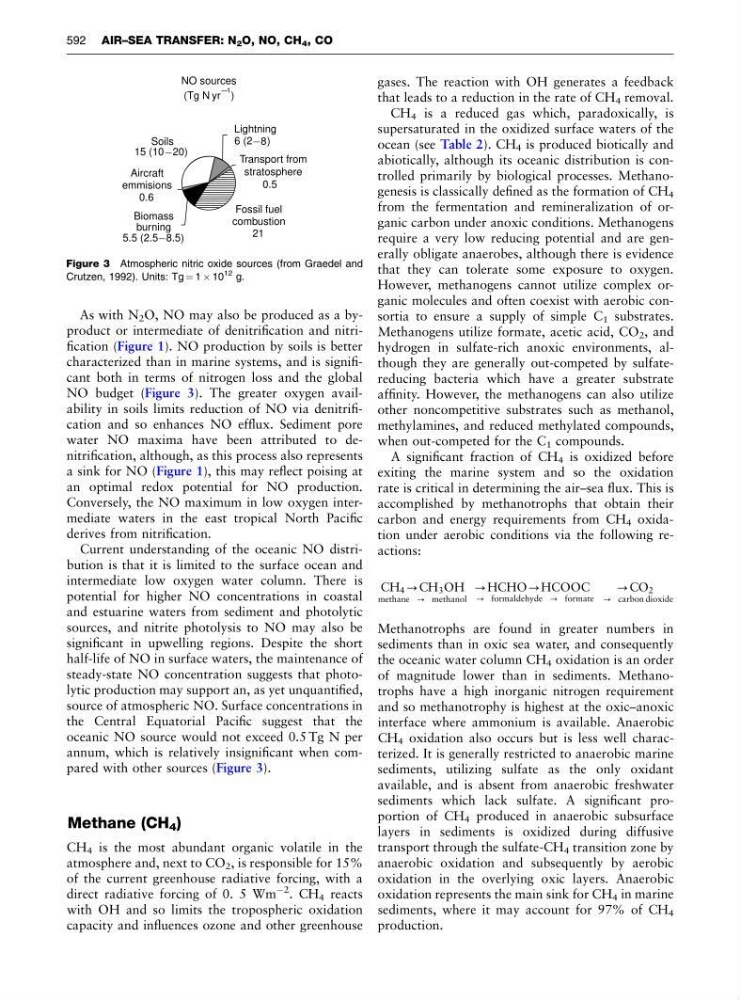
NO budget (Figure 3). The greater oxygen availability in soils limits reduction of NO via denitrification and so enhances NO efflux. Sediment pore
water NO maxima have been attributed to denitrification, although, as this process also represents
a sink for NO (Figure 1), this may reflect poising at
an optimal redox potential for NO production.
Conversely, the NO maximum in low oxygen intermediate waters in the east tropical North Pacific
derives from nitrification.
Current understanding of the oceanic NO distribution is that it is limited to the surface ocean and
intermediate low oxygen water column. There is
potential for higher NO concentrations in coastal
and estuarine waters from sediment and photolytic
sources, and nitrite photolysis to NO may also be
significant in upwelling regions. Despite the short
half-life of NO in surface waters, the maintenance of
steady-state NO concentration suggests that photolytic production may support an, as yet unquantified,
source of atmospheric NO. Surface concentrations in
the Central Equatorial Pacific suggest that the
oceanic NO source would not exceed 0.5 Tg N per
annum, which is relatively insignificant when compared with other sources (Figure 3).
Methane (CH 4 )
CH 4 is the most abundant organic volatile in the
atmosphere and, next to CO 2 , is responsible for 15%
of the current greenhouse radiative forcing, with a
direct radiative forcing of 0. 5 Wm
À2
. CH 4 reacts
with OH and so limits the tropospheric oxidation
capacity and influences ozone and other greenhouse
gases. The reaction with OH generates a feedback
that leads to a reduction in the rate of CH 4 removal.
CH 4 is a reduced gas which, paradoxically, is
supersaturated in the oxidized surface waters of the
ocean (see Table 2). CH 4 is produced biotically and
abiotically, although its oceanic distribution is controlled primarily by biological processes. Methanogenesis is classically defined as the formation of CH 4
from the fermentation and remineralization of organic carbon under anoxic conditions. Methanogens
require a very low reducing potential and are generally obligate anaerobes, although there is evidence
that they can tolerate some exposure to oxygen.
However, methanogens cannot utilize complex organic molecules and often coexist with aerobic consortia to ensure a supply of simple C 1 substrates.
Methanogens utilize formate, acetic acid, CO 2 , and
hydrogen in sulfate-rich anoxic environments, although they are generally out-competed by sulfatereducing bacteria which have a greater substrate
affinity. However, the methanogens can also utilize
other noncompetitive substrates such as methanol,
methylamines, and reduced methylated compounds,
when out-competed for the C 1 compounds.
A significant fraction of CH 4 is oxidized before
exiting the marine system and so the oxidation
rate is critical in determining the air–sea flux. This is
accomplished by methanotrophs that obtain their
carbon and energy requirements from CH 4 oxidation under aerobic conditions via the following reactions:
CH 4 -CH 3 OH
methane - methanol
-HCHO-HCOOC
- formaldehyde - formate
-CO 2
- carbon dioxide
Methanotrophs are found in greater numbers in
sediments than in oxic sea water, and consequently
the oceanic water column CH 4 oxidation is an order
of magnitude lower than in sediments. Methanotrophs have a high inorganic nitrogen requirement
and so methanotrophy is highest at the oxic–anoxic
interface where ammonium is available. Anaerobic
CH 4 oxidation also occurs but is less well characterized. It is generally restricted to anaerobic marine
sediments, utilizing sulfate as the only oxidant
available, and is absent from anaerobic freshwater
sediments which lack sulfate. A significant proportion of CH 4 produced in anaerobic subsurface
layers in sediments is oxidized during diffusive
transport through the sulfate-CH 4 transition zone by
anaerobic oxidation and subsequently by aerobic
oxidation in the overlying oxic layers. Anaerobic
oxidation represents the main sink for CH 4 in marine
sediments, where it may account for 97% of CH 4
production.
(Tg N yr
_
)
1
Lightning
6 (2 _ 8)
Transport from
stratosphere
0.5
Fossil fuel
combustion
21
Biomass
burning
5.5 (2.5 _ 8.5)
Aircraft
emmisions
0.6
Soils
15 (10 _ 20)
NO sources
Figure 3 Atmospheric nitric oxide sources (from Graedel and
Crutzen, 1992). Units: Tg ¼ 1 Â 10
12 g.
592 AIR–SEA TRANSFER: N 2 O, NO, CH 4 , CO