

Particle Reactivity and Mean Oceanic
Residence Times of REEs
The major process that removes dissolved REEs from
the water column is considered to be adsorptive
scavenging by sinking particulate matter (Figure 5)
which controls the distributions of not only REEs but
also a number of reactive elements in the ocean.
Some elements can also be removed by lateral
transport along with currents and subsequent intensified particle scavenging and/or uptake at the sediment–water interface of the oceanic margins. This,
‘boundary scavenging’ is known to occur for
210 Pb
and
231 Pa, but this mechanism is probably insignificant for dissolved REEs. The vertical profiles of
dissolved REEs (Figure 3) strongly suggest that they
are involved in the oceanic biogeochemical cycle.
Marine particulate matter comprises biogenic organic matter, opaline silica, and carbonates as well as
inorganic oxides and terrestrial detritus. The biogenic particles are produced in the surface water and
transported by settling to the deep water and the
seafloor where they are largely remineralized to the
water. Despite a rough similarity in the vertical
profile between the REEs and dissolved Si or alkalinity, however, active processes such as biological
uptake and incorporation of REEs into calcareous
and opaline skeletons do not seem to play any
important role in this respect. For instance, the REE
concentrations of shells are extremely low. Also, it is
unlikely that the dissolved REEs are actively taken
up into organic tissues.
Adsorptive scavenging of reactive metals has been
clearly demonstrated, since some short-lived radionuclides such as
234 Th,
210 Po and
210
Pb are highly
enriched in particulate matter collected by filtration
and sediment traps. The scavenging processes of reactive metals may be governed by competitive reactions between binding affinity onto the particle
surfaces and complex formation with ligands in
seawater (Figure 5). Although marine particles are
composed of various materials, their surfaces are
thought to be coated with organic matter and oxides
of manganese and iron. The fine suspended particles,
that can be conventionally collected by filtration,
predominate in the surface area onto which reactive
metals are adsorbed and the standing stock of mass.
In contrast, the large, fast sinking particles, that can
be effectively collected by a sediment trap, virtually
govern the vertical flux of materials. Those particles
however, are frequently exchanged through aggregation and disaggregation during sinking through the
water column. Since the vertical transport of particulate matter to the sedimentary sink is a process
common to all associated elements, the overall rate
of removal from the ocean for metals such as the
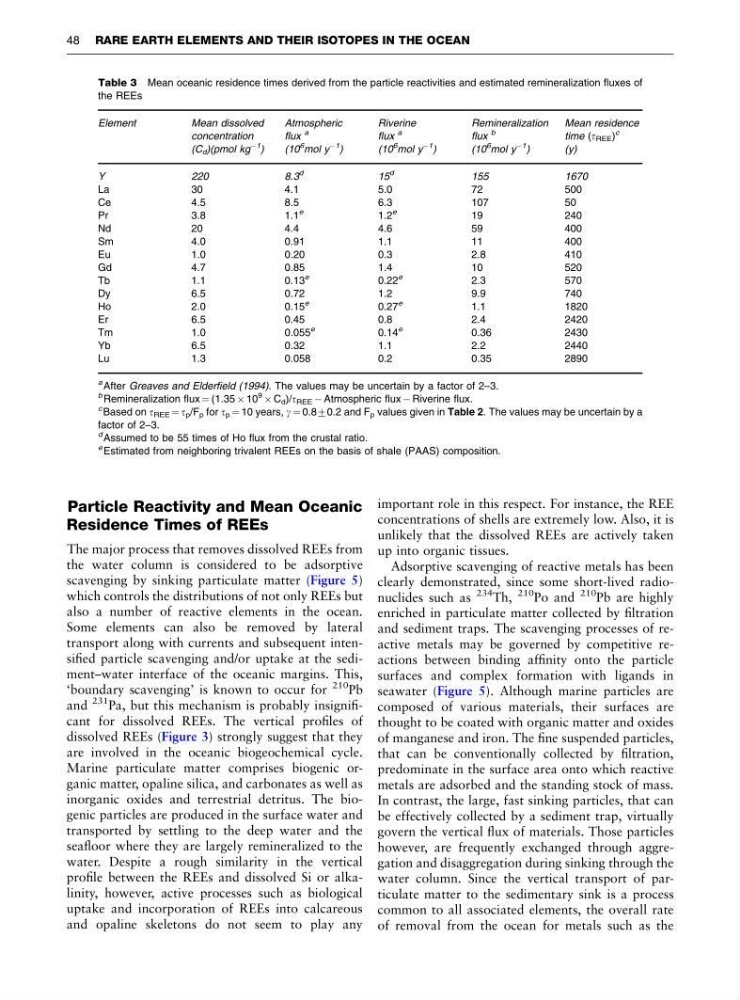
Table 3 Mean oceanic residence times derived from the particle reactivities and estimated remineralization fluxes of
the REEs
Element
Mean dissolved
concentration
(C d )(pmol kg
À1
)
Atmospheric
flux
a
(10
6 mol y
À1
)
Riverine
flux
a
(10
6 mol y
À1 )
Remineralization
flux
b
(10
6
mol y
À1 )
Mean residence
time (t REE )
c
(y)
Y
220
8.3
d
15
d
155
1670
La
30
4.1
5.0
72
500
Ce
4.5
8.5
6.3
107
50
Pr
3.8
1.1
e
1.2
e
19
240
Nd
20
4.4
4.6
59
400
Sm
4.0
0.91
1.1
11
400
Eu
1.0
0.20
0.3
2.8
410
Gd
4.7
0.85
1.4
10
520
Tb
1.1
0.13
e
0.22
e
2.3
570
Dy
6.5
0.72
1.2
9.9
740
Ho
2.0
0.15
e
0.27
e
1.1
1820
Er
6.5
0.45
0.8
2.4
2420
Tm
1.0
0.055
e
0.14
e
0.36
2430
Yb
6.5
0.32
1.1
2.2
2440
Lu
1.3
0.058
0.2
0.35
2890
a After Greaves and Elderfield (1994). The values may be uncertain by a factor of 2–3.
b Remineralization flux ¼ (1.35 Â 10
9 Â C d )/t REE À Atmospheric flux À Riverine flux.
c Based on t REE ¼ t p /F p for t p ¼ 10 years, g ¼ 0.870.2 and F p values given in Table 2. The values may be uncertain by a
factor of 2–3.
d Assumed to be 55 times of Ho flux from the crustal ratio.
e Estimated from neighboring trivalent REEs on the basis of shale (PAAS) composition.
48 RARE EARTH ELEMENTS AND THEIR ISOTOPES IN THE OCEAN
Residence Times of REEs
The major process that removes dissolved REEs from
the water column is considered to be adsorptive
scavenging by sinking particulate matter (Figure 5)
which controls the distributions of not only REEs but
also a number of reactive elements in the ocean.
Some elements can also be removed by lateral
transport along with currents and subsequent intensified particle scavenging and/or uptake at the sediment–water interface of the oceanic margins. This,
‘boundary scavenging’ is known to occur for
210 Pb
and
231 Pa, but this mechanism is probably insignificant for dissolved REEs. The vertical profiles of
dissolved REEs (Figure 3) strongly suggest that they
are involved in the oceanic biogeochemical cycle.
Marine particulate matter comprises biogenic organic matter, opaline silica, and carbonates as well as
inorganic oxides and terrestrial detritus. The biogenic particles are produced in the surface water and
transported by settling to the deep water and the
seafloor where they are largely remineralized to the
water. Despite a rough similarity in the vertical
profile between the REEs and dissolved Si or alkalinity, however, active processes such as biological
uptake and incorporation of REEs into calcareous
and opaline skeletons do not seem to play any
important role in this respect. For instance, the REE
concentrations of shells are extremely low. Also, it is
unlikely that the dissolved REEs are actively taken
up into organic tissues.
Adsorptive scavenging of reactive metals has been
clearly demonstrated, since some short-lived radionuclides such as
234 Th,
210 Po and
210
Pb are highly
enriched in particulate matter collected by filtration
and sediment traps. The scavenging processes of reactive metals may be governed by competitive reactions between binding affinity onto the particle
surfaces and complex formation with ligands in
seawater (Figure 5). Although marine particles are
composed of various materials, their surfaces are
thought to be coated with organic matter and oxides
of manganese and iron. The fine suspended particles,
that can be conventionally collected by filtration,
predominate in the surface area onto which reactive
metals are adsorbed and the standing stock of mass.
In contrast, the large, fast sinking particles, that can
be effectively collected by a sediment trap, virtually
govern the vertical flux of materials. Those particles
however, are frequently exchanged through aggregation and disaggregation during sinking through the
water column. Since the vertical transport of particulate matter to the sedimentary sink is a process
common to all associated elements, the overall rate
of removal from the ocean for metals such as the
Table 3 Mean oceanic residence times derived from the particle reactivities and estimated remineralization fluxes of
the REEs
Element
Mean dissolved
concentration
(C d )(pmol kg
À1
)
Atmospheric
flux
a
(10
6 mol y
À1
)
Riverine
flux
a
(10
6 mol y
À1 )
Remineralization
flux
b
(10
6
mol y
À1 )
Mean residence
time (t REE )
c
(y)
Y
220
8.3
d
15
d
155
1670
La
30
4.1
5.0
72
500
Ce
4.5
8.5
6.3
107
50
Pr
3.8
1.1
e
1.2
e
19
240
Nd
20
4.4
4.6
59
400
Sm
4.0
0.91
1.1
11
400
Eu
1.0
0.20
0.3
2.8
410
Gd
4.7
0.85
1.4
10
520
Tb
1.1
0.13
e
0.22
e
2.3
570
Dy
6.5
0.72
1.2
9.9
740
Ho
2.0
0.15
e
0.27
e
1.1
1820
Er
6.5
0.45
0.8
2.4
2420
Tm
1.0
0.055
e
0.14
e
0.36
2430
Yb
6.5
0.32
1.1
2.2
2440
Lu
1.3
0.058
0.2
0.35
2890
a After Greaves and Elderfield (1994). The values may be uncertain by a factor of 2–3.
b Remineralization flux ¼ (1.35 Â 10
9 Â C d )/t REE À Atmospheric flux À Riverine flux.
c Based on t REE ¼ t p /F p for t p ¼ 10 years, g ¼ 0.870.2 and F p values given in Table 2. The values may be uncertain by a
factor of 2–3.
d Assumed to be 55 times of Ho flux from the crustal ratio.
e Estimated from neighboring trivalent REEs on the basis of shale (PAAS) composition.
48 RARE EARTH ELEMENTS AND THEIR ISOTOPES IN THE OCEAN