

potential for a larger oceanic dissolved phosphate
inventory could have been realized due to the reduced importance of sequestering with ferric oxyhydroxides. This iron–phosphorus–oxygen coupling
produces a negative feedback, which may have kept
atmospheric O 2 within equable levels throughout the
Phanerozoic. Thus, it is in the oceans that the role of
phosphorus as limiting nutrient has the greatest repercussions for the global carbon and oxygen cycles.
Summary
The global cycle of phosphorus is truly a biogeochemical cycle, owing to the involvement of phosphorus in both biochemical and geochemical reactions
and pathways. There have been marked advances in
the last decade on numerous fronts of phosphorus
research, resulting from application of new methods
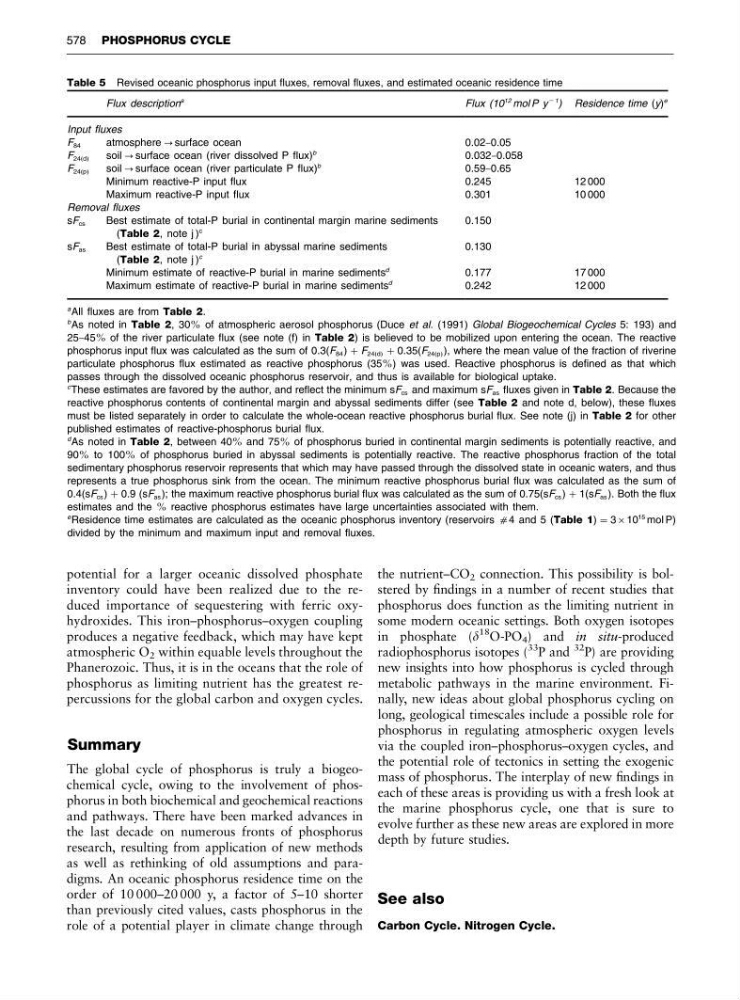
as well as rethinking of old assumptions and paradigms. An oceanic phosphorus residence time on the
order of 10 000–20 000 y, a factor of 5–10 shorter
than previously cited values, casts phosphorus in the
role of a potential player in climate change through
the nutrient–CO 2 connection. This possibility is bolstered by findings in a number of recent studies that
phosphorus does function as the limiting nutrient in
some modern oceanic settings. Both oxygen isotopes
in phosphate (d
18
O-PO 4 ) and in situ-produced
radiophosphorus isotopes (
33
P and
32
P) are providing
new insights into how phosphorus is cycled through
metabolic pathways in the marine environment. Finally, new ideas about global phosphorus cycling on
long, geological timescales include a possible role for
phosphorus in regulating atmospheric oxygen levels
via the coupled iron–phosphorus–oxygen cycles, and
the potential role of tectonics in setting the exogenic
mass of phosphorus. The interplay of new findings in
each of these areas is providing us with a fresh look at
the marine phosphorus cycle, one that is sure to
evolve further as these new areas are explored in more
depth by future studies.
See also
Carbon Cycle. Nitrogen Cycle.
Table 5 Revised oceanic phosphorus input fluxes, removal fluxes, and estimated oceanic residence time
578 PHOSPHORUS CYCLE