

particles is consistent with the inference that deep
particles are the breakdown products of material
exported from the surface, and that bacteria preferentially remineralize low-d
15 N PN.
Isotopic analysis of zooplankton and organisms at
higher trophic levels can provide insights into the
marine N cycle. The ‘trophic effect’, an observed
B3% increase in d
15
N per trophic level that presumably results from isotopic discrimination during
metabolism of N-bearing organic matter, is used
widely in food-web studies. N isotopic analysis of
specific amino acids within organisms and organic
matter promises new insights, as some amino acids
increase in d
15 N with trophic level while others
preserve the d
15 N of the food source.
Sinking particulate Nitrogen and sedimentary
Nitrogen Because vertical sinking is an important
mode of N export from the surface ocean, the d
15 N
of the sinking flux is one of the most valuable N
isotopic constraints on modern ocean processes.
Combined with other isotopic data, sinking flux
d
15 N data can provide information on the routes
and mechanisms of nitrate supply and can be used
to constrain other sources of N to the surface. The
sinking flux also transfers the isotopic signal from
the surface ocean to the seafloor, providing the link
through which the sediment column records the
history of surface ocean processes (Figure 7(c)).
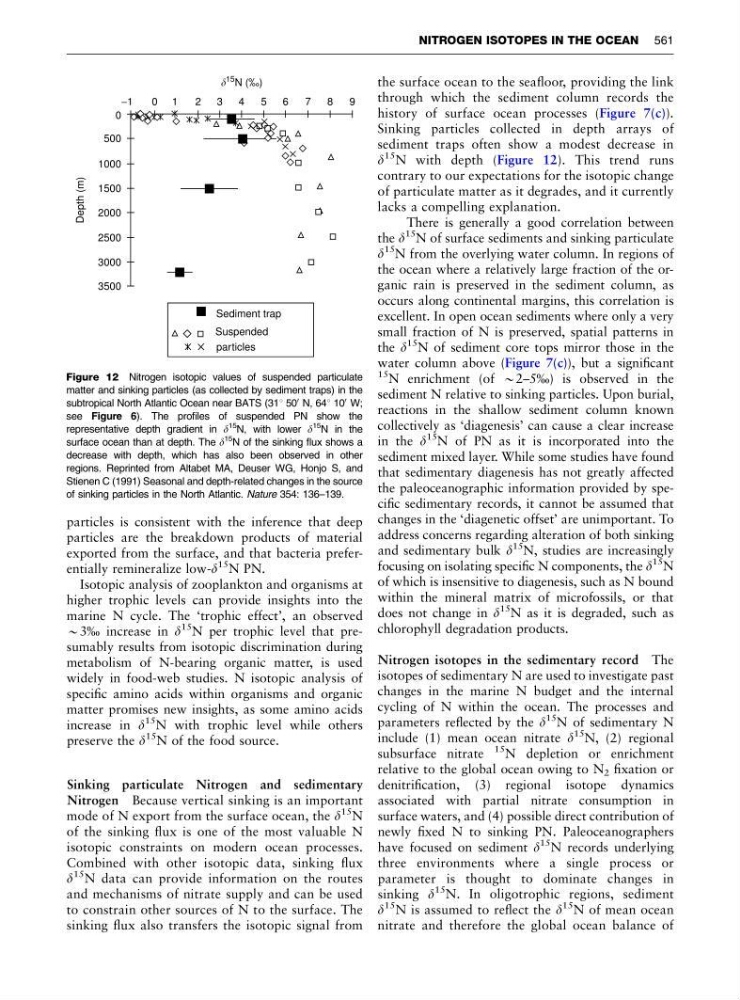
Sinking particles collected in depth arrays of
sediment traps often show a modest decrease in
d
15 N with depth (Figure 12). This trend runs
contrary to our expectations for the isotopic change
of particulate matter as it degrades, and it currently
lacks a compelling explanation.
There is generally a good correlation between
the d
15
N of surface sediments and sinking particulate
d
15
N from the overlying water column. In regions of
the ocean where a relatively large fraction of the organic rain is preserved in the sediment column, as
occurs along continental margins, this correlation is
excellent. In open ocean sediments where only a very
small fraction of N is preserved, spatial patterns in
the d
15
N of sediment core tops mirror those in the
water column above (Figure 7(c)), but a significant
15
N enrichment (of B2–5%) is observed in the
sediment N relative to sinking particles. Upon burial,
reactions in the shallow sediment column known
collectively as ‘diagenesis’ can cause a clear increase
in the d
15
N of PN as it is incorporated into the
sediment mixed layer. While some studies have found
that sedimentary diagenesis has not greatly affected
the paleoceanographic information provided by specific sedimentary records, it cannot be assumed that
changes in the ‘diagenetic offset’ are unimportant. To
address concerns regarding alteration of both sinking
and sedimentary bulk d
15
N, studies are increasingly
focusing on isolating specific N components, the d
15
N
of which is insensitive to diagenesis, such as N bound
within the mineral matrix of microfossils, or that
does not change in d
15
N as it is degraded, such as
chlorophyll degradation products.
Nitrogen isotopes in the sedimentary record The
isotopes of sedimentary N are used to investigate past
changes in the marine N budget and the internal
cycling of N within the ocean. The processes and
parameters reflected by the d
15
N of sedimentary N
include (1) mean ocean nitrate d
15
N, (2) regional
subsurface nitrate
15
N depletion or enrichment
relative to the global ocean owing to N 2 fixation or
denitrification, (3) regional isotope dynamics
associated with partial nitrate consumption in
surface waters, and (4) possible direct contribution of
newly fixed N to sinking PN. Paleoceanographers
have focused on sediment d
15 N records underlying
three environments where a single process or
parameter is thought to dominate changes in
sinking d
15 N. In oligotrophic regions, sediment
d
15 N is assumed to reflect the d
15 N of mean ocean
nitrate and therefore the global ocean balance of
9
8
7
6
5
4
3
2
1
0
−1
Sediment trap
Suspended
particles
3500
3000
2500
2000
Depth (m)
1500
1000
500
0
15 N (‰)
Figure 12 Nitrogen isotopic values of suspended particulate
matter and sinking particles (as collected by sediment traps) in the
subtropical North Atlantic Ocean near BATS (311 50
0 N, 641 10
0 W;
see Figure 6). The profiles of suspended PN show the
representative depth gradient in d
15
N, with lower d
15
N in the
surface ocean than at depth. The d
15
N of the sinking flux shows a
decrease with depth, which has also been observed in other
regions. Reprinted from Altabet MA, Deuser WG, Honjo S, and
Stienen C (1991) Seasonal and depth-related changes in the source
of sinking particles in the North Atlantic. Nature 354: 136–139.
NITROGEN ISOTOPES IN THE OCEAN 561
particles are the breakdown products of material
exported from the surface, and that bacteria preferentially remineralize low-d
15 N PN.
Isotopic analysis of zooplankton and organisms at
higher trophic levels can provide insights into the
marine N cycle. The ‘trophic effect’, an observed
B3% increase in d
15
N per trophic level that presumably results from isotopic discrimination during
metabolism of N-bearing organic matter, is used
widely in food-web studies. N isotopic analysis of
specific amino acids within organisms and organic
matter promises new insights, as some amino acids
increase in d
15 N with trophic level while others
preserve the d
15 N of the food source.
Sinking particulate Nitrogen and sedimentary
Nitrogen Because vertical sinking is an important
mode of N export from the surface ocean, the d
15 N
of the sinking flux is one of the most valuable N
isotopic constraints on modern ocean processes.
Combined with other isotopic data, sinking flux
d
15 N data can provide information on the routes
and mechanisms of nitrate supply and can be used
to constrain other sources of N to the surface. The
sinking flux also transfers the isotopic signal from
the surface ocean to the seafloor, providing the link
through which the sediment column records the
history of surface ocean processes (Figure 7(c)).
Sinking particles collected in depth arrays of
sediment traps often show a modest decrease in
d
15 N with depth (Figure 12). This trend runs
contrary to our expectations for the isotopic change
of particulate matter as it degrades, and it currently
lacks a compelling explanation.
There is generally a good correlation between
the d
15
N of surface sediments and sinking particulate
d
15
N from the overlying water column. In regions of
the ocean where a relatively large fraction of the organic rain is preserved in the sediment column, as
occurs along continental margins, this correlation is
excellent. In open ocean sediments where only a very
small fraction of N is preserved, spatial patterns in
the d
15
N of sediment core tops mirror those in the
water column above (Figure 7(c)), but a significant
15
N enrichment (of B2–5%) is observed in the
sediment N relative to sinking particles. Upon burial,
reactions in the shallow sediment column known
collectively as ‘diagenesis’ can cause a clear increase
in the d
15
N of PN as it is incorporated into the
sediment mixed layer. While some studies have found
that sedimentary diagenesis has not greatly affected
the paleoceanographic information provided by specific sedimentary records, it cannot be assumed that
changes in the ‘diagenetic offset’ are unimportant. To
address concerns regarding alteration of both sinking
and sedimentary bulk d
15
N, studies are increasingly
focusing on isolating specific N components, the d
15
N
of which is insensitive to diagenesis, such as N bound
within the mineral matrix of microfossils, or that
does not change in d
15
N as it is degraded, such as
chlorophyll degradation products.
Nitrogen isotopes in the sedimentary record The
isotopes of sedimentary N are used to investigate past
changes in the marine N budget and the internal
cycling of N within the ocean. The processes and
parameters reflected by the d
15
N of sedimentary N
include (1) mean ocean nitrate d
15
N, (2) regional
subsurface nitrate
15
N depletion or enrichment
relative to the global ocean owing to N 2 fixation or
denitrification, (3) regional isotope dynamics
associated with partial nitrate consumption in
surface waters, and (4) possible direct contribution of
newly fixed N to sinking PN. Paleoceanographers
have focused on sediment d
15 N records underlying
three environments where a single process or
parameter is thought to dominate changes in
sinking d
15 N. In oligotrophic regions, sediment
d
15 N is assumed to reflect the d
15 N of mean ocean
nitrate and therefore the global ocean balance of
9
8
7
6
5
4
3
2
1
0
−1
Sediment trap
Suspended
particles
3500
3000
2500
2000
Depth (m)
1500
1000
500
0
15 N (‰)
Figure 12 Nitrogen isotopic values of suspended particulate
matter and sinking particles (as collected by sediment traps) in the
subtropical North Atlantic Ocean near BATS (311 50
0 N, 641 10
0 W;
see Figure 6). The profiles of suspended PN show the
representative depth gradient in d
15
N, with lower d
15
N in the
surface ocean than at depth. The d
15
N of the sinking flux shows a
decrease with depth, which has also been observed in other
regions. Reprinted from Altabet MA, Deuser WG, Honjo S, and
Stienen C (1991) Seasonal and depth-related changes in the source
of sinking particles in the North Atlantic. Nature 354: 136–139.
NITROGEN ISOTOPES IN THE OCEAN 561