

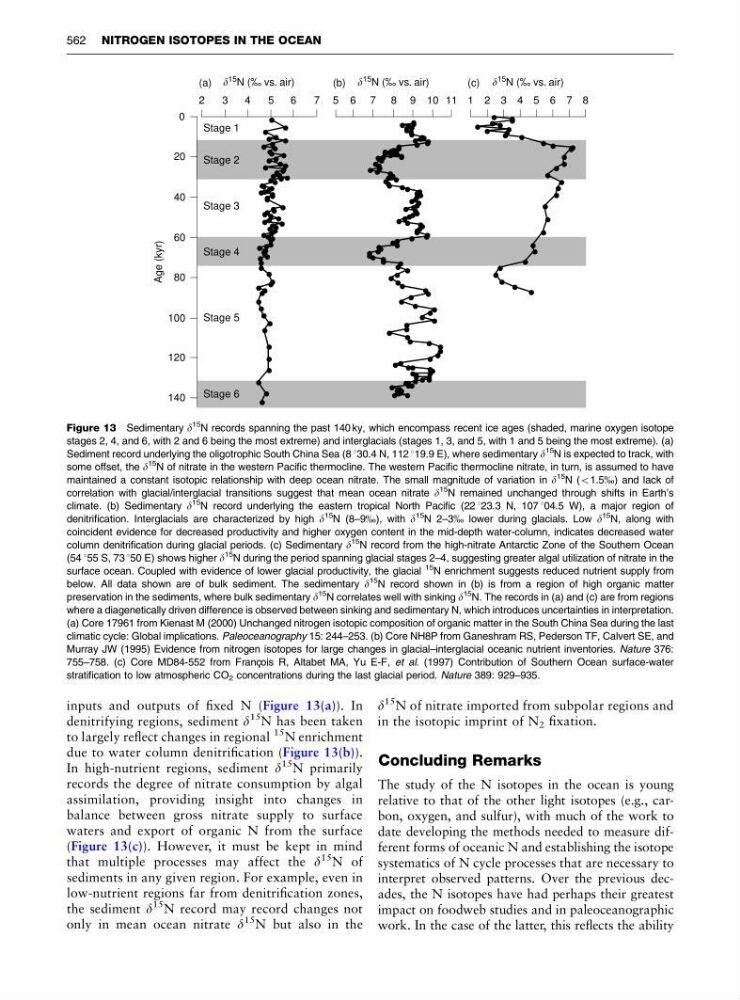
inputs and outputs of fixed N (Figure 13(a)). In
denitrifying regions, sediment d
15 N has been taken
to largely reflect changes in regional
15 N enrichment
due to water column denitrification (Figure 13(b)).
In high-nutrient regions, sediment d
15 N primarily
records the degree of nitrate consumption by algal
assimilation, providing insight into changes in
balance between gross nitrate supply to surface
waters and export of organic N from the surface
(Figure 13(c)). However, it must be kept in mind
that multiple processes may affect the d
15 N of
sediments in any given region. For example, even in
low-nutrient regions far from denitrification zones,
the sediment d
15 N record may record changes not
only in mean ocean nitrate d
15 N but also in the
d
15 N of nitrate imported from subpolar regions and
in the isotopic imprint of N 2 fixation.
Concluding Remarks
The study of the N isotopes in the ocean is young
relative to that of the other light isotopes (e.g., carbon, oxygen, and sulfur), with much of the work to
date developing the methods needed to measure different forms of oceanic N and establishing the isotope
systematics of N cycle processes that are necessary to
interpret observed patterns. Over the previous decades, the N isotopes have had perhaps their greatest
impact on foodweb studies and in paleoceanographic
work. In the case of the latter, this reflects the ability
Stage 2
Stage 4
Stage 1
Stage 3
Stage 5
Stage 6
140
120
100
80
60
40
20
0
11
10
9
8
7
6
5
15 N (‰ vs. air)
7
6
5
4
3
2
15 N (‰ vs. air)
8
7
6
5
4
3
2
1
15 N (‰ vs. air)
Age (kyr)
(a)
(b)
(c)
Figure 13 Sedimentary d
15
N records spanning the past 140 ky, which encompass recent ice ages (shaded, marine oxygen isotope
stages 2, 4, and 6, with 2 and 6 being the most extreme) and interglacials (stages 1, 3, and 5, with 1 and 5 being the most extreme). (a)
Sediment record underlying the oligotrophic South China Sea (8 130.4 N, 112 119.9 E), where sedimentary d
15
N is expected to track, with
some offset, the d
15
N of nitrate in the western Pacific thermocline. The western Pacific thermocline nitrate, in turn, is assumed to have
maintained a constant isotopic relationship with deep ocean nitrate. The small magnitude of variation in d
15
N (o1.5%) and lack of
correlation with glacial/interglacial transitions suggest that mean ocean nitrate d
15
N remained unchanged through shifts in Earth’s
climate. (b) Sedimentary d
15
N record underlying the eastern tropical North Pacific (22 123.3 N, 107 104.5 W), a major region of
denitrification. Interglacials are characterized by high d
15
N (8–9%), with d
15
N 2–3% lower during glacials. Low d
15
N, along with
coincident evidence for decreased productivity and higher oxygen content in the mid-depth water-column, indicates decreased water
column denitrification during glacial periods. (c) Sedimentary d
15
N record from the high-nitrate Antarctic Zone of the Southern Ocean
(54 155 S, 73 150 E) shows higher d
15
N during the period spanning glacial stages 2–4, suggesting greater algal utilization of nitrate in the
surface ocean. Coupled with evidence of lower glacial productivity, the glacial
15
N enrichment suggests reduced nutrient supply from
below. All data shown are of bulk sediment. The sedimentary d
15
N record shown in (b) is from a region of high organic matter
preservation in the sediments, where bulk sedimentary d
15
N correlates well with sinking d
15
N. The records in (a) and (c) are from regions
where a diagenetically driven difference is observed between sinking and sedimentary N, which introduces uncertainties in interpretation.
(a) Core 17961 from Kienast M (2000) Unchanged nitrogen isotopic composition of organic matter in the South China Sea during the last
climatic cycle: Global implications. Paleoceanography 15: 244–253. (b) Core NH8P from Ganeshram RS, Pederson TF, Calvert SE, and
Murray JW (1995) Evidence from nitrogen isotopes for large changes in glacial–interglacial oceanic nutrient inventories. Nature 376:
755–758. (c) Core MD84-552 from Franc¸ ois R, Altabet MA, Yu E-F, et al. (1997) Contribution of Southern Ocean surface-water
stratification to low atmospheric CO 2 concentrations during the last glacial period. Nature 389: 929–935.
562 NITROGEN ISOTOPES IN THE OCEAN
denitrifying regions, sediment d
15 N has been taken
to largely reflect changes in regional
15 N enrichment
due to water column denitrification (Figure 13(b)).
In high-nutrient regions, sediment d
15 N primarily
records the degree of nitrate consumption by algal
assimilation, providing insight into changes in
balance between gross nitrate supply to surface
waters and export of organic N from the surface
(Figure 13(c)). However, it must be kept in mind
that multiple processes may affect the d
15 N of
sediments in any given region. For example, even in
low-nutrient regions far from denitrification zones,
the sediment d
15 N record may record changes not
only in mean ocean nitrate d
15 N but also in the
d
15 N of nitrate imported from subpolar regions and
in the isotopic imprint of N 2 fixation.
Concluding Remarks
The study of the N isotopes in the ocean is young
relative to that of the other light isotopes (e.g., carbon, oxygen, and sulfur), with much of the work to
date developing the methods needed to measure different forms of oceanic N and establishing the isotope
systematics of N cycle processes that are necessary to
interpret observed patterns. Over the previous decades, the N isotopes have had perhaps their greatest
impact on foodweb studies and in paleoceanographic
work. In the case of the latter, this reflects the ability
Stage 2
Stage 4
Stage 1
Stage 3
Stage 5
Stage 6
140
120
100
80
60
40
20
0
11
10
9
8
7
6
5
15 N (‰ vs. air)
7
6
5
4
3
2
15 N (‰ vs. air)
8
7
6
5
4
3
2
1
15 N (‰ vs. air)
Age (kyr)
(a)
(b)
(c)
Figure 13 Sedimentary d
15
N records spanning the past 140 ky, which encompass recent ice ages (shaded, marine oxygen isotope
stages 2, 4, and 6, with 2 and 6 being the most extreme) and interglacials (stages 1, 3, and 5, with 1 and 5 being the most extreme). (a)
Sediment record underlying the oligotrophic South China Sea (8 130.4 N, 112 119.9 E), where sedimentary d
15
N is expected to track, with
some offset, the d
15
N of nitrate in the western Pacific thermocline. The western Pacific thermocline nitrate, in turn, is assumed to have
maintained a constant isotopic relationship with deep ocean nitrate. The small magnitude of variation in d
15
N (o1.5%) and lack of
correlation with glacial/interglacial transitions suggest that mean ocean nitrate d
15
N remained unchanged through shifts in Earth’s
climate. (b) Sedimentary d
15
N record underlying the eastern tropical North Pacific (22 123.3 N, 107 104.5 W), a major region of
denitrification. Interglacials are characterized by high d
15
N (8–9%), with d
15
N 2–3% lower during glacials. Low d
15
N, along with
coincident evidence for decreased productivity and higher oxygen content in the mid-depth water-column, indicates decreased water
column denitrification during glacial periods. (c) Sedimentary d
15
N record from the high-nitrate Antarctic Zone of the Southern Ocean
(54 155 S, 73 150 E) shows higher d
15
N during the period spanning glacial stages 2–4, suggesting greater algal utilization of nitrate in the
surface ocean. Coupled with evidence of lower glacial productivity, the glacial
15
N enrichment suggests reduced nutrient supply from
below. All data shown are of bulk sediment. The sedimentary d
15
N record shown in (b) is from a region of high organic matter
preservation in the sediments, where bulk sedimentary d
15
N correlates well with sinking d
15
N. The records in (a) and (c) are from regions
where a diagenetically driven difference is observed between sinking and sedimentary N, which introduces uncertainties in interpretation.
(a) Core 17961 from Kienast M (2000) Unchanged nitrogen isotopic composition of organic matter in the South China Sea during the last
climatic cycle: Global implications. Paleoceanography 15: 244–253. (b) Core NH8P from Ganeshram RS, Pederson TF, Calvert SE, and
Murray JW (1995) Evidence from nitrogen isotopes for large changes in glacial–interglacial oceanic nutrient inventories. Nature 376:
755–758. (c) Core MD84-552 from Franc¸ ois R, Altabet MA, Yu E-F, et al. (1997) Contribution of Southern Ocean surface-water
stratification to low atmospheric CO 2 concentrations during the last glacial period. Nature 389: 929–935.
562 NITROGEN ISOTOPES IN THE OCEAN