

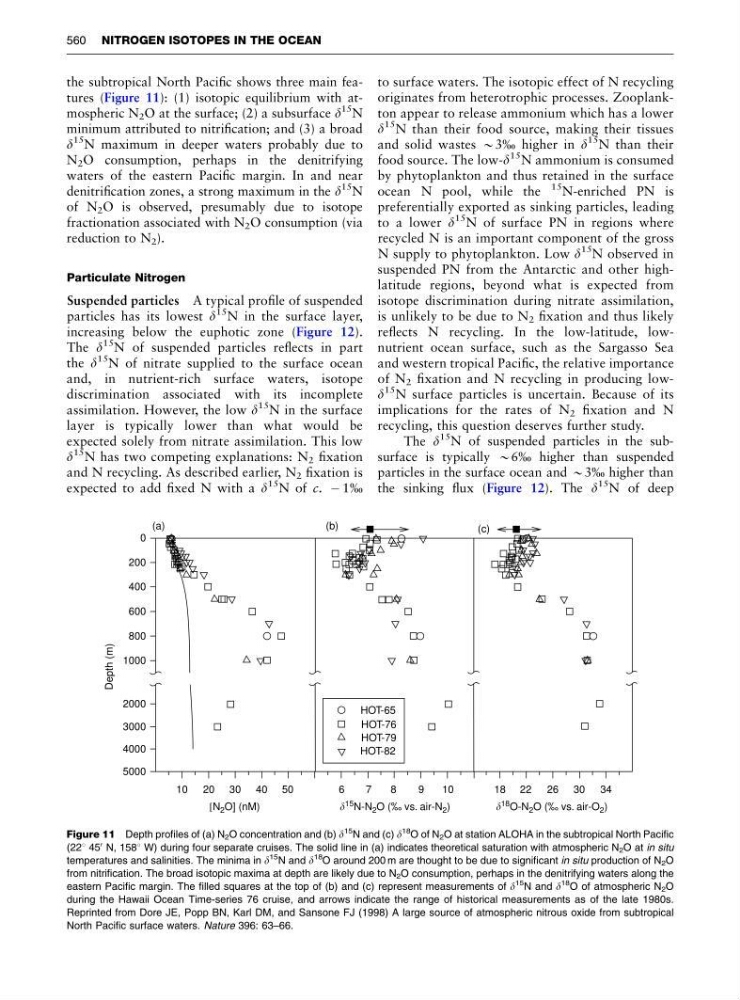
the subtropical North Pacific shows three main features (Figure 11): (1) isotopic equilibrium with atmospheric N 2 O at the surface; (2) a subsurface d
15 N
minimum attributed to nitrification; and (3) a broad
d
15 N maximum in deeper waters probably due to
N 2 O consumption, perhaps in the denitrifying
waters of the eastern Pacific margin. In and near
denitrification zones, a strong maximum in the d
15 N
of N 2 O is observed, presumably due to isotope
fractionation associated with N 2 O consumption (via
reduction to N 2 ).
Particulate Nitrogen
Suspended particles A typical profile of suspended
particles has its lowest d
15 N in the surface layer,
increasing below the euphotic zone (Figure 12).
The d
15 N of suspended particles reflects in part
the d
15 N of nitrate supplied to the surface ocean
and, in nutrient-rich surface waters, isotope
discrimination associated with its incomplete
assimilation. However, the low d
15 N in the surface
layer is typically lower than what would be
expected solely from nitrate assimilation. This low
d
15 N has two competing explanations: N 2 fixation
and N recycling. As described earlier, N 2 fixation is
expected to add fixed N with a d
15 N of c. À 1%
to surface waters. The isotopic effect of N recycling
originates from heterotrophic processes. Zooplankton appear to release ammonium which has a lower
d
15 N than their food source, making their tissues
and solid wastes B3% higher in d
15 N than their
food source. The low-d
15 N ammonium is consumed
by phytoplankton and thus retained in the surface
ocean N pool, while the
15 N-enriched PN is
preferentially exported as sinking particles, leading
to a lower d
15 N of surface PN in regions where
recycled N is an important component of the gross
N supply to phytoplankton. Low d
15 N observed in
suspended PN from the Antarctic and other highlatitude regions, beyond what is expected from
isotope discrimination during nitrate assimilation,
is unlikely to be due to N 2 fixation and thus likely
reflects N recycling. In the low-latitude, lownutrient ocean surface, such as the Sargasso Sea
and western tropical Pacific, the relative importance
of N 2 fixation and N recycling in producing lowd
15 N surface particles is uncertain. Because of its
implications for the rates of N 2 fixation and N
recycling, this question deserves further study.
The d
15
N of suspended particles in the subsurface is typically B6% higher than suspended
particles in the surface ocean and B3% higher than
the sinking flux (Figure 12). The d
15 N of deep
0
200
400
600
800
1000
Depth (m)
2000
3000
4000
5000
10 20 30 40 50
6
7
8
9
10
18 22 26 30 34
HOT-65
HOT-76
HOT-79
HOT-82
15 N-N 2 O (‰ vs. air-N 2 )
18 O-N 2 O (‰ vs. air-O 2 )
[N 2 O] (nM)
(a)
(b)
(c)
Figure 11 Depth profiles of (a) N 2 O concentration and (b) d
15 N and (c) d
18
O of N 2 O at station ALOHA in the subtropical North Pacific
(221 45
0 N, 1581 W) during four separate cruises. The solid line in (a) indicates theoretical saturation with atmospheric N 2 O at in situ
temperatures and salinities. The minima in d
15 N and d
18
O around 200 m are thought to be due to significant in situ production of N 2 O
from nitrification. The broad isotopic maxima at depth are likely due to N 2 O consumption, perhaps in the denitrifying waters along the
eastern Pacific margin. The filled squares at the top of (b) and (c) represent measurements of d
15 N and d
18 O of atmospheric N 2 O
during the Hawaii Ocean Time-series 76 cruise, and arrows indicate the range of historical measurements as of the late 1980s.
Reprinted from Dore JE, Popp BN, Karl DM, and Sansone FJ (1998) A large source of atmospheric nitrous oxide from subtropical
North Pacific surface waters. Nature 396: 63–66.
560 NITROGEN ISOTOPES IN THE OCEAN
15 N
minimum attributed to nitrification; and (3) a broad
d
15 N maximum in deeper waters probably due to
N 2 O consumption, perhaps in the denitrifying
waters of the eastern Pacific margin. In and near
denitrification zones, a strong maximum in the d
15 N
of N 2 O is observed, presumably due to isotope
fractionation associated with N 2 O consumption (via
reduction to N 2 ).
Particulate Nitrogen
Suspended particles A typical profile of suspended
particles has its lowest d
15 N in the surface layer,
increasing below the euphotic zone (Figure 12).
The d
15 N of suspended particles reflects in part
the d
15 N of nitrate supplied to the surface ocean
and, in nutrient-rich surface waters, isotope
discrimination associated with its incomplete
assimilation. However, the low d
15 N in the surface
layer is typically lower than what would be
expected solely from nitrate assimilation. This low
d
15 N has two competing explanations: N 2 fixation
and N recycling. As described earlier, N 2 fixation is
expected to add fixed N with a d
15 N of c. À 1%
to surface waters. The isotopic effect of N recycling
originates from heterotrophic processes. Zooplankton appear to release ammonium which has a lower
d
15 N than their food source, making their tissues
and solid wastes B3% higher in d
15 N than their
food source. The low-d
15 N ammonium is consumed
by phytoplankton and thus retained in the surface
ocean N pool, while the
15 N-enriched PN is
preferentially exported as sinking particles, leading
to a lower d
15 N of surface PN in regions where
recycled N is an important component of the gross
N supply to phytoplankton. Low d
15 N observed in
suspended PN from the Antarctic and other highlatitude regions, beyond what is expected from
isotope discrimination during nitrate assimilation,
is unlikely to be due to N 2 fixation and thus likely
reflects N recycling. In the low-latitude, lownutrient ocean surface, such as the Sargasso Sea
and western tropical Pacific, the relative importance
of N 2 fixation and N recycling in producing lowd
15 N surface particles is uncertain. Because of its
implications for the rates of N 2 fixation and N
recycling, this question deserves further study.
The d
15
N of suspended particles in the subsurface is typically B6% higher than suspended
particles in the surface ocean and B3% higher than
the sinking flux (Figure 12). The d
15 N of deep
0
200
400
600
800
1000
Depth (m)
2000
3000
4000
5000
10 20 30 40 50
6
7
8
9
10
18 22 26 30 34
HOT-65
HOT-76
HOT-79
HOT-82
15 N-N 2 O (‰ vs. air-N 2 )
18 O-N 2 O (‰ vs. air-O 2 )
[N 2 O] (nM)
(a)
(b)
(c)
Figure 11 Depth profiles of (a) N 2 O concentration and (b) d
15 N and (c) d
18
O of N 2 O at station ALOHA in the subtropical North Pacific
(221 45
0 N, 1581 W) during four separate cruises. The solid line in (a) indicates theoretical saturation with atmospheric N 2 O at in situ
temperatures and salinities. The minima in d
15 N and d
18
O around 200 m are thought to be due to significant in situ production of N 2 O
from nitrification. The broad isotopic maxima at depth are likely due to N 2 O consumption, perhaps in the denitrifying waters along the
eastern Pacific margin. The filled squares at the top of (b) and (c) represent measurements of d
15 N and d
18 O of atmospheric N 2 O
during the Hawaii Ocean Time-series 76 cruise, and arrows indicate the range of historical measurements as of the late 1980s.
Reprinted from Dore JE, Popp BN, Karl DM, and Sansone FJ (1998) A large source of atmospheric nitrous oxide from subtropical
North Pacific surface waters. Nature 396: 63–66.
560 NITROGEN ISOTOPES IN THE OCEAN