

(1) the importance of sedimentary denitrification,
which appears to express a minimal isotope effect;
and (2) the localized nature of water-column denitrification. With regard to the second, because denitrification consumes a significant fraction of the
ambient nitrate in the ocean’s suboxic zones and elevates its d
15
N above that of the mean ocean (Figures 5
and 8), the d
15
N of nitrate being removed by water
column denitrification is higher than if the substrate
for denitrification had the mean ocean d
15
N. Much as
with sedimentary denitrification, this reduces the expression of the organism-level isotope effect of water
column denitrification and thus lowers the mean d
15
N
of nitrate required to achieve an isotope balance between inputs and outputs. With these considerations,
one study estimates that water-column denitrification
is responsible for 30% of fixed N loss from the
modern ocean, with sedimentary denitrification responsible for the remainder. Still, this isotope-based
budget for marine fixed N remains uncertain.
One limitation of using the N isotopes to investigate N cycling in the ocean is their inability to
separate co-occurring processes with competing N
isotopic signatures, such as denitrification/N 2 fixation and nitrate assimilation/nitrification. Coupled
analysis of N and O isotopes in nitrate promises to
disentangle such otherwise overprinting processes.
Culture studies have demonstrated that the two most
important nitrate-consuming processes, nitrate assimilation and denitrification, fractionate the N and
O in nitrate with a ratio close to 1:1 (Figure 10).
Deviations in the ratio of d
18 O and d
15
N in nitrate
from 1:1 can therefore provide information about
the nitrate being added by nitrification, such as if it
derives from newly fixed N or if there is otherwise
undetected nitrate cycling within a water parcel.
Nitrite Nitrite is an intermediate in oxidative and
reductive processes such as nitrification and
denitrification. It also serves as a substrate for
anammox and can be assimilated by phytoplankton.
Only when these processes become uncoupled, such
as at the base of the euphotic zone and in oxygen
minimum zones, does nitrite accumulate to significant levels (0.1–10 mM). In some oxygen-deficient
regions of the water column in the eastern tropical North Pacific, eastern tropical South Pacific,
and the Arabian Sea, nitrite can represent as much
as 25% of the pool of nitrogen oxides (NO 3
À þ
NO 2
À ).
[TON]
[NO 3
−
]
TON
15 N
NO 3
−
15 N
5
4
3
2
(b)
(a)
20
15
10
5
0
0
200
400
Depth (m)
600
800
1000
6
[N] (μM)
15 N (‰ vs. air)
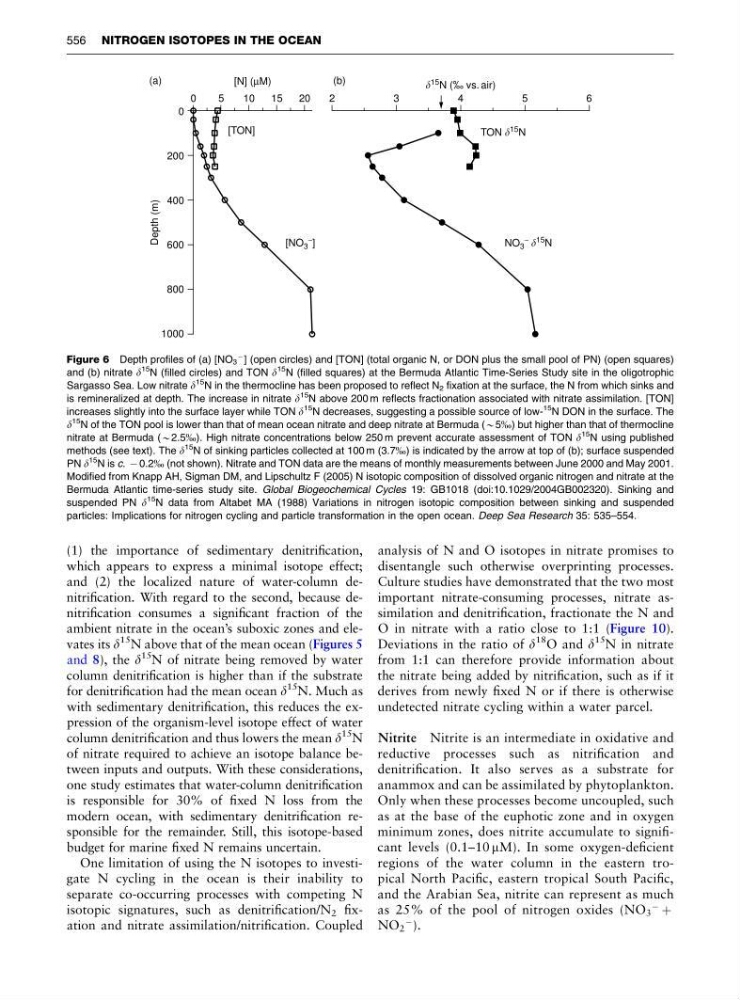
Figure 6 Depth profiles of (a) [NO 3
À ] (open circles) and [TON] (total organic N, or DON plus the small pool of PN) (open squares)
and (b) nitrate d
15
N (filled circles) and TON d
15 N (filled squares) at the Bermuda Atlantic Time-Series Study site in the oligotrophic
Sargasso Sea. Low nitrate d
15 N in the thermocline has been proposed to reflect N 2 fixation at the surface, the N from which sinks and
is remineralized at depth. The increase in nitrate d
15
N above 200 m reflects fractionation associated with nitrate assimilation. [TON]
increases slightly into the surface layer while TON d
15 N decreases, suggesting a possible source of low15 N DON in the surface. The
d
15
N of the TON pool is lower than that of mean ocean nitrate and deep nitrate at Bermuda (B5%) but higher than that of thermocline
nitrate at Bermuda (B2.5%). High nitrate concentrations below 250 m prevent accurate assessment of TON d
15 N using published
methods (see text). The d
15 N of sinking particles collected at 100 m (3.7%) is indicated by the arrow at top of (b); surface suspended
PN d
15 N is c. À 0.2% (not shown). Nitrate and TON data are the means of monthly measurements between June 2000 and May 2001.
Modified from Knapp AH, Sigman DM, and Lipschultz F (2005) N isotopic composition of dissolved organic nitrogen and nitrate at the
Bermuda Atlantic time-series study site. Global Biogeochemical Cycles 19: GB1018 (doi:10.1029/2004GB002320). Sinking and
suspended PN d
15 N data from Altabet MA (1988) Variations in nitrogen isotopic composition between sinking and suspended
particles: Implications for nitrogen cycling and particle transformation in the open ocean. Deep Sea Research 35: 535–554.
556 NITROGEN ISOTOPES IN THE OCEAN
which appears to express a minimal isotope effect;
and (2) the localized nature of water-column denitrification. With regard to the second, because denitrification consumes a significant fraction of the
ambient nitrate in the ocean’s suboxic zones and elevates its d
15
N above that of the mean ocean (Figures 5
and 8), the d
15
N of nitrate being removed by water
column denitrification is higher than if the substrate
for denitrification had the mean ocean d
15
N. Much as
with sedimentary denitrification, this reduces the expression of the organism-level isotope effect of water
column denitrification and thus lowers the mean d
15
N
of nitrate required to achieve an isotope balance between inputs and outputs. With these considerations,
one study estimates that water-column denitrification
is responsible for 30% of fixed N loss from the
modern ocean, with sedimentary denitrification responsible for the remainder. Still, this isotope-based
budget for marine fixed N remains uncertain.
One limitation of using the N isotopes to investigate N cycling in the ocean is their inability to
separate co-occurring processes with competing N
isotopic signatures, such as denitrification/N 2 fixation and nitrate assimilation/nitrification. Coupled
analysis of N and O isotopes in nitrate promises to
disentangle such otherwise overprinting processes.
Culture studies have demonstrated that the two most
important nitrate-consuming processes, nitrate assimilation and denitrification, fractionate the N and
O in nitrate with a ratio close to 1:1 (Figure 10).
Deviations in the ratio of d
18 O and d
15
N in nitrate
from 1:1 can therefore provide information about
the nitrate being added by nitrification, such as if it
derives from newly fixed N or if there is otherwise
undetected nitrate cycling within a water parcel.
Nitrite Nitrite is an intermediate in oxidative and
reductive processes such as nitrification and
denitrification. It also serves as a substrate for
anammox and can be assimilated by phytoplankton.
Only when these processes become uncoupled, such
as at the base of the euphotic zone and in oxygen
minimum zones, does nitrite accumulate to significant levels (0.1–10 mM). In some oxygen-deficient
regions of the water column in the eastern tropical North Pacific, eastern tropical South Pacific,
and the Arabian Sea, nitrite can represent as much
as 25% of the pool of nitrogen oxides (NO 3
À þ
NO 2
À ).
[TON]
[NO 3
−
]
TON
15 N
NO 3
−
15 N
5
4
3
2
(b)
(a)
20
15
10
5
0
0
200
400
Depth (m)
600
800
1000
6
[N] (μM)
15 N (‰ vs. air)
Figure 6 Depth profiles of (a) [NO 3
À ] (open circles) and [TON] (total organic N, or DON plus the small pool of PN) (open squares)
and (b) nitrate d
15
N (filled circles) and TON d
15 N (filled squares) at the Bermuda Atlantic Time-Series Study site in the oligotrophic
Sargasso Sea. Low nitrate d
15 N in the thermocline has been proposed to reflect N 2 fixation at the surface, the N from which sinks and
is remineralized at depth. The increase in nitrate d
15
N above 200 m reflects fractionation associated with nitrate assimilation. [TON]
increases slightly into the surface layer while TON d
15 N decreases, suggesting a possible source of low15 N DON in the surface. The
d
15
N of the TON pool is lower than that of mean ocean nitrate and deep nitrate at Bermuda (B5%) but higher than that of thermocline
nitrate at Bermuda (B2.5%). High nitrate concentrations below 250 m prevent accurate assessment of TON d
15 N using published
methods (see text). The d
15 N of sinking particles collected at 100 m (3.7%) is indicated by the arrow at top of (b); surface suspended
PN d
15 N is c. À 0.2% (not shown). Nitrate and TON data are the means of monthly measurements between June 2000 and May 2001.
Modified from Knapp AH, Sigman DM, and Lipschultz F (2005) N isotopic composition of dissolved organic nitrogen and nitrate at the
Bermuda Atlantic time-series study site. Global Biogeochemical Cycles 19: GB1018 (doi:10.1029/2004GB002320). Sinking and
suspended PN d
15 N data from Altabet MA (1988) Variations in nitrogen isotopic composition between sinking and suspended
particles: Implications for nitrogen cycling and particle transformation in the open ocean. Deep Sea Research 35: 535–554.
556 NITROGEN ISOTOPES IN THE OCEAN