

Outputs
Denitrification, the bacterial reduction of nitrate to
N 2 , is the major mechanism of fixed N loss from the
ocean, occurring both in the water column and in
sediments when the oxygen concentration is low
(o5 mM) (Figure 2). Denitrification strongly discriminates against the heavier isotope,
15 N, progressively enriching the remaining nitrate pool in
15 N
as nitrate consumption proceeds. Culture studies of
denitrifying bacteria suggest (with some exceptions)
an isotope effect of B20–30%, a range supported by
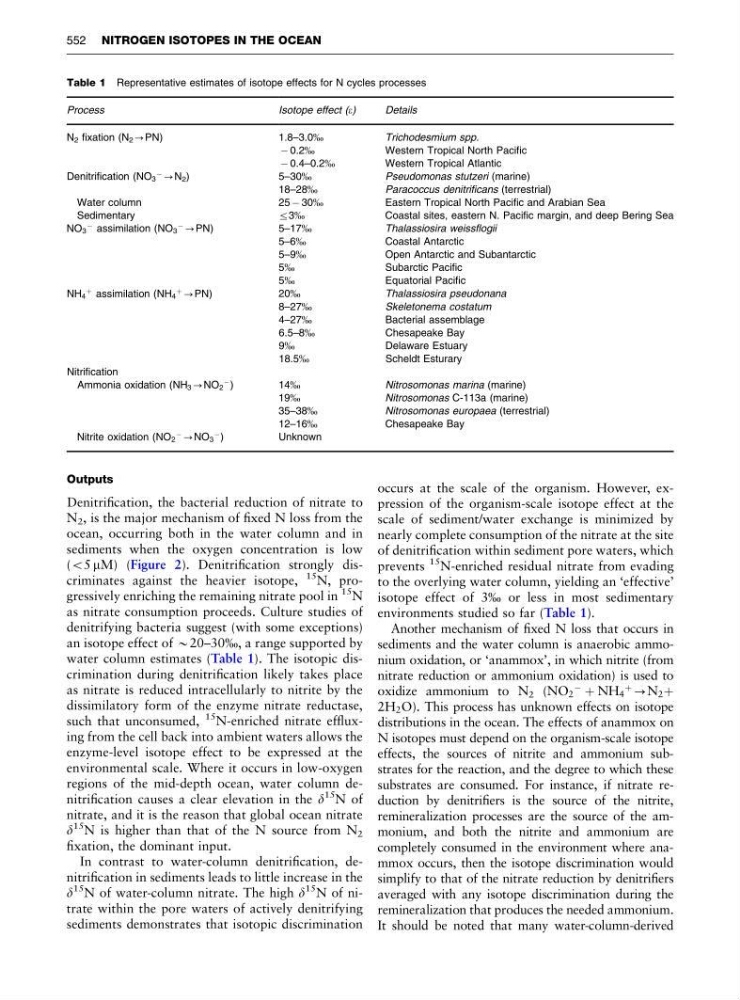
water column estimates (Table 1). The isotopic discrimination during denitrification likely takes place
as nitrate is reduced intracellularly to nitrite by the
dissimilatory form of the enzyme nitrate reductase,
such that unconsumed,
15 N-enriched nitrate effluxing from the cell back into ambient waters allows the
enzyme-level isotope effect to be expressed at the
environmental scale. Where it occurs in low-oxygen
regions of the mid-depth ocean, water column denitrification causes a clear elevation in the d
15
N of
nitrate, and it is the reason that global ocean nitrate
d
15 N is higher than that of the N source from N 2
fixation, the dominant input.
In contrast to water-column denitrification, denitrification in sediments leads to little increase in the
d
15 N of water-column nitrate. The high d
15 N of nitrate within the pore waters of actively denitrifying
sediments demonstrates that isotopic discrimination
occurs at the scale of the organism. However, expression of the organism-scale isotope effect at the
scale of sediment/water exchange is minimized by
nearly complete consumption of the nitrate at the site
of denitrification within sediment pore waters, which
prevents
15 N-enriched residual nitrate from evading
to the overlying water column, yielding an ‘effective’
isotope effect of 3% or less in most sedimentary
environments studied so far (Table 1).
Another mechanism of fixed N loss that occurs in
sediments and the water column is anaerobic ammonium oxidation, or ‘anammox’, in which nitrite (from
nitrate reduction or ammonium oxidation) is used to
oxidize ammonium to N 2 (NO 2
À þ NH 4
þ
-N 2 þ
2H 2 O). This process has unknown effects on isotope
distributions in the ocean. The effects of anammox on
N isotopes must depend on the organism-scale isotope
effects, the sources of nitrite and ammonium substrates for the reaction, and the degree to which these
substrates are consumed. For instance, if nitrate reduction by denitrifiers is the source of the nitrite,
remineralization processes are the source of the ammonium, and both the nitrite and ammonium are
completely consumed in the environment where anammox occurs, then the isotope discrimination would
simplify to that of the nitrate reduction by denitrifiers
averaged with any isotope discrimination during the
remineralization that produces the needed ammonium.
It should be noted that many water-column-derived
Table 1 Representative estimates of isotope effects for N cycles processes
Process
Isotope effect (e)
Details
N 2 fixation (N 2 -PN)
1.8–3.0%
Trichodesmium spp.
À 0.2%
Western Tropical North Pacific
À 0.4–0.2%
Western Tropical Atlantic
Denitrification (NO 3
À -N 2 )
5–30%
Pseudomonas stutzeri (marine)
18–28%
Paracoccus denitrificans (terrestrial)
Water column
25 À 30%
Eastern Tropical North Pacific and Arabian Sea
Sedimentary
r3%
Coastal sites, eastern N. Pacific margin, and deep Bering Sea
NO 3
À assimilation (NO 3
À -PN)
5–17%
Thalassiosira weissflogii
5–6%
Coastal Antarctic
5–9%
Open Antarctic and Subantarctic
5%
Subarctic Pacific
5%
Equatorial Pacific
NH 4
þ assimilation (NH 4
þ -PN)
20%
Thalassiosira pseudonana
8–27%
Skeletonema costatum
4–27%
Bacterial assemblage
6.5–8%
Chesapeake Bay
9%
Delaware Estuary
18.5%
Scheldt Esturary
Nitrification
Ammonia oxidation (NH 3 -NO 2
À )
1 4 %
Nitrosomonas marina (marine)
19%
Nitrosomonas C-113a (marine)
35–38%
Nitrosomonas europaea (terrestrial)
12–16%
Chesapeake Bay
Nitrite oxidation (NO 2
À -NO 3
À )
Unknown
552 NITROGEN ISOTOPES IN THE OCEAN
Denitrification, the bacterial reduction of nitrate to
N 2 , is the major mechanism of fixed N loss from the
ocean, occurring both in the water column and in
sediments when the oxygen concentration is low
(o5 mM) (Figure 2). Denitrification strongly discriminates against the heavier isotope,
15 N, progressively enriching the remaining nitrate pool in
15 N
as nitrate consumption proceeds. Culture studies of
denitrifying bacteria suggest (with some exceptions)
an isotope effect of B20–30%, a range supported by
water column estimates (Table 1). The isotopic discrimination during denitrification likely takes place
as nitrate is reduced intracellularly to nitrite by the
dissimilatory form of the enzyme nitrate reductase,
such that unconsumed,
15 N-enriched nitrate effluxing from the cell back into ambient waters allows the
enzyme-level isotope effect to be expressed at the
environmental scale. Where it occurs in low-oxygen
regions of the mid-depth ocean, water column denitrification causes a clear elevation in the d
15
N of
nitrate, and it is the reason that global ocean nitrate
d
15 N is higher than that of the N source from N 2
fixation, the dominant input.
In contrast to water-column denitrification, denitrification in sediments leads to little increase in the
d
15 N of water-column nitrate. The high d
15 N of nitrate within the pore waters of actively denitrifying
sediments demonstrates that isotopic discrimination
occurs at the scale of the organism. However, expression of the organism-scale isotope effect at the
scale of sediment/water exchange is minimized by
nearly complete consumption of the nitrate at the site
of denitrification within sediment pore waters, which
prevents
15 N-enriched residual nitrate from evading
to the overlying water column, yielding an ‘effective’
isotope effect of 3% or less in most sedimentary
environments studied so far (Table 1).
Another mechanism of fixed N loss that occurs in
sediments and the water column is anaerobic ammonium oxidation, or ‘anammox’, in which nitrite (from
nitrate reduction or ammonium oxidation) is used to
oxidize ammonium to N 2 (NO 2
À þ NH 4
þ
-N 2 þ
2H 2 O). This process has unknown effects on isotope
distributions in the ocean. The effects of anammox on
N isotopes must depend on the organism-scale isotope
effects, the sources of nitrite and ammonium substrates for the reaction, and the degree to which these
substrates are consumed. For instance, if nitrate reduction by denitrifiers is the source of the nitrite,
remineralization processes are the source of the ammonium, and both the nitrite and ammonium are
completely consumed in the environment where anammox occurs, then the isotope discrimination would
simplify to that of the nitrate reduction by denitrifiers
averaged with any isotope discrimination during the
remineralization that produces the needed ammonium.
It should be noted that many water-column-derived
Table 1 Representative estimates of isotope effects for N cycles processes
Process
Isotope effect (e)
Details
N 2 fixation (N 2 -PN)
1.8–3.0%
Trichodesmium spp.
À 0.2%
Western Tropical North Pacific
À 0.4–0.2%
Western Tropical Atlantic
Denitrification (NO 3
À -N 2 )
5–30%
Pseudomonas stutzeri (marine)
18–28%
Paracoccus denitrificans (terrestrial)
Water column
25 À 30%
Eastern Tropical North Pacific and Arabian Sea
Sedimentary
r3%
Coastal sites, eastern N. Pacific margin, and deep Bering Sea
NO 3
À assimilation (NO 3
À -PN)
5–17%
Thalassiosira weissflogii
5–6%
Coastal Antarctic
5–9%
Open Antarctic and Subantarctic
5%
Subarctic Pacific
5%
Equatorial Pacific
NH 4
þ assimilation (NH 4
þ -PN)
20%
Thalassiosira pseudonana
8–27%
Skeletonema costatum
4–27%
Bacterial assemblage
6.5–8%
Chesapeake Bay
9%
Delaware Estuary
18.5%
Scheldt Esturary
Nitrification
Ammonia oxidation (NH 3 -NO 2
À )
1 4 %
Nitrosomonas marina (marine)
19%
Nitrosomonas C-113a (marine)
35–38%
Nitrosomonas europaea (terrestrial)
12–16%
Chesapeake Bay
Nitrite oxidation (NO 2
À -NO 3
À )
Unknown
552 NITROGEN ISOTOPES IN THE OCEAN