

Processes
Inputs
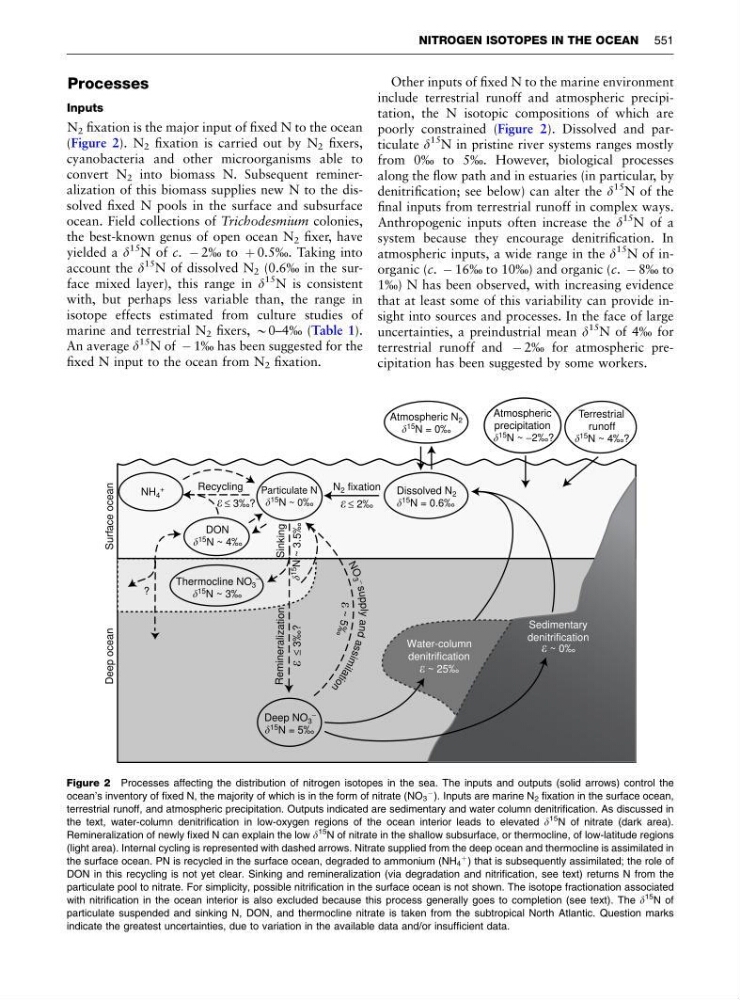
N 2 fixation is the major input of fixed N to the ocean
(Figure 2). N 2 fixation is carried out by N 2 fixers,
cyanobacteria and other microorganisms able to
convert N 2 into biomass N. Subsequent remineralization of this biomass supplies new N to the dissolved fixed N pools in the surface and subsurface
ocean. Field collections of Trichodesmium colonies,
the best-known genus of open ocean N 2 fixer, have
yielded a d
15
N of c. À 2% to þ 0.5%. Taking into
account the d
15 N of dissolved N 2 (0.6% in the surface mixed layer), this range in d
15 N is consistent
with, but perhaps less variable than, the range in
isotope effects estimated from culture studies of
marine and terrestrial N 2 fixers, B0–4% (Table 1).
An average d
15 N of À 1% has been suggested for the
fixed N input to the ocean from N 2 fixation.
Other inputs of fixed N to the marine environment
include terrestrial runoff and atmospheric precipitation, the N isotopic compositions of which are
poorly constrained (Figure 2). Dissolved and particulate d
15
N in pristine river systems ranges mostly
from 0% to 5%. However, biological processes
along the flow path and in estuaries (in particular, by
denitrification; see below) can alter the d
15 N of the
final inputs from terrestrial runoff in complex ways.
Anthropogenic inputs often increase the d
15 N of a
system because they encourage denitrification. In
atmospheric inputs, a wide range in the d
15
N of inorganic (c. À 16% to 10%) and organic (c. À 8% to
1%) N has been observed, with increasing evidence
that at least some of this variability can provide insight into sources and processes. In the face of large
uncertainties, a preindustrial mean d
15
N of 4% for
terrestrial runoff and À 2% for atmospheric precipitation has been suggested by some workers.
N 2 fixation
≤ 2‰
Dissolved N 2
15 N = 0.6‰
Particulate N
15 N ~ 0‰
Surface ocean
Deep ocean
Atmospheric
precipitation
15 N ~ −2‰?
Terrestrial
runoff
15 N ~ 4‰?
DON
15 N ~ 4‰
NH 4
+
Recycling
Atmospheric N 2
15 N = 0‰
Deep NO 3
−
15 N = 5‰
Thermocline NO 3
−
15 N ~ 3‰
Remineralization
≤ 3‰?
N
O3
−
su
pply
an
d
a
s
s
im
il
a
t
i
o
n
~
5‰
?
≤ 3‰?
5
1
N 5
.
3
~ ‰
g
n
i
k
n
i
S
Sedimentary
denitrification
~ 0‰
Water-column
denitrification
~ 25‰
Figure 2 Processes affecting the distribution of nitrogen isotopes in the sea. The inputs and outputs (solid arrows) control the
ocean’s inventory of fixed N, the majority of which is in the form of nitrate (NO 3
À ). Inputs are marine N 2 fixation in the surface ocean,
terrestrial runoff, and atmospheric precipitation. Outputs indicated are sedimentary and water column denitrification. As discussed in
the text, water-column denitrification in low-oxygen regions of the ocean interior leads to elevated d
15 N of nitrate (dark area).
Remineralization of newly fixed N can explain the low d
15 N of nitrate in the shallow subsurface, or thermocline, of low-latitude regions
(light area). Internal cycling is represented with dashed arrows. Nitrate supplied from the deep ocean and thermocline is assimilated in
the surface ocean. PN is recycled in the surface ocean, degraded to ammonium (NH 4
þ ) that is subsequently assimilated; the role of
DON in this recycling is not yet clear. Sinking and remineralization (via degradation and nitrification, see text) returns N from the
particulate pool to nitrate. For simplicity, possible nitrification in the surface ocean is not shown. The isotope fractionation associated
with nitrification in the ocean interior is also excluded because this process generally goes to completion (see text). The d
15 N of
particulate suspended and sinking N, DON, and thermocline nitrate is taken from the subtropical North Atlantic. Question marks
indicate the greatest uncertainties, due to variation in the available data and/or insufficient data.
NITROGEN ISOTOPES IN THE OCEAN 551
Inputs
N 2 fixation is the major input of fixed N to the ocean
(Figure 2). N 2 fixation is carried out by N 2 fixers,
cyanobacteria and other microorganisms able to
convert N 2 into biomass N. Subsequent remineralization of this biomass supplies new N to the dissolved fixed N pools in the surface and subsurface
ocean. Field collections of Trichodesmium colonies,
the best-known genus of open ocean N 2 fixer, have
yielded a d
15
N of c. À 2% to þ 0.5%. Taking into
account the d
15 N of dissolved N 2 (0.6% in the surface mixed layer), this range in d
15 N is consistent
with, but perhaps less variable than, the range in
isotope effects estimated from culture studies of
marine and terrestrial N 2 fixers, B0–4% (Table 1).
An average d
15 N of À 1% has been suggested for the
fixed N input to the ocean from N 2 fixation.
Other inputs of fixed N to the marine environment
include terrestrial runoff and atmospheric precipitation, the N isotopic compositions of which are
poorly constrained (Figure 2). Dissolved and particulate d
15
N in pristine river systems ranges mostly
from 0% to 5%. However, biological processes
along the flow path and in estuaries (in particular, by
denitrification; see below) can alter the d
15 N of the
final inputs from terrestrial runoff in complex ways.
Anthropogenic inputs often increase the d
15 N of a
system because they encourage denitrification. In
atmospheric inputs, a wide range in the d
15
N of inorganic (c. À 16% to 10%) and organic (c. À 8% to
1%) N has been observed, with increasing evidence
that at least some of this variability can provide insight into sources and processes. In the face of large
uncertainties, a preindustrial mean d
15
N of 4% for
terrestrial runoff and À 2% for atmospheric precipitation has been suggested by some workers.
N 2 fixation
≤ 2‰
Dissolved N 2
15 N = 0.6‰
Particulate N
15 N ~ 0‰
Surface ocean
Deep ocean
Atmospheric
precipitation
15 N ~ −2‰?
Terrestrial
runoff
15 N ~ 4‰?
DON
15 N ~ 4‰
NH 4
+
Recycling
Atmospheric N 2
15 N = 0‰
Deep NO 3
−
15 N = 5‰
Thermocline NO 3
−
15 N ~ 3‰
Remineralization
≤ 3‰?
N
O3
−
su
pply
an
d
a
s
s
im
il
a
t
i
o
n
~
5‰
?
≤ 3‰?
5
1
N 5
.
3
~ ‰
g
n
i
k
n
i
S
Sedimentary
denitrification
~ 0‰
Water-column
denitrification
~ 25‰
Figure 2 Processes affecting the distribution of nitrogen isotopes in the sea. The inputs and outputs (solid arrows) control the
ocean’s inventory of fixed N, the majority of which is in the form of nitrate (NO 3
À ). Inputs are marine N 2 fixation in the surface ocean,
terrestrial runoff, and atmospheric precipitation. Outputs indicated are sedimentary and water column denitrification. As discussed in
the text, water-column denitrification in low-oxygen regions of the ocean interior leads to elevated d
15 N of nitrate (dark area).
Remineralization of newly fixed N can explain the low d
15 N of nitrate in the shallow subsurface, or thermocline, of low-latitude regions
(light area). Internal cycling is represented with dashed arrows. Nitrate supplied from the deep ocean and thermocline is assimilated in
the surface ocean. PN is recycled in the surface ocean, degraded to ammonium (NH 4
þ ) that is subsequently assimilated; the role of
DON in this recycling is not yet clear. Sinking and remineralization (via degradation and nitrification, see text) returns N from the
particulate pool to nitrate. For simplicity, possible nitrification in the surface ocean is not shown. The isotope fractionation associated
with nitrification in the ocean interior is also excluded because this process generally goes to completion (see text). The d
15 N of
particulate suspended and sinking N, DON, and thermocline nitrate is taken from the subtropical North Atlantic. Question marks
indicate the greatest uncertainties, due to variation in the available data and/or insufficient data.
NITROGEN ISOTOPES IN THE OCEAN 551