

with a modern atmosphere-ocean exchange flux of
7.5 Â 10
15 mol C y
À1 (i.e., 90 Gt C y
À1
) and an atmospheric content of 62.5 Â 10
15 mol C (i.e., 750 Gt
C), the turnover time of carbon in the atmosphere
can be calculated to be only 8.33 years. Similarly, the
terrestrial biosphere has not been included, since its
size is small compared to other reservoirs and it can
be assumed in equilibrium with the atmosphere–
ocean system. The fluxes involved in the cycle are
MOR/metamorphic CO 2 release (‘volcanism’), weathering fluxes, and deposition of carbonates or organic carbon on the seafloor. The reported values of
these fluxes are long-term averages, that is, they
should be thought of as averages over several glacial–
interglacial oscillations of the Pleistocene, although
such averages cannot always be estimated from
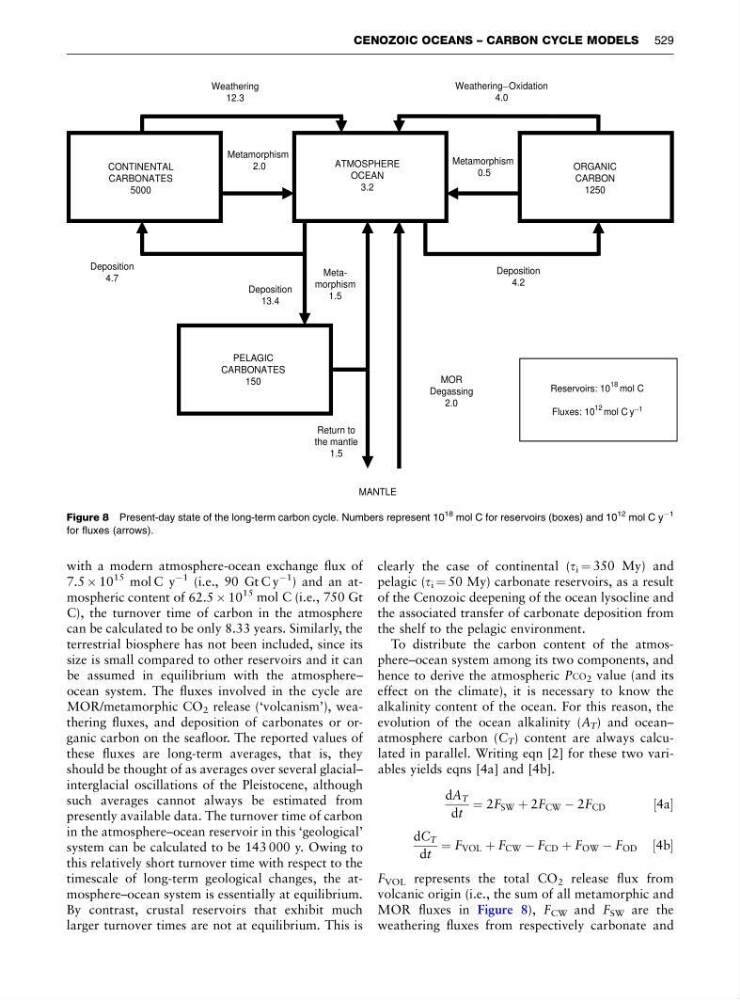
presently available data. The turnover time of carbon
in the atmosphere–ocean reservoir in this ‘geological’
system can be calculated to be 143 000 y. Owing to
this relatively short turnover time with respect to the
timescale of long-term geological changes, the atmosphere–ocean system is essentially at equilibrium.
By contrast, crustal reservoirs that exhibit much
larger turnover times are not at equilibrium. This is
clearly the case of continental (t i ¼ 350 My) and
pelagic (t i ¼ 50 My) carbonate reservoirs, as a result
of the Cenozoic deepening of the ocean lysocline and
the associated transfer of carbonate deposition from
the shelf to the pelagic environment.
To distribute the carbon content of the atmosphere–ocean system among its two components, and
hence to derive the atmospheric PCO 2 value (and its
effect on the climate), it is necessary to know the
alkalinity content of the ocean. For this reason, the
evolution of the ocean alkalinity (A T ) and ocean–
atmosphere carbon (C T ) content are always calculated in parallel. Writing eqn [2] for these two variables yields eqns [4a] and [4b].
dA T
dt
¼ 2F SW þ 2F CW À 2F CD
½4a
dC T
dt
¼ F VOL þ F CW À F CD þ F OW À F OD ½4b
F VOL represents the total CO 2 release flux from
volcanic origin (i.e., the sum of all metamorphic and
MOR fluxes in Figure 8), F CW and F SW are the
weathering fluxes from respectively carbonate and
Weathering _ Oxidation
4.0
ATMOSPHERE
OCEAN
3.2
ORGANIC
CARBON
1250
CONTINENTAL
CARBONATES
5000
PELAGIC
CARBONATES
150
Deposition
13.4
Deposition
4.7
MANTLE
Return to
the mantle
1.5
Metamorphism
0.5
Deposition
4.2
Weathering
12.3
Reservoirs: 10
18 mol C
Fluxes: 10
12 mol C y
_ 1
MOR
Degassing
2.0
Metamorphism
1.5
Metamorphism
2.0
Figure 8 Present-day state of the long-term carbon cycle. Numbers represent 10
18 mol C for reservoirs (boxes) and 10
12 mol C y
À1
for fluxes (arrows).
CENOZOIC OCEANS – CARBON CYCLE MODELS 529
7.5 Â 10
15 mol C y
À1 (i.e., 90 Gt C y
À1
) and an atmospheric content of 62.5 Â 10
15 mol C (i.e., 750 Gt
C), the turnover time of carbon in the atmosphere
can be calculated to be only 8.33 years. Similarly, the
terrestrial biosphere has not been included, since its
size is small compared to other reservoirs and it can
be assumed in equilibrium with the atmosphere–
ocean system. The fluxes involved in the cycle are
MOR/metamorphic CO 2 release (‘volcanism’), weathering fluxes, and deposition of carbonates or organic carbon on the seafloor. The reported values of
these fluxes are long-term averages, that is, they
should be thought of as averages over several glacial–
interglacial oscillations of the Pleistocene, although
such averages cannot always be estimated from
presently available data. The turnover time of carbon
in the atmosphere–ocean reservoir in this ‘geological’
system can be calculated to be 143 000 y. Owing to
this relatively short turnover time with respect to the
timescale of long-term geological changes, the atmosphere–ocean system is essentially at equilibrium.
By contrast, crustal reservoirs that exhibit much
larger turnover times are not at equilibrium. This is
clearly the case of continental (t i ¼ 350 My) and
pelagic (t i ¼ 50 My) carbonate reservoirs, as a result
of the Cenozoic deepening of the ocean lysocline and
the associated transfer of carbonate deposition from
the shelf to the pelagic environment.
To distribute the carbon content of the atmosphere–ocean system among its two components, and
hence to derive the atmospheric PCO 2 value (and its
effect on the climate), it is necessary to know the
alkalinity content of the ocean. For this reason, the
evolution of the ocean alkalinity (A T ) and ocean–
atmosphere carbon (C T ) content are always calculated in parallel. Writing eqn [2] for these two variables yields eqns [4a] and [4b].
dA T
dt
¼ 2F SW þ 2F CW À 2F CD
½4a
dC T
dt
¼ F VOL þ F CW À F CD þ F OW À F OD ½4b
F VOL represents the total CO 2 release flux from
volcanic origin (i.e., the sum of all metamorphic and
MOR fluxes in Figure 8), F CW and F SW are the
weathering fluxes from respectively carbonate and
Weathering _ Oxidation
4.0
ATMOSPHERE
OCEAN
3.2
ORGANIC
CARBON
1250
CONTINENTAL
CARBONATES
5000
PELAGIC
CARBONATES
150
Deposition
13.4
Deposition
4.7
MANTLE
Return to
the mantle
1.5
Metamorphism
0.5
Deposition
4.2
Weathering
12.3
Reservoirs: 10
18 mol C
Fluxes: 10
12 mol C y
_ 1
MOR
Degassing
2.0
Metamorphism
1.5
Metamorphism
2.0
Figure 8 Present-day state of the long-term carbon cycle. Numbers represent 10
18 mol C for reservoirs (boxes) and 10
12 mol C y
À1
for fluxes (arrows).
CENOZOIC OCEANS – CARBON CYCLE MODELS 529