

REE Patterns
Shale-normalized dissolved REE patterns for the
western North Pacific are shown in Figure 4(A).
Generalized features common to all seawaters are: a
progressive heavier REE enrichment relative to the
lighter ones and a pronounced depression at Ce.
These features can be best understood by the conceptual model for interactions between REEs in solution and particles and subsequent removal of
particulate matter by settling (Figure 5). The former
is ascribed to a systematic increase in stability constant with atomic number of complexes of REE-ligands (mainly carbonate) in seawater. The latter is
explained by preferential removal of Ce
4þ species
from seawater relative to trivalent REEs. It is also
noted that La is always enriched compared to that
expected by extrapolation from heavier Pr and Nd.
Furthermore, the increasing trend from the light to
the heavy REE is nonlinear and often has a marked
break between Gd and Tb. These less-pronounced
features have been discussed in terms of the basic
physicochemical characteristics relating to absence
for La and half filled for Gd of 4f electrons. However,
the reasoning is somewhat controversial and has not
yet been confirmed.
The NPDW-normalized REE patterns in the water
column of the western North Pacific are shown in
Figure 4(B). In comparison with Figure 4(A), it
generally shows a flat pattern (no fractionation) including those between 400 and 600 m where the
North Pacific Intermediate Water (NPIW) penetrates.
The exception is that the surface samples (o200 m)
indicate a middle REE enriched pattern being reflected by the sources and fractionation during
scavenging of REEs. The different water masses have
unique NPDW-normalized patterns (Figure 6). Thus,
the REE patterns are useful as tracers in defining
those water masses.
Redox Reaction of Ce, and Ce
Anomalies
Cerium is oxidized in seawater according to the
following equation,
Ce
3þ þ 2H 2 O ¼ CeO 2 þ 4H
þ þ e
À
where CeO 2 is highly insoluble species and rapidly
removed by scavenging. This oxidation is considered
to occur mainly in the surface water through
90 ˚ N
60 ˚ E
120 ˚ E
180 ˚
120 ˚ W
6 0 ˚ W
0 ˚
13
10
11
96-236
63
24
28
36
32
8.3
9.7 6.9
6.9
7.7
8.1
8.2
7.0
7.9
Nd
(pmol/kg),
Unfiltered
Filtered (<0.4 _ 1.0 μm)
PA-4
4.1
9.1
51
6.3
6.6 4.8
5.1
5.4 4.6
5.4
4.4
4.3
3.9
4.6
4.7 5.2
10
8.2
9.8
4.2
5.1
7.5 28
6.8
7.0
4.6 4.2 11 4.9 5.8 6.4
8.7
8.3
10
5.1
7.6
3.4
13
14
DBB-#86/1
19
7.9
14
25
21
32
35
39
40
35 38
32
9.3 13 14
34
31
14
73
25
27
20
8.5
9.2
8.7
13
9.1
2.9
2.7
3.4
4.7
TPG-7/8
SS-#8
CM-22
(See Fig. 2B)
4.7
8
_ 15
9.8
7.9
(A)
60 ˚ N
30 ˚ N
0 ˚
0 ˚
30 ˚ S
60 ˚ S
90 ˚ S
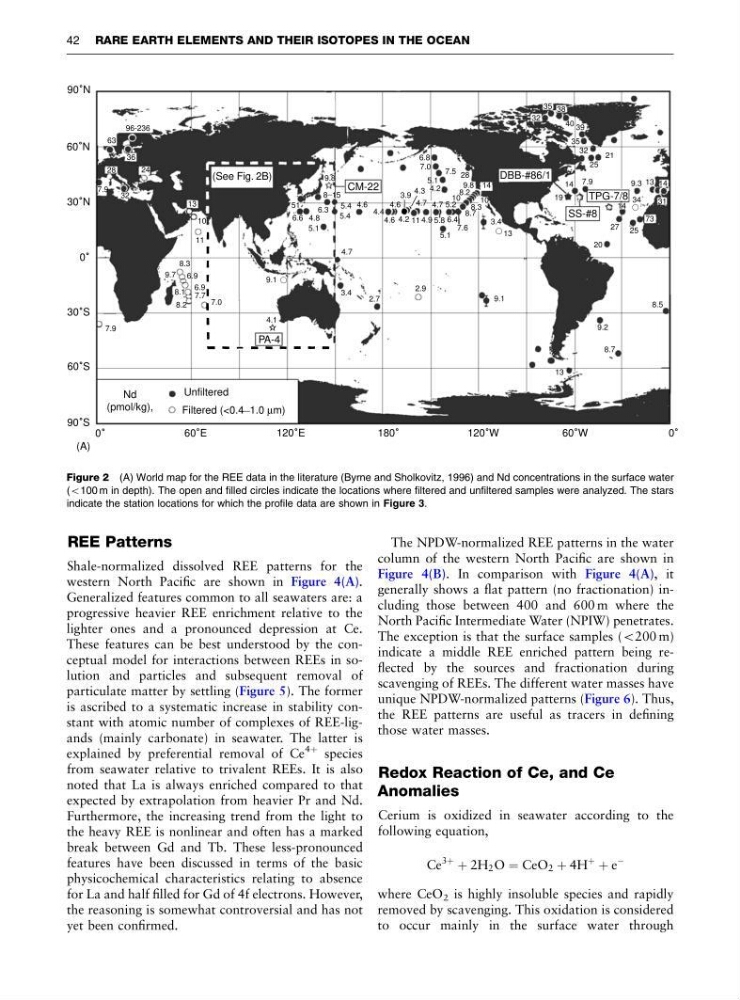
Figure 2 (A) World map for the REE data in the literature (Byrne and Sholkovitz, 1996) and Nd concentrations in the surface water
(o100 m in depth). The open and filled circles indicate the locations where filtered and unfiltered samples were analyzed. The stars
indicate the station locations for which the profile data are shown in Figure 3.
42 RARE EARTH ELEMENTS AND THEIR ISOTOPES IN THE OCEAN
Shale-normalized dissolved REE patterns for the
western North Pacific are shown in Figure 4(A).
Generalized features common to all seawaters are: a
progressive heavier REE enrichment relative to the
lighter ones and a pronounced depression at Ce.
These features can be best understood by the conceptual model for interactions between REEs in solution and particles and subsequent removal of
particulate matter by settling (Figure 5). The former
is ascribed to a systematic increase in stability constant with atomic number of complexes of REE-ligands (mainly carbonate) in seawater. The latter is
explained by preferential removal of Ce
4þ species
from seawater relative to trivalent REEs. It is also
noted that La is always enriched compared to that
expected by extrapolation from heavier Pr and Nd.
Furthermore, the increasing trend from the light to
the heavy REE is nonlinear and often has a marked
break between Gd and Tb. These less-pronounced
features have been discussed in terms of the basic
physicochemical characteristics relating to absence
for La and half filled for Gd of 4f electrons. However,
the reasoning is somewhat controversial and has not
yet been confirmed.
The NPDW-normalized REE patterns in the water
column of the western North Pacific are shown in
Figure 4(B). In comparison with Figure 4(A), it
generally shows a flat pattern (no fractionation) including those between 400 and 600 m where the
North Pacific Intermediate Water (NPIW) penetrates.
The exception is that the surface samples (o200 m)
indicate a middle REE enriched pattern being reflected by the sources and fractionation during
scavenging of REEs. The different water masses have
unique NPDW-normalized patterns (Figure 6). Thus,
the REE patterns are useful as tracers in defining
those water masses.
Redox Reaction of Ce, and Ce
Anomalies
Cerium is oxidized in seawater according to the
following equation,
Ce
3þ þ 2H 2 O ¼ CeO 2 þ 4H
þ þ e
À
where CeO 2 is highly insoluble species and rapidly
removed by scavenging. This oxidation is considered
to occur mainly in the surface water through
90 ˚ N
60 ˚ E
120 ˚ E
180 ˚
120 ˚ W
6 0 ˚ W
0 ˚
13
10
11
96-236
63
24
28
36
32
8.3
9.7 6.9
6.9
7.7
8.1
8.2
7.0
7.9
Nd
(pmol/kg),
Unfiltered
Filtered (<0.4 _ 1.0 μm)
PA-4
4.1
9.1
51
6.3
6.6 4.8
5.1
5.4 4.6
5.4
4.4
4.3
3.9
4.6
4.7 5.2
10
8.2
9.8
4.2
5.1
7.5 28
6.8
7.0
4.6 4.2 11 4.9 5.8 6.4
8.7
8.3
10
5.1
7.6
3.4
13
14
DBB-#86/1
19
7.9
14
25
21
32
35
39
40
35 38
32
9.3 13 14
34
31
14
73
25
27
20
8.5
9.2
8.7
13
9.1
2.9
2.7
3.4
4.7
TPG-7/8
SS-#8
CM-22
(See Fig. 2B)
4.7
8
_ 15
9.8
7.9
(A)
60 ˚ N
30 ˚ N
0 ˚
0 ˚
30 ˚ S
60 ˚ S
90 ˚ S
Figure 2 (A) World map for the REE data in the literature (Byrne and Sholkovitz, 1996) and Nd concentrations in the surface water
(o100 m in depth). The open and filled circles indicate the locations where filtered and unfiltered samples were analyzed. The stars
indicate the station locations for which the profile data are shown in Figure 3.
42 RARE EARTH ELEMENTS AND THEIR ISOTOPES IN THE OCEAN