

remain an important element in tuning some of the
mixing coefficients and surface boundary conditions
and in evaluating the model solutions.
Based on resolution, many inverse models can also
be categorized as intermediate complexity, but their
mode of operation differs considerably from the
models considered so far. In an inverse model, the
circulation field and biogeochemical net source/sink
(the J terms in the notation above) are solved for
using the observed large-scale hydrographic and
tracer distributions as constraints. Additional dynamic information may also be incorporated such as
the geostrophic velocity field, general water mass
properties, or float and mooring velocities.
Inverse calculations are typically posed as a large
set of simultaneous linear equations, which are then
solved using standard linear algebra methods. The
inverse techniques are most commonly applied to
steady-state tracers, though some exploration of
transient tracers has been carried out. The beauty of
the inverse approach is that it tries to produce dynamically consistent physical and/or biogeochemical
solutions that match the data within some assigned
error. The solutions are often underdetermined in
practice, however, which indicates the existence of a
range of possible solutions. From a biogeochemical
perspective, the inverse circulation models provide
estimates of the net source/sink patterns, which can
then be related to potential mechanisms.
Thermocline Models
Ocean process tracers and idealized models have
also been used extensively to study the ventilation of
the main thermocline. The main thermocline includes the upper 1 km of the tropical to subpolar
ocean where the temperature and potential density
vertical gradients are particularly steep. Thermocline
ventilation refers to the downward transport of surface water recently exposed to the atmosphere, replenishing the oxygen and other properties of the
subsurface interior. Based on the vertical profiles of
tritium and
3
He as well as simple 1-D and box
models, researchers in the early 1980s showed that
ventilation of the main thermocline in the subtropical gyres occurs predominately as a horizontal
process along surfaces of constant density rather
than by local vertical mixing. Later work on basinscale bomb-tritium distributions confirmed this result and suggested the total magnitude of subtropical
ventilation is large, comparable to the total winddriven gyre circulation.
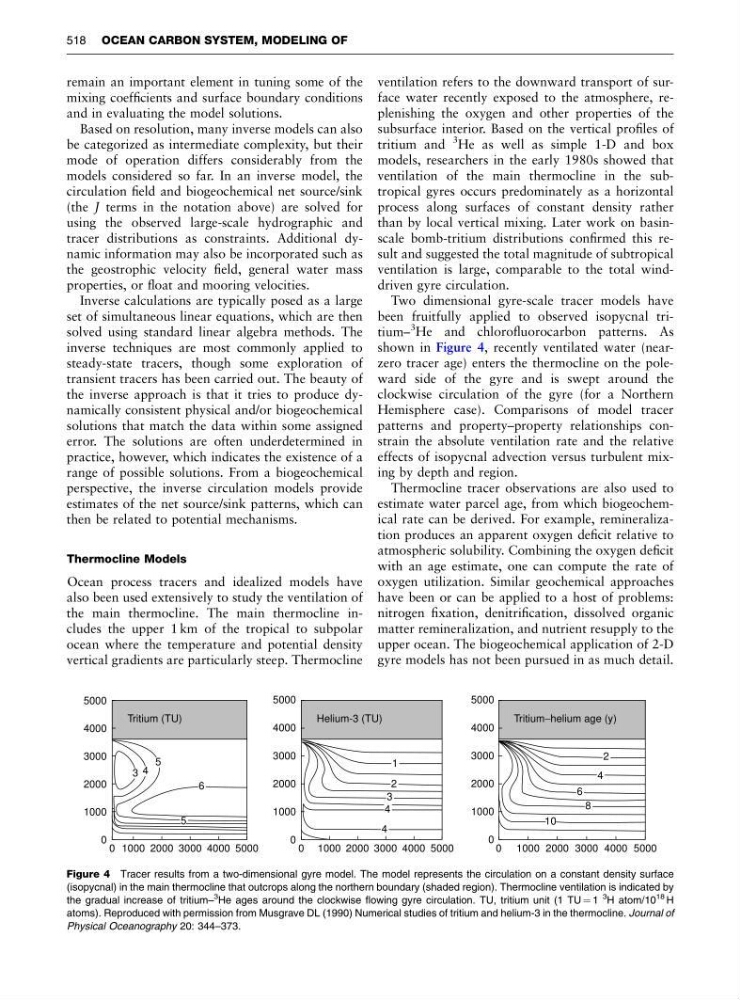
Two dimensional gyre-scale tracer models have
been fruitfully applied to observed isopycnal tritium–
3
He and chlorofluorocarbon patterns. As
shown in Figure 4, recently ventilated water (nearzero tracer age) enters the thermocline on the poleward side of the gyre and is swept around the
clockwise circulation of the gyre (for a Northern
Hemisphere case). Comparisons of model tracer
patterns and property–property relationships constrain the absolute ventilation rate and the relative
effects of isopycnal advection versus turbulent mixing by depth and region.
Thermocline tracer observations are also used to
estimate water parcel age, from which biogeochemical rate can be derived. For example, remineralization produces an apparent oxygen deficit relative to
atmospheric solubility. Combining the oxygen deficit
with an age estimate, one can compute the rate of
oxygen utilization. Similar geochemical approaches
have been or can be applied to a host of problems:
nitrogen fixation, denitrification, dissolved organic
matter remineralization, and nutrient resupply to the
upper ocean. The biogeochemical application of 2-D
gyre models has not been pursued in as much detail.
Tritium (TU)
5000
4000
3000
2000
1000
0
0 1000 2000 3000 4000 5000
Helium-3 (TU)
5000
4000
3000
2000
1000
0
0 1000 2000 3000 4000 5000
Tritium−helium age (y)
5000
4000
3000
2000
1000
0
0 1000 2000 3000 4000 5000
6
5
4
3
1
2
2
3
4
4
6
8
10
4
5
Figure 4 Tracer results from a two-dimensional gyre model. The model represents the circulation on a constant density surface
(isopycnal) in the main thermocline that outcrops along the northern boundary (shaded region). Thermocline ventilation is indicated by
the gradual increase of tritium–
3 He ages around the clockwise flowing gyre circulation. TU, tritium unit (1 TU ¼ 1
3 H atom/10
18 H
atoms). Reproduced with permission from Musgrave DL (1990) Numerical studies of tritium and helium-3 in the thermocline. Journal of
Physical Oceanography 20: 344–373.
518 OCEAN CARBON SYSTEM, MODELING OF
mixing coefficients and surface boundary conditions
and in evaluating the model solutions.
Based on resolution, many inverse models can also
be categorized as intermediate complexity, but their
mode of operation differs considerably from the
models considered so far. In an inverse model, the
circulation field and biogeochemical net source/sink
(the J terms in the notation above) are solved for
using the observed large-scale hydrographic and
tracer distributions as constraints. Additional dynamic information may also be incorporated such as
the geostrophic velocity field, general water mass
properties, or float and mooring velocities.
Inverse calculations are typically posed as a large
set of simultaneous linear equations, which are then
solved using standard linear algebra methods. The
inverse techniques are most commonly applied to
steady-state tracers, though some exploration of
transient tracers has been carried out. The beauty of
the inverse approach is that it tries to produce dynamically consistent physical and/or biogeochemical
solutions that match the data within some assigned
error. The solutions are often underdetermined in
practice, however, which indicates the existence of a
range of possible solutions. From a biogeochemical
perspective, the inverse circulation models provide
estimates of the net source/sink patterns, which can
then be related to potential mechanisms.
Thermocline Models
Ocean process tracers and idealized models have
also been used extensively to study the ventilation of
the main thermocline. The main thermocline includes the upper 1 km of the tropical to subpolar
ocean where the temperature and potential density
vertical gradients are particularly steep. Thermocline
ventilation refers to the downward transport of surface water recently exposed to the atmosphere, replenishing the oxygen and other properties of the
subsurface interior. Based on the vertical profiles of
tritium and
3
He as well as simple 1-D and box
models, researchers in the early 1980s showed that
ventilation of the main thermocline in the subtropical gyres occurs predominately as a horizontal
process along surfaces of constant density rather
than by local vertical mixing. Later work on basinscale bomb-tritium distributions confirmed this result and suggested the total magnitude of subtropical
ventilation is large, comparable to the total winddriven gyre circulation.
Two dimensional gyre-scale tracer models have
been fruitfully applied to observed isopycnal tritium–
3
He and chlorofluorocarbon patterns. As
shown in Figure 4, recently ventilated water (nearzero tracer age) enters the thermocline on the poleward side of the gyre and is swept around the
clockwise circulation of the gyre (for a Northern
Hemisphere case). Comparisons of model tracer
patterns and property–property relationships constrain the absolute ventilation rate and the relative
effects of isopycnal advection versus turbulent mixing by depth and region.
Thermocline tracer observations are also used to
estimate water parcel age, from which biogeochemical rate can be derived. For example, remineralization produces an apparent oxygen deficit relative to
atmospheric solubility. Combining the oxygen deficit
with an age estimate, one can compute the rate of
oxygen utilization. Similar geochemical approaches
have been or can be applied to a host of problems:
nitrogen fixation, denitrification, dissolved organic
matter remineralization, and nutrient resupply to the
upper ocean. The biogeochemical application of 2-D
gyre models has not been pursued in as much detail.
Tritium (TU)
5000
4000
3000
2000
1000
0
0 1000 2000 3000 4000 5000
Helium-3 (TU)
5000
4000
3000
2000
1000
0
0 1000 2000 3000 4000 5000
Tritium−helium age (y)
5000
4000
3000
2000
1000
0
0 1000 2000 3000 4000 5000
6
5
4
3
1
2
2
3
4
4
6
8
10
4
5
Figure 4 Tracer results from a two-dimensional gyre model. The model represents the circulation on a constant density surface
(isopycnal) in the main thermocline that outcrops along the northern boundary (shaded region). Thermocline ventilation is indicated by
the gradual increase of tritium–
3 He ages around the clockwise flowing gyre circulation. TU, tritium unit (1 TU ¼ 1
3 H atom/10
18 H
atoms). Reproduced with permission from Musgrave DL (1990) Numerical studies of tritium and helium-3 in the thermocline. Journal of
Physical Oceanography 20: 344–373.
518 OCEAN CARBON SYSTEM, MODELING OF