

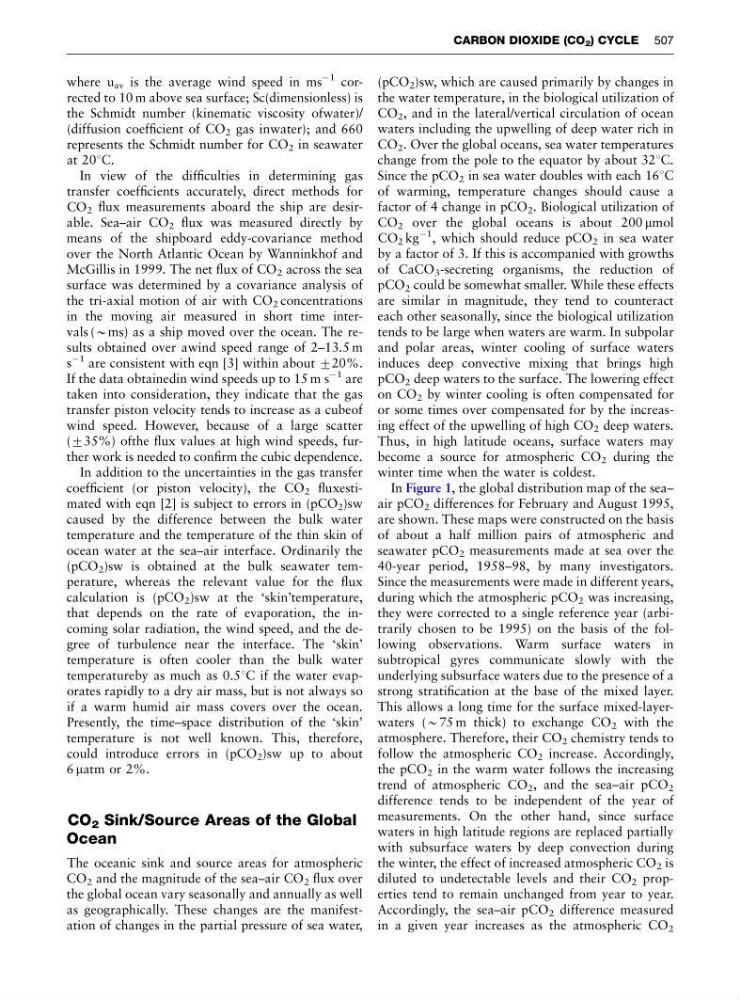
where u av is the average wind speed in ms
À1 corrected to 10 m above sea surface; Sc(dimensionless) is
the Schmidt number (kinematic viscosity ofwater)/
(diffusion coefficient of CO 2 gas inwater); and 660
represents the Schmidt number for CO 2 in seawater
at 201C.
In view of the difficulties in determining gas
transfer coefficients accurately, direct methods for
CO 2 flux measurements aboard the ship are desirable. Sea–air CO 2 flux was measured directly by
means of the shipboard eddy-covariance method
over the North Atlantic Ocean by Wanninkhof and
McGillis in 1999. The net flux of CO 2 across the sea
surface was determined by a covariance analysis of
the tri-axial motion of air with CO 2 concentrations
in the moving air measured in short time intervals (Bms) as a ship moved over the ocean. The results obtained over awind speed range of 2–13.5 m
s
À1 are consistent with eqn [3] within about 720%.
If the data obtainedin wind speeds up to 15 m s
À1 are
taken into consideration, they indicate that the gas
transfer piston velocity tends to increase as a cubeof
wind speed. However, because of a large scatter
(735%) ofthe flux values at high wind speeds, further work is needed to confirm the cubic dependence.
In addition to the uncertainties in the gas transfer
coefficient (or piston velocity), the CO 2 fluxestimated with eqn [2] is subject to errors in (pCO 2 )sw
caused by the difference between the bulk water
temperature and the temperature of the thin skin of
ocean water at the sea–air interface. Ordinarily the
(pCO 2 )sw is obtained at the bulk seawater temperature, whereas the relevant value for the flux
calculation is (pCO 2 )sw at the ‘skin’temperature,
that depends on the rate of evaporation, the incoming solar radiation, the wind speed, and the degree of turbulence near the interface. The ‘skin’
temperature is often cooler than the bulk water
temperatureby as much as 0.51C if the water evaporates rapidly to a dry air mass, but is not always so
if a warm humid air mass covers over the ocean.
Presently, the time–space distribution of the ‘skin’
temperature is not well known. This, therefore,
could introduce errors in (pCO 2 )sw up to about
6 matm or 2%.
CO 2 Sink/Source Areas of the Global
Ocean
The oceanic sink and source areas for atmospheric
CO 2 and the magnitude of the sea–air CO 2 flux over
the global ocean vary seasonally and annually as well
as geographically. These changes are the manifestation of changes in the partial pressure of sea water,
(pCO 2 )sw, which are caused primarily by changes in
the water temperature, in the biological utilization of
CO 2 , and in the lateral/vertical circulation of ocean
waters including the upwelling of deep water rich in
CO 2 . Over the global oceans, sea water temperatures
change from the pole to the equator by about 321C.
Since the pCO 2 in sea water doubles with each 161C
of warming, temperature changes should cause a
factor of 4 change in pCO 2 . Biological utilization of
CO 2 over the global oceans is about 200 mmol
CO 2 kg
À1 , which should reduce pCO 2 in sea water
by a factor of 3. If this is accompanied with growths
of CaCO 3 -secreting organisms, the reduction of
pCO 2 could be somewhat smaller. While these effects
are similar in magnitude, they tend to counteract
each other seasonally, since the biological utilization
tends to be large when waters are warm. In subpolar
and polar areas, winter cooling of surface waters
induces deep convective mixing that brings high
pCO 2 deep waters to the surface. The lowering effect
on CO 2 by winter cooling is often compensated for
or some times over compensated for by the increasing effect of the upwelling of high CO 2 deep waters.
Thus, in high latitude oceans, surface waters may
become a source for atmospheric CO 2 during the
winter time when the water is coldest.
In Figure 1, the global distribution map of the sea–
air pCO 2 differences for February and August 1995,
are shown. These maps were constructed on the basis
of about a half million pairs of atmospheric and
seawater pCO 2 measurements made at sea over the
40-year period, 1958–98, by many investigators.
Since the measurements were made in different years,
during which the atmospheric pCO 2 was increasing,
they were corrected to a single reference year (arbitrarily chosen to be 1995) on the basis of the following observations. Warm surface waters in
subtropical gyres communicate slowly with the
underlying subsurface waters due to the presence of a
strong stratification at the base of the mixed layer.
This allows a long time for the surface mixed-layerwaters (B75 m thick) to exchange CO 2 with the
atmosphere. Therefore, their CO 2 chemistry tends to
follow the atmospheric CO 2 increase. Accordingly,
the pCO 2 in the warm water follows the increasing
trend of atmospheric CO 2 , and the sea–air pCO 2
difference tends to be independent of the year of
measurements. On the other hand, since surface
waters in high latitude regions are replaced partially
with subsurface waters by deep convection during
the winter, the effect of increased atmospheric CO 2 is
diluted to undetectable levels and their CO 2 properties tend to remain unchanged from year to year.
Accordingly, the sea–air pCO 2 difference measured
in a given year increases as the atmospheric CO 2
CARBON DIOXIDE (CO 2 ) CYCLE 507
À1 corrected to 10 m above sea surface; Sc(dimensionless) is
the Schmidt number (kinematic viscosity ofwater)/
(diffusion coefficient of CO 2 gas inwater); and 660
represents the Schmidt number for CO 2 in seawater
at 201C.
In view of the difficulties in determining gas
transfer coefficients accurately, direct methods for
CO 2 flux measurements aboard the ship are desirable. Sea–air CO 2 flux was measured directly by
means of the shipboard eddy-covariance method
over the North Atlantic Ocean by Wanninkhof and
McGillis in 1999. The net flux of CO 2 across the sea
surface was determined by a covariance analysis of
the tri-axial motion of air with CO 2 concentrations
in the moving air measured in short time intervals (Bms) as a ship moved over the ocean. The results obtained over awind speed range of 2–13.5 m
s
À1 are consistent with eqn [3] within about 720%.
If the data obtainedin wind speeds up to 15 m s
À1 are
taken into consideration, they indicate that the gas
transfer piston velocity tends to increase as a cubeof
wind speed. However, because of a large scatter
(735%) ofthe flux values at high wind speeds, further work is needed to confirm the cubic dependence.
In addition to the uncertainties in the gas transfer
coefficient (or piston velocity), the CO 2 fluxestimated with eqn [2] is subject to errors in (pCO 2 )sw
caused by the difference between the bulk water
temperature and the temperature of the thin skin of
ocean water at the sea–air interface. Ordinarily the
(pCO 2 )sw is obtained at the bulk seawater temperature, whereas the relevant value for the flux
calculation is (pCO 2 )sw at the ‘skin’temperature,
that depends on the rate of evaporation, the incoming solar radiation, the wind speed, and the degree of turbulence near the interface. The ‘skin’
temperature is often cooler than the bulk water
temperatureby as much as 0.51C if the water evaporates rapidly to a dry air mass, but is not always so
if a warm humid air mass covers over the ocean.
Presently, the time–space distribution of the ‘skin’
temperature is not well known. This, therefore,
could introduce errors in (pCO 2 )sw up to about
6 matm or 2%.
CO 2 Sink/Source Areas of the Global
Ocean
The oceanic sink and source areas for atmospheric
CO 2 and the magnitude of the sea–air CO 2 flux over
the global ocean vary seasonally and annually as well
as geographically. These changes are the manifestation of changes in the partial pressure of sea water,
(pCO 2 )sw, which are caused primarily by changes in
the water temperature, in the biological utilization of
CO 2 , and in the lateral/vertical circulation of ocean
waters including the upwelling of deep water rich in
CO 2 . Over the global oceans, sea water temperatures
change from the pole to the equator by about 321C.
Since the pCO 2 in sea water doubles with each 161C
of warming, temperature changes should cause a
factor of 4 change in pCO 2 . Biological utilization of
CO 2 over the global oceans is about 200 mmol
CO 2 kg
À1 , which should reduce pCO 2 in sea water
by a factor of 3. If this is accompanied with growths
of CaCO 3 -secreting organisms, the reduction of
pCO 2 could be somewhat smaller. While these effects
are similar in magnitude, they tend to counteract
each other seasonally, since the biological utilization
tends to be large when waters are warm. In subpolar
and polar areas, winter cooling of surface waters
induces deep convective mixing that brings high
pCO 2 deep waters to the surface. The lowering effect
on CO 2 by winter cooling is often compensated for
or some times over compensated for by the increasing effect of the upwelling of high CO 2 deep waters.
Thus, in high latitude oceans, surface waters may
become a source for atmospheric CO 2 during the
winter time when the water is coldest.
In Figure 1, the global distribution map of the sea–
air pCO 2 differences for February and August 1995,
are shown. These maps were constructed on the basis
of about a half million pairs of atmospheric and
seawater pCO 2 measurements made at sea over the
40-year period, 1958–98, by many investigators.
Since the measurements were made in different years,
during which the atmospheric pCO 2 was increasing,
they were corrected to a single reference year (arbitrarily chosen to be 1995) on the basis of the following observations. Warm surface waters in
subtropical gyres communicate slowly with the
underlying subsurface waters due to the presence of a
strong stratification at the base of the mixed layer.
This allows a long time for the surface mixed-layerwaters (B75 m thick) to exchange CO 2 with the
atmosphere. Therefore, their CO 2 chemistry tends to
follow the atmospheric CO 2 increase. Accordingly,
the pCO 2 in the warm water follows the increasing
trend of atmospheric CO 2 , and the sea–air pCO 2
difference tends to be independent of the year of
measurements. On the other hand, since surface
waters in high latitude regions are replaced partially
with subsurface waters by deep convection during
the winter, the effect of increased atmospheric CO 2 is
diluted to undetectable levels and their CO 2 properties tend to remain unchanged from year to year.
Accordingly, the sea–air pCO 2 difference measured
in a given year increases as the atmospheric CO 2
CARBON DIOXIDE (CO 2 ) CYCLE 507