

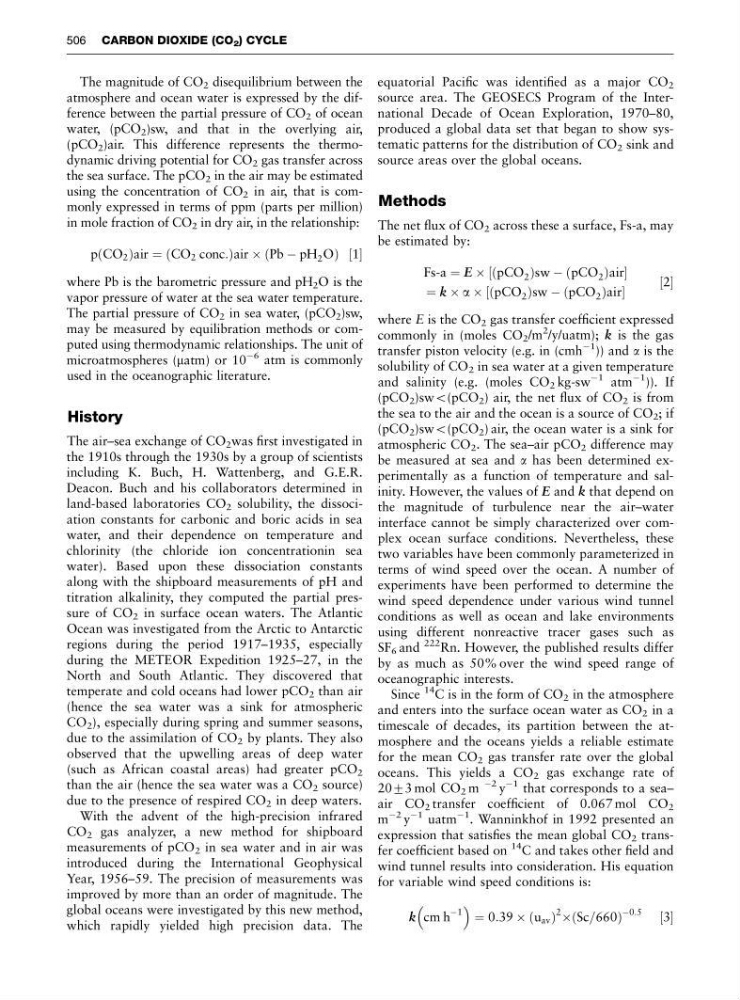
The magnitude of CO 2 disequilibrium between the
atmosphere and ocean water is expressed by the difference between the partial pressure of CO 2 of ocean
water, (pCO 2 )sw, and that in the overlying air,
(pCO 2 )air. This difference represents the thermodynamic driving potential for CO 2 gas transfer across
the sea surface. The pCO 2 in the air may be estimated
using the concentration of CO 2 in air, that is commonly expressed in terms of ppm (parts per million)
in mole fraction of CO 2 in dry air, in the relationship:
p CO 2
ð
Þair ¼ CO 2 conc:
ð
Þ air  Pb À pH 2 O
ð
Þ ½ 1
where Pb is the barometric pressure and pH 2 O is the
vapor pressure of water at the sea water temperature.
The partial pressure of CO 2 in sea water, (pCO 2 )sw,
may be measured by equilibration methods or computed using thermodynamic relationships. The unit of
microatmospheres (matm) or 10
À6 atm is commonly
used in the oceanographic literature.
History
The air–sea exchange of CO 2 was first investigated in
the 1910s through the 1930s by a group of scientists
including K. Buch, H. Wattenberg, and G.E.R.
Deacon. Buch and his collaborators determined in
land-based laboratories CO 2 solubility, the dissociation constants for carbonic and boric acids in sea
water, and their dependence on temperature and
chlorinity (the chloride ion concentrationin sea
water). Based upon these dissociation constants
along with the shipboard measurements of pH and
titration alkalinity, they computed the partial pressure of CO 2 in surface ocean waters. The Atlantic
Ocean was investigated from the Arctic to Antarctic
regions during the period 1917–1935, especially
during the METEOR Expedition 1925–27, in the
North and South Atlantic. They discovered that
temperate and cold oceans had lower pCO 2 than air
(hence the sea water was a sink for atmospheric
CO 2 ), especially during spring and summer seasons,
due to the assimilation of CO 2 by plants. They also
observed that the upwelling areas of deep water
(such as African coastal areas) had greater pCO 2
than the air (hence the sea water was a CO 2 source)
due to the presence of respired CO 2 in deep waters.
With the advent of the high-precision infrared
CO 2 gas analyzer, a new method for shipboard
measurements of pCO 2 in sea water and in air was
introduced during the International Geophysical
Year, 1956–59. The precision of measurements was
improved by more than an order of magnitude. The
global oceans were investigated by this new method,
which rapidly yielded high precision data. The
equatorial Pacific was identified as a major CO 2
source area. The GEOSECS Program of the International Decade of Ocean Exploration, 1970–80,
produced a global data set that began to show systematic patterns for the distribution of CO 2 sink and
source areas over the global oceans.
Methods
The net flux of CO 2 across these a surface, Fs-a, may
be estimated by:
Fs-a ¼ E Â pCO 2
ð
Þsw À pCO 2
ð
Þair
½
¼ k  a  pCO 2
ð
Þsw À pCO 2
ð
Þair
½
½2
where E is the CO 2 gas transfer coefficient expressed
commonly in (moles CO 2 /m
2
/y/uatm); k is the gas
transfer piston velocity (e.g. in (cmh
À1
)) and a is the
solubility of CO 2 in sea water at a given temperature
and salinity (e.g. (moles CO 2 kg-sw
À1 atm
À1
)). If
(pCO 2 )swo(pCO 2 ) air, the net flux of CO 2 is from
the sea to the air and the ocean is a source of CO 2 ; if
(pCO 2 )swo(pCO 2 ) air, the ocean water is a sink for
atmospheric CO 2 . The sea–air pCO 2 difference may
be measured at sea and a has been determined experimentally as a function of temperature and salinity. However, the values of E and k that depend on
the magnitude of turbulence near the air–water
interface cannot be simply characterized over complex ocean surface conditions. Nevertheless, these
two variables have been commonly parameterized in
terms of wind speed over the ocean. A number of
experiments have been performed to determine the
wind speed dependence under various wind tunnel
conditions as well as ocean and lake environments
using different nonreactive tracer gases such as
SF 6 and
222 Rn. However, the published results differ
by as much as 50% over the wind speed range of
oceanographic interests.
Since
14
C is in the form of CO 2 in the atmosphere
and enters into the surface ocean water as CO 2 in a
timescale of decades, its partition between the atmosphere and the oceans yields a reliable estimate
for the mean CO 2 gas transfer rate over the global
oceans. This yields a CO 2 gas exchange rate of
2073 mol CO 2 m
À2 y
À1 that corresponds to a sea–
air CO 2 transfer coefficient of 0.067 mol CO 2
m
À2 y
À1 uatm
À1
. Wanninkhof in 1992 presented an
expression that satisfies the mean global CO 2 transfer coefficient based on
14 C and takes other field and
wind tunnel results into consideration. His equation
for variable wind speed conditions is:
k cm h
À1
¼ 0:39 Â u av
ð Þ
2 Â Sc=660
ð
Þ
À0:5
½3
506 CARBON DIOXIDE (CO 2 ) CYCLE
atmosphere and ocean water is expressed by the difference between the partial pressure of CO 2 of ocean
water, (pCO 2 )sw, and that in the overlying air,
(pCO 2 )air. This difference represents the thermodynamic driving potential for CO 2 gas transfer across
the sea surface. The pCO 2 in the air may be estimated
using the concentration of CO 2 in air, that is commonly expressed in terms of ppm (parts per million)
in mole fraction of CO 2 in dry air, in the relationship:
p CO 2
ð
Þair ¼ CO 2 conc:
ð
Þ air  Pb À pH 2 O
ð
Þ ½ 1
where Pb is the barometric pressure and pH 2 O is the
vapor pressure of water at the sea water temperature.
The partial pressure of CO 2 in sea water, (pCO 2 )sw,
may be measured by equilibration methods or computed using thermodynamic relationships. The unit of
microatmospheres (matm) or 10
À6 atm is commonly
used in the oceanographic literature.
History
The air–sea exchange of CO 2 was first investigated in
the 1910s through the 1930s by a group of scientists
including K. Buch, H. Wattenberg, and G.E.R.
Deacon. Buch and his collaborators determined in
land-based laboratories CO 2 solubility, the dissociation constants for carbonic and boric acids in sea
water, and their dependence on temperature and
chlorinity (the chloride ion concentrationin sea
water). Based upon these dissociation constants
along with the shipboard measurements of pH and
titration alkalinity, they computed the partial pressure of CO 2 in surface ocean waters. The Atlantic
Ocean was investigated from the Arctic to Antarctic
regions during the period 1917–1935, especially
during the METEOR Expedition 1925–27, in the
North and South Atlantic. They discovered that
temperate and cold oceans had lower pCO 2 than air
(hence the sea water was a sink for atmospheric
CO 2 ), especially during spring and summer seasons,
due to the assimilation of CO 2 by plants. They also
observed that the upwelling areas of deep water
(such as African coastal areas) had greater pCO 2
than the air (hence the sea water was a CO 2 source)
due to the presence of respired CO 2 in deep waters.
With the advent of the high-precision infrared
CO 2 gas analyzer, a new method for shipboard
measurements of pCO 2 in sea water and in air was
introduced during the International Geophysical
Year, 1956–59. The precision of measurements was
improved by more than an order of magnitude. The
global oceans were investigated by this new method,
which rapidly yielded high precision data. The
equatorial Pacific was identified as a major CO 2
source area. The GEOSECS Program of the International Decade of Ocean Exploration, 1970–80,
produced a global data set that began to show systematic patterns for the distribution of CO 2 sink and
source areas over the global oceans.
Methods
The net flux of CO 2 across these a surface, Fs-a, may
be estimated by:
Fs-a ¼ E Â pCO 2
ð
Þsw À pCO 2
ð
Þair
½
¼ k  a  pCO 2
ð
Þsw À pCO 2
ð
Þair
½
½2
where E is the CO 2 gas transfer coefficient expressed
commonly in (moles CO 2 /m
2
/y/uatm); k is the gas
transfer piston velocity (e.g. in (cmh
À1
)) and a is the
solubility of CO 2 in sea water at a given temperature
and salinity (e.g. (moles CO 2 kg-sw
À1 atm
À1
)). If
(pCO 2 )swo(pCO 2 ) air, the net flux of CO 2 is from
the sea to the air and the ocean is a source of CO 2 ; if
(pCO 2 )swo(pCO 2 ) air, the ocean water is a sink for
atmospheric CO 2 . The sea–air pCO 2 difference may
be measured at sea and a has been determined experimentally as a function of temperature and salinity. However, the values of E and k that depend on
the magnitude of turbulence near the air–water
interface cannot be simply characterized over complex ocean surface conditions. Nevertheless, these
two variables have been commonly parameterized in
terms of wind speed over the ocean. A number of
experiments have been performed to determine the
wind speed dependence under various wind tunnel
conditions as well as ocean and lake environments
using different nonreactive tracer gases such as
SF 6 and
222 Rn. However, the published results differ
by as much as 50% over the wind speed range of
oceanographic interests.
Since
14
C is in the form of CO 2 in the atmosphere
and enters into the surface ocean water as CO 2 in a
timescale of decades, its partition between the atmosphere and the oceans yields a reliable estimate
for the mean CO 2 gas transfer rate over the global
oceans. This yields a CO 2 gas exchange rate of
2073 mol CO 2 m
À2 y
À1 that corresponds to a sea–
air CO 2 transfer coefficient of 0.067 mol CO 2
m
À2 y
À1 uatm
À1
. Wanninkhof in 1992 presented an
expression that satisfies the mean global CO 2 transfer coefficient based on
14 C and takes other field and
wind tunnel results into consideration. His equation
for variable wind speed conditions is:
k cm h
À1
¼ 0:39 Â u av
ð Þ
2 Â Sc=660
ð
Þ
À0:5
½3
506 CARBON DIOXIDE (CO 2 ) CYCLE