

in surface waters can also be transported downward
by subduction or convective mixing of surface waters
(Figure 7). Finally, vertically migrating zooplankton
that feed in the surface waters at night and return to
deep waters during the day actively transport dissolved and particulate material to depth, where a
portion is metabolized (Figure 7).
Production via photosynthesis can occur only in
the surface ocean, whereas remineralization can
occur throughout the water column. The biological
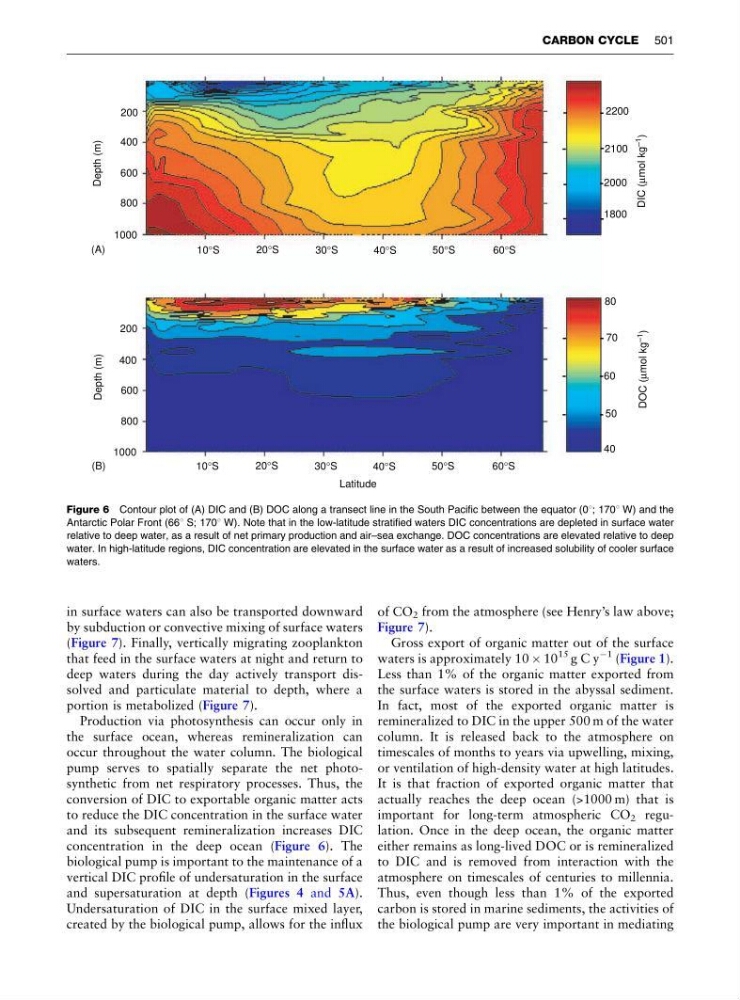
pump serves to spatially separate the net photosynthetic from net respiratory processes. Thus, the
conversion of DIC to exportable organic matter acts
to reduce the DIC concentration in the surface water
and its subsequent remineralization increases DIC
concentration in the deep ocean (Figure 6). The
biological pump is important to the maintenance of a
vertical DIC profile of undersaturation in the surface
and supersaturation at depth (Figures 4 and 5A).
Undersaturation of DIC in the surface mixed layer,
created by the biological pump, allows for the influx
of CO 2 from the atmosphere (see Henry’s law above;
Figure 7).
Gross export of organic matter out of the surface
waters is approximately 10 Â 10
15 g C y
À1 (Figure 1).
Less than 1% of the organic matter exported from
the surface waters is stored in the abyssal sediment.
In fact, most of the exported organic matter is
remineralized to DIC in the upper 500 m of the water
column. It is released back to the atmosphere on
timescales of months to years via upwelling, mixing,
or ventilation of high-density water at high latitudes.
It is that fraction of exported organic matter that
actually reaches the deep ocean (>1000 m) that is
important for long-term atmospheric CO 2 regulation. Once in the deep ocean, the organic matter
either remains as long-lived DOC or is remineralized
to DIC and is removed from interaction with the
atmosphere on timescales of centuries to millennia.
Thus, even though less than 1% of the exported
carbon is stored in marine sediments, the activities of
the biological pump are very important in mediating
200
400
600
800
1000
(A)
200
400
600
800
1000
Latitude
2200
2100
2000
1800
80
70
60
50
40
DIC (μmol kg
–1
)
DOC (μmol kg –1
)
(B)
Depth (m)
Depth (m)
10°S
20°S
30°S
40°S
50°S
60°S
10°S
20°S
30°S
40°S
50°S
60°S
Figure 6 Contour plot of (A) DIC and (B) DOC along a transect line in the South Pacific between the equator (01; 1701 W) and the
Antarctic Polar Front (661 S; 1701 W). Note that in the low-latitude stratified waters DIC concentrations are depleted in surface water
relative to deep water, as a result of net primary production and air–sea exchange. DOC concentrations are elevated relative to deep
water. In high-latitude regions, DIC concentration are elevated in the surface water as a result of increased solubility of cooler surface
waters.
CARBON CYCLE 501
by subduction or convective mixing of surface waters
(Figure 7). Finally, vertically migrating zooplankton
that feed in the surface waters at night and return to
deep waters during the day actively transport dissolved and particulate material to depth, where a
portion is metabolized (Figure 7).
Production via photosynthesis can occur only in
the surface ocean, whereas remineralization can
occur throughout the water column. The biological
pump serves to spatially separate the net photosynthetic from net respiratory processes. Thus, the
conversion of DIC to exportable organic matter acts
to reduce the DIC concentration in the surface water
and its subsequent remineralization increases DIC
concentration in the deep ocean (Figure 6). The
biological pump is important to the maintenance of a
vertical DIC profile of undersaturation in the surface
and supersaturation at depth (Figures 4 and 5A).
Undersaturation of DIC in the surface mixed layer,
created by the biological pump, allows for the influx
of CO 2 from the atmosphere (see Henry’s law above;
Figure 7).
Gross export of organic matter out of the surface
waters is approximately 10 Â 10
15 g C y
À1 (Figure 1).
Less than 1% of the organic matter exported from
the surface waters is stored in the abyssal sediment.
In fact, most of the exported organic matter is
remineralized to DIC in the upper 500 m of the water
column. It is released back to the atmosphere on
timescales of months to years via upwelling, mixing,
or ventilation of high-density water at high latitudes.
It is that fraction of exported organic matter that
actually reaches the deep ocean (>1000 m) that is
important for long-term atmospheric CO 2 regulation. Once in the deep ocean, the organic matter
either remains as long-lived DOC or is remineralized
to DIC and is removed from interaction with the
atmosphere on timescales of centuries to millennia.
Thus, even though less than 1% of the exported
carbon is stored in marine sediments, the activities of
the biological pump are very important in mediating
200
400
600
800
1000
(A)
200
400
600
800
1000
Latitude
2200
2100
2000
1800
80
70
60
50
40
DIC (μmol kg
–1
)
DOC (μmol kg –1
)
(B)
Depth (m)
Depth (m)
10°S
20°S
30°S
40°S
50°S
60°S
10°S
20°S
30°S
40°S
50°S
60°S
Figure 6 Contour plot of (A) DIC and (B) DOC along a transect line in the South Pacific between the equator (01; 1701 W) and the
Antarctic Polar Front (661 S; 1701 W). Note that in the low-latitude stratified waters DIC concentrations are depleted in surface water
relative to deep water, as a result of net primary production and air–sea exchange. DOC concentrations are elevated relative to deep
water. In high-latitude regions, DIC concentration are elevated in the surface water as a result of increased solubility of cooler surface
waters.
CARBON CYCLE 501