

circulation) and the deep ocean (thermohaline circulation). These circulation patterns assist in the
transfer of atmospheric CO 2 to the deep ocean and
help to maintain the vertical gradient of DIC found
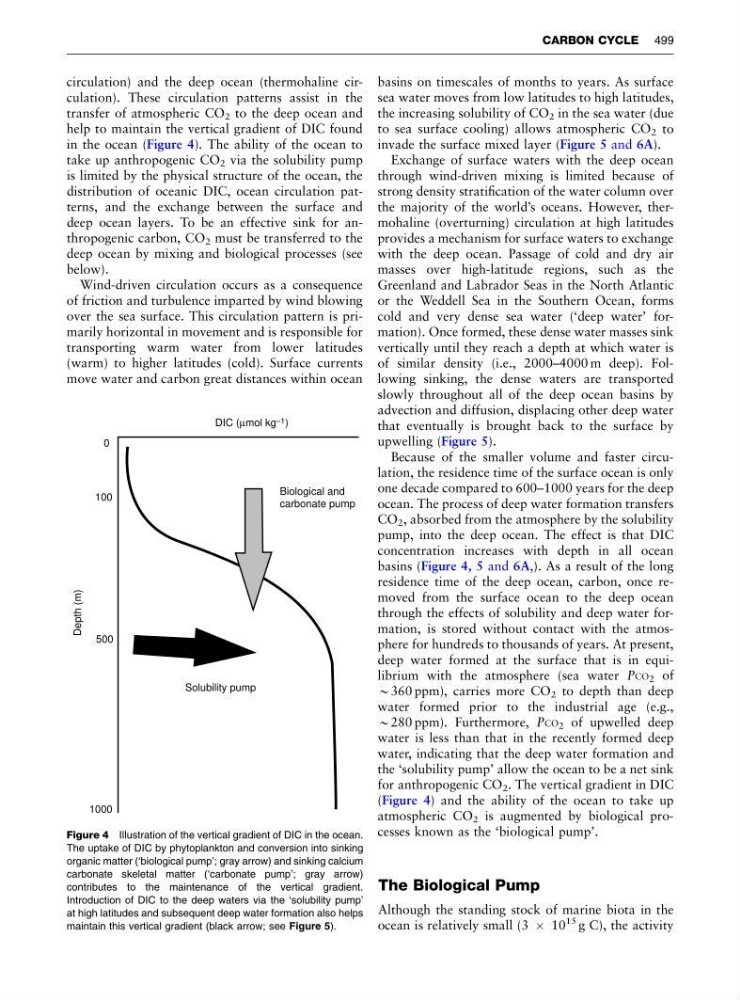
in the ocean (Figure 4). The ability of the ocean to
take up anthropogenic CO 2 via the solubility pump
is limited by the physical structure of the ocean, the
distribution of oceanic DIC, ocean circulation patterns, and the exchange between the surface and
deep ocean layers. To be an effective sink for anthropogenic carbon, CO 2 must be transferred to the
deep ocean by mixing and biological processes (see
below).
Wind-driven circulation occurs as a consequence
of friction and turbulence imparted by wind blowing
over the sea surface. This circulation pattern is primarily horizontal in movement and is responsible for
transporting warm water from lower latitudes
(warm) to higher latitudes (cold). Surface currents
move water and carbon great distances within ocean
basins on timescales of months to years. As surface
sea water moves from low latitudes to high latitudes,
the increasing solubility of CO 2 in the sea water (due
to sea surface cooling) allows atmospheric CO 2 to
invade the surface mixed layer (Figure 5 and 6A).
Exchange of surface waters with the deep ocean
through wind-driven mixing is limited because of
strong density stratification of the water column over
the majority of the world’s oceans. However, thermohaline (overturning) circulation at high latitudes
provides a mechanism for surface waters to exchange
with the deep ocean. Passage of cold and dry air
masses over high-latitude regions, such as the
Greenland and Labrador Seas in the North Atlantic
or the Weddell Sea in the Southern Ocean, forms
cold and very dense sea water (‘deep water’ formation). Once formed, these dense water masses sink
vertically until they reach a depth at which water is
of similar density (i.e., 2000–4000 m deep). Following sinking, the dense waters are transported
slowly throughout all of the deep ocean basins by
advection and diffusion, displacing other deep water
that eventually is brought back to the surface by
upwelling (Figure 5).
Because of the smaller volume and faster circulation, the residence time of the surface ocean is only
one decade compared to 600–1000 years for the deep
ocean. The process of deep water formation transfers
CO 2 , absorbed from the atmosphere by the solubility
pump, into the deep ocean. The effect is that DIC
concentration increases with depth in all ocean
basins (Figure 4, 5 and 6A,). As a result of the long
residence time of the deep ocean, carbon, once removed from the surface ocean to the deep ocean
through the effects of solubility and deep water formation, is stored without contact with the atmosphere for hundreds to thousands of years. At present,
deep water formed at the surface that is in equilibrium with the atmosphere (sea water PCO 2 of
B360 ppm), carries more CO 2 to depth than deep
water formed prior to the industrial age (e.g.,
B280 ppm). Furthermore, PCO 2 of upwelled deep
water is less than that in the recently formed deep
water, indicating that the deep water formation and
the ‘solubility pump’ allow the ocean to be a net sink
for anthropogenic CO 2 . The vertical gradient in DIC
(Figure 4) and the ability of the ocean to take up
atmospheric CO 2 is augmented by biological processes known as the ‘biological pump’.
The Biological Pump
Although the standing stock of marine biota in the
ocean is relatively small (3 Â 10
15 g C), the activity
DIC (μmol kg –1 )
0
100
500
1000
Depth (m)
Biological and
carbonate pump
Solubility pump
Figure 4 Illustration of the vertical gradient of DIC in the ocean.
The uptake of DIC by phytoplankton and conversion into sinking
organic matter (‘biological pump’; gray arrow) and sinking calcium
carbonate skeletal matter (‘carbonate pump’; gray arrow)
contributes to the maintenance of the vertical gradient.
Introduction of DIC to the deep waters via the ‘solubility pump’
at high latitudes and subsequent deep water formation also helps
maintain this vertical gradient (black arrow; see Figure 5).
CARBON CYCLE 499
transfer of atmospheric CO 2 to the deep ocean and
help to maintain the vertical gradient of DIC found
in the ocean (Figure 4). The ability of the ocean to
take up anthropogenic CO 2 via the solubility pump
is limited by the physical structure of the ocean, the
distribution of oceanic DIC, ocean circulation patterns, and the exchange between the surface and
deep ocean layers. To be an effective sink for anthropogenic carbon, CO 2 must be transferred to the
deep ocean by mixing and biological processes (see
below).
Wind-driven circulation occurs as a consequence
of friction and turbulence imparted by wind blowing
over the sea surface. This circulation pattern is primarily horizontal in movement and is responsible for
transporting warm water from lower latitudes
(warm) to higher latitudes (cold). Surface currents
move water and carbon great distances within ocean
basins on timescales of months to years. As surface
sea water moves from low latitudes to high latitudes,
the increasing solubility of CO 2 in the sea water (due
to sea surface cooling) allows atmospheric CO 2 to
invade the surface mixed layer (Figure 5 and 6A).
Exchange of surface waters with the deep ocean
through wind-driven mixing is limited because of
strong density stratification of the water column over
the majority of the world’s oceans. However, thermohaline (overturning) circulation at high latitudes
provides a mechanism for surface waters to exchange
with the deep ocean. Passage of cold and dry air
masses over high-latitude regions, such as the
Greenland and Labrador Seas in the North Atlantic
or the Weddell Sea in the Southern Ocean, forms
cold and very dense sea water (‘deep water’ formation). Once formed, these dense water masses sink
vertically until they reach a depth at which water is
of similar density (i.e., 2000–4000 m deep). Following sinking, the dense waters are transported
slowly throughout all of the deep ocean basins by
advection and diffusion, displacing other deep water
that eventually is brought back to the surface by
upwelling (Figure 5).
Because of the smaller volume and faster circulation, the residence time of the surface ocean is only
one decade compared to 600–1000 years for the deep
ocean. The process of deep water formation transfers
CO 2 , absorbed from the atmosphere by the solubility
pump, into the deep ocean. The effect is that DIC
concentration increases with depth in all ocean
basins (Figure 4, 5 and 6A,). As a result of the long
residence time of the deep ocean, carbon, once removed from the surface ocean to the deep ocean
through the effects of solubility and deep water formation, is stored without contact with the atmosphere for hundreds to thousands of years. At present,
deep water formed at the surface that is in equilibrium with the atmosphere (sea water PCO 2 of
B360 ppm), carries more CO 2 to depth than deep
water formed prior to the industrial age (e.g.,
B280 ppm). Furthermore, PCO 2 of upwelled deep
water is less than that in the recently formed deep
water, indicating that the deep water formation and
the ‘solubility pump’ allow the ocean to be a net sink
for anthropogenic CO 2 . The vertical gradient in DIC
(Figure 4) and the ability of the ocean to take up
atmospheric CO 2 is augmented by biological processes known as the ‘biological pump’.
The Biological Pump
Although the standing stock of marine biota in the
ocean is relatively small (3 Â 10
15 g C), the activity
DIC (μmol kg –1 )
0
100
500
1000
Depth (m)
Biological and
carbonate pump
Solubility pump
Figure 4 Illustration of the vertical gradient of DIC in the ocean.
The uptake of DIC by phytoplankton and conversion into sinking
organic matter (‘biological pump’; gray arrow) and sinking calcium
carbonate skeletal matter (‘carbonate pump’; gray arrow)
contributes to the maintenance of the vertical gradient.
Introduction of DIC to the deep waters via the ‘solubility pump’
at high latitudes and subsequent deep water formation also helps
maintain this vertical gradient (black arrow; see Figure 5).
CARBON CYCLE 499