

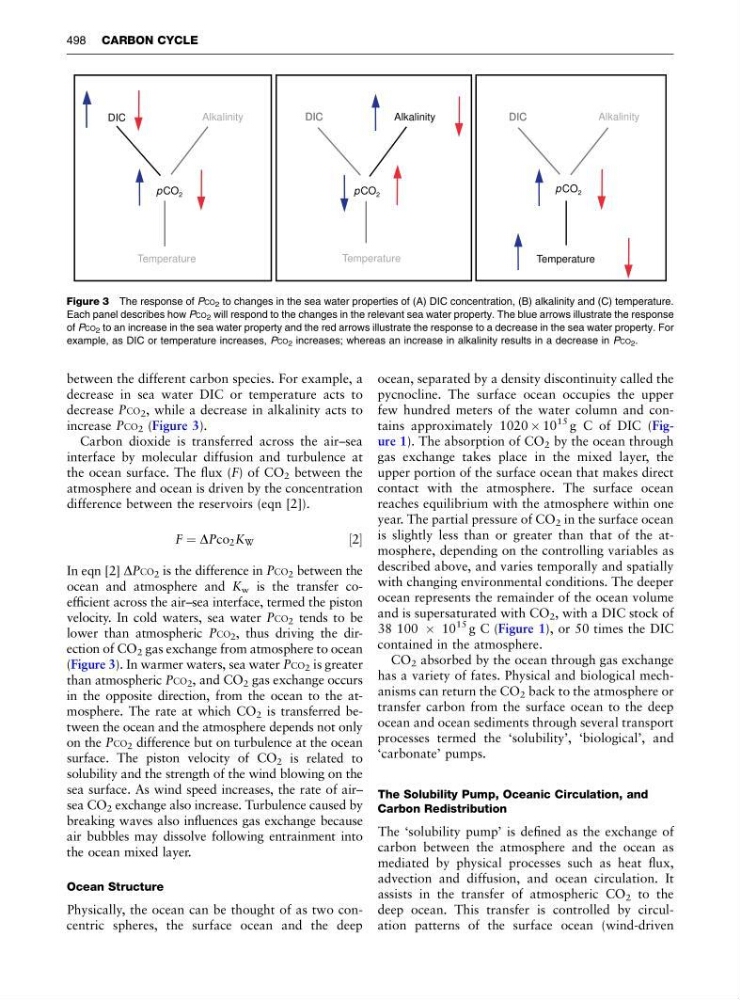
between the different carbon species. For example, a
decrease in sea water DIC or temperature acts to
decrease PCO 2 , while a decrease in alkalinity acts to
increase PCO 2 (Figure 3).
Carbon dioxide is transferred across the air–sea
interface by molecular diffusion and turbulence at
the ocean surface. The flux (F) of CO 2 between the
atmosphere and ocean is driven by the concentration
difference between the reservoirs (eqn [2]).
F ¼ DPco 2 K W
½2
In eqn [2] DPCO 2 is the difference in PCO 2 between the
ocean and atmosphere and K w is the transfer coefficient across the air–sea interface, termed the piston
velocity. In cold waters, sea water PCO 2 tends to be
lower than atmospheric PCO 2 , thus driving the direction of CO 2 gas exchange from atmosphere to ocean
(Figure 3). In warmer waters, sea water PCO 2 is greater
than atmospheric PCO 2 , and CO 2 gas exchange occurs
in the opposite direction, from the ocean to the atmosphere. The rate at which CO 2 is transferred between the ocean and the atmosphere depends not only
on the PCO 2 difference but on turbulence at the ocean
surface. The piston velocity of CO 2 is related to
solubility and the strength of the wind blowing on the
sea surface. As wind speed increases, the rate of air–
sea CO 2 exchange also increase. Turbulence caused by
breaking waves also influences gas exchange because
air bubbles may dissolve following entrainment into
the ocean mixed layer.
Ocean Structure
Physically, the ocean can be thought of as two concentric spheres, the surface ocean and the deep
ocean, separated by a density discontinuity called the
pycnocline. The surface ocean occupies the upper
few hundred meters of the water column and contains approximately 1020 Â 10
15 g C of DIC (Figure 1). The absorption of CO 2 by the ocean through
gas exchange takes place in the mixed layer, the
upper portion of the surface ocean that makes direct
contact with the atmosphere. The surface ocean
reaches equilibrium with the atmosphere within one
year. The partial pressure of CO 2 in the surface ocean
is slightly less than or greater than that of the atmosphere, depending on the controlling variables as
described above, and varies temporally and spatially
with changing environmental conditions. The deeper
ocean represents the remainder of the ocean volume
and is supersaturated with CO 2 , with a DIC stock of
38 100 Â 10
15 g C (Figure 1), or 50 times the DIC
contained in the atmosphere.
CO 2 absorbed by the ocean through gas exchange
has a variety of fates. Physical and biological mechanisms can return the CO 2 back to the atmosphere or
transfer carbon from the surface ocean to the deep
ocean and ocean sediments through several transport
processes termed the ‘solubility’, ‘biological’, and
‘carbonate’ pumps.
The Solubility Pump, Oceanic Circulation, and
Carbon Redistribution
The ‘solubility pump’ is defined as the exchange of
carbon between the atmosphere and the ocean as
mediated by physical processes such as heat flux,
advection and diffusion, and ocean circulation. It
assists in the transfer of atmospheric CO 2 to the
deep ocean. This transfer is controlled by circulation patterns of the surface ocean (wind-driven
Temperature
DIC
p CO 2
pCO 2
Alkalinity
DIC
Temperature
Alkalinity
p CO 2
Temperature
Alkalinity
DIC
Figure 3 The response of PCO 2 to changes in the sea water properties of (A) DIC concentration, (B) alkalinity and (C) temperature.
Each panel describes how PCO 2 will respond to the changes in the relevant sea water property. The blue arrows illustrate the response
of PCO 2 to an increase in the sea water property and the red arrows illustrate the response to a decrease in the sea water property. For
example, as DIC or temperature increases, PCO 2 increases; whereas an increase in alkalinity results in a decrease in PCO 2 .
498 CARBON CYCLE
decrease in sea water DIC or temperature acts to
decrease PCO 2 , while a decrease in alkalinity acts to
increase PCO 2 (Figure 3).
Carbon dioxide is transferred across the air–sea
interface by molecular diffusion and turbulence at
the ocean surface. The flux (F) of CO 2 between the
atmosphere and ocean is driven by the concentration
difference between the reservoirs (eqn [2]).
F ¼ DPco 2 K W
½2
In eqn [2] DPCO 2 is the difference in PCO 2 between the
ocean and atmosphere and K w is the transfer coefficient across the air–sea interface, termed the piston
velocity. In cold waters, sea water PCO 2 tends to be
lower than atmospheric PCO 2 , thus driving the direction of CO 2 gas exchange from atmosphere to ocean
(Figure 3). In warmer waters, sea water PCO 2 is greater
than atmospheric PCO 2 , and CO 2 gas exchange occurs
in the opposite direction, from the ocean to the atmosphere. The rate at which CO 2 is transferred between the ocean and the atmosphere depends not only
on the PCO 2 difference but on turbulence at the ocean
surface. The piston velocity of CO 2 is related to
solubility and the strength of the wind blowing on the
sea surface. As wind speed increases, the rate of air–
sea CO 2 exchange also increase. Turbulence caused by
breaking waves also influences gas exchange because
air bubbles may dissolve following entrainment into
the ocean mixed layer.
Ocean Structure
Physically, the ocean can be thought of as two concentric spheres, the surface ocean and the deep
ocean, separated by a density discontinuity called the
pycnocline. The surface ocean occupies the upper
few hundred meters of the water column and contains approximately 1020 Â 10
15 g C of DIC (Figure 1). The absorption of CO 2 by the ocean through
gas exchange takes place in the mixed layer, the
upper portion of the surface ocean that makes direct
contact with the atmosphere. The surface ocean
reaches equilibrium with the atmosphere within one
year. The partial pressure of CO 2 in the surface ocean
is slightly less than or greater than that of the atmosphere, depending on the controlling variables as
described above, and varies temporally and spatially
with changing environmental conditions. The deeper
ocean represents the remainder of the ocean volume
and is supersaturated with CO 2 , with a DIC stock of
38 100 Â 10
15 g C (Figure 1), or 50 times the DIC
contained in the atmosphere.
CO 2 absorbed by the ocean through gas exchange
has a variety of fates. Physical and biological mechanisms can return the CO 2 back to the atmosphere or
transfer carbon from the surface ocean to the deep
ocean and ocean sediments through several transport
processes termed the ‘solubility’, ‘biological’, and
‘carbonate’ pumps.
The Solubility Pump, Oceanic Circulation, and
Carbon Redistribution
The ‘solubility pump’ is defined as the exchange of
carbon between the atmosphere and the ocean as
mediated by physical processes such as heat flux,
advection and diffusion, and ocean circulation. It
assists in the transfer of atmospheric CO 2 to the
deep ocean. This transfer is controlled by circulation patterns of the surface ocean (wind-driven
Temperature
DIC
p CO 2
pCO 2
Alkalinity
DIC
Temperature
Alkalinity
p CO 2
Temperature
Alkalinity
DIC
Figure 3 The response of PCO 2 to changes in the sea water properties of (A) DIC concentration, (B) alkalinity and (C) temperature.
Each panel describes how PCO 2 will respond to the changes in the relevant sea water property. The blue arrows illustrate the response
of PCO 2 to an increase in the sea water property and the red arrows illustrate the response to a decrease in the sea water property. For
example, as DIC or temperature increases, PCO 2 increases; whereas an increase in alkalinity results in a decrease in PCO 2 .
498 CARBON CYCLE