

The residual inventory, or ‘excess’, is then divided by
the concentration of the tracer in the discharging
groundwater to calculate the groundwater flow rate.
Naturally occurring radionuclides such as radium
isotopes and radon-222 have gained popularity as
tracers of SGD due to their enrichment in groundwater relative to other sources and their built-in
radioactive ‘clocks’. The enrichment of these tracers
is owed to the fact that the water–sediment ratio in
aquifers is usually quite small and that aquifer sediments (and sediments in general) are enriched in
many U and Th series isotopes; while many of these
isotopes are particle reactive and remain bound
to the sediments, some like Ra can easily partition
into the aqueous phase. Radon-222 (t 1/2 ¼ 3.82 days)
is the daughter product of
226 Ra (t 1/2 ¼ 1600 years)
and a noble gas; therefore, it is even more enriched in
groundwater than radium.
A key issue when comparing different techniques
for measuring SGD is the need to define the fluid
composition that each method is measuring (i.e.,
fresh, saline, or brackish SGD). For example,
whereas hydrogeological techniques are estimates of
fresh SGD, the radium and radon methods include a
component of recirculated seawater. Therefore, it is
often not possible to directly compare the utility of
these techniques. Instead, they should be regarded as
complementary.
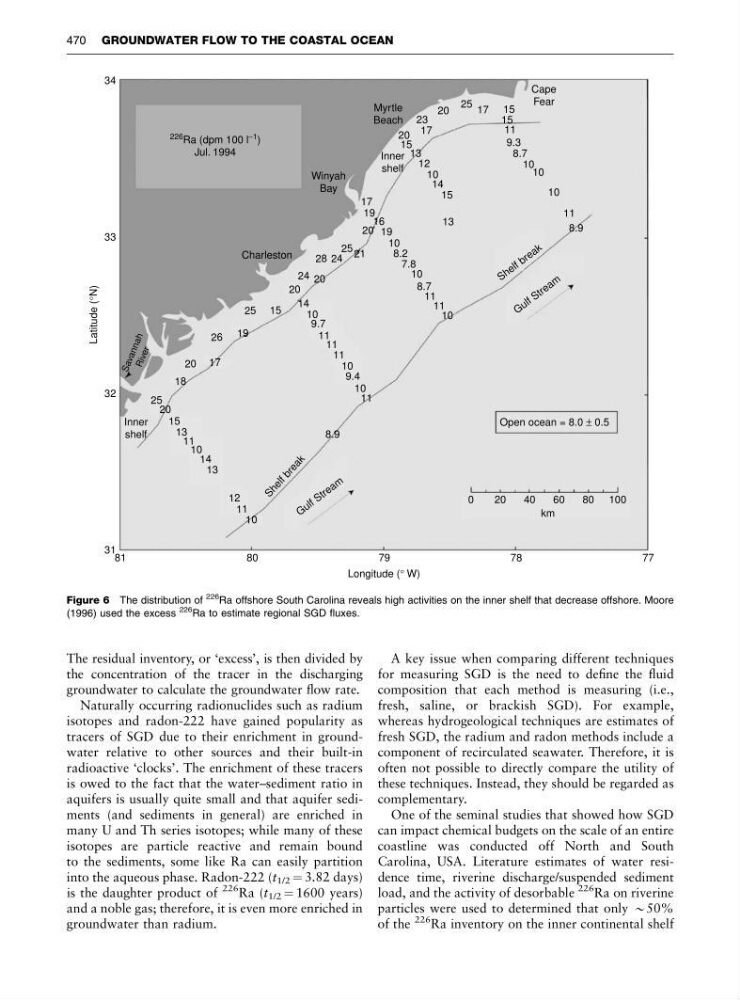
One of the seminal studies that showed how SGD
can impact chemical budgets on the scale of an entire
coastline was conducted off North and South
Carolina, USA. Literature estimates of water residence time, riverine discharge/suspended sediment
load, and the activity of desorbable
226
Ra on riverine
particles were used to determined that only B50%
of the
226 Ra inventory on the inner continental shelf
34
33
32
31
81
80
79
78
77
Longitude (° W)
0
20
40
60
80 100
km
Open ocean = 8.0 ± 0.5
G u l f S t r e a m
G u l f S t r e a m
S a v a n n a h
R iv e r
Myrtle
Beach
Inner
shelf
Winyah
Bay
Charleston
226 Ra (dpm 100 l
−1 )
Jul. 1994
Cape
Fear
25
20
20
23
17
15
13
12
10
10
10
10
10
11
11
11
11
8.9
8.2
8.7
7.8
10
10
10
11
17
16
19
19
20
21
25
25
26
17
20
18
25
20
15
13
11
10
14
13
12
11
10
24
24
28
20
19
20
15
14
10
10
11
11
11
15
15
14
15
13
17
9.3
8.9
8.7
S h e l f b r e a k
S h e l f b r e a k
Inner
shelf
9.7
9.4
Latitude (°N)
Figure 6 The distribution of
226 Ra offshore South Carolina reveals high activities on the inner shelf that decrease offshore. Moore
(1996) used the excess
226 Ra to estimate regional SGD fluxes.
470 GROUNDWATER FLOW TO THE COASTAL OCEAN
the concentration of the tracer in the discharging
groundwater to calculate the groundwater flow rate.
Naturally occurring radionuclides such as radium
isotopes and radon-222 have gained popularity as
tracers of SGD due to their enrichment in groundwater relative to other sources and their built-in
radioactive ‘clocks’. The enrichment of these tracers
is owed to the fact that the water–sediment ratio in
aquifers is usually quite small and that aquifer sediments (and sediments in general) are enriched in
many U and Th series isotopes; while many of these
isotopes are particle reactive and remain bound
to the sediments, some like Ra can easily partition
into the aqueous phase. Radon-222 (t 1/2 ¼ 3.82 days)
is the daughter product of
226 Ra (t 1/2 ¼ 1600 years)
and a noble gas; therefore, it is even more enriched in
groundwater than radium.
A key issue when comparing different techniques
for measuring SGD is the need to define the fluid
composition that each method is measuring (i.e.,
fresh, saline, or brackish SGD). For example,
whereas hydrogeological techniques are estimates of
fresh SGD, the radium and radon methods include a
component of recirculated seawater. Therefore, it is
often not possible to directly compare the utility of
these techniques. Instead, they should be regarded as
complementary.
One of the seminal studies that showed how SGD
can impact chemical budgets on the scale of an entire
coastline was conducted off North and South
Carolina, USA. Literature estimates of water residence time, riverine discharge/suspended sediment
load, and the activity of desorbable
226
Ra on riverine
particles were used to determined that only B50%
of the
226 Ra inventory on the inner continental shelf
34
33
32
31
81
80
79
78
77
Longitude (° W)
0
20
40
60
80 100
km
Open ocean = 8.0 ± 0.5
G u l f S t r e a m
G u l f S t r e a m
S a v a n n a h
R iv e r
Myrtle
Beach
Inner
shelf
Winyah
Bay
Charleston
226 Ra (dpm 100 l
−1 )
Jul. 1994
Cape
Fear
25
20
20
23
17
15
13
12
10
10
10
10
10
11
11
11
11
8.9
8.2
8.7
7.8
10
10
10
11
17
16
19
19
20
21
25
25
26
17
20
18
25
20
15
13
11
10
14
13
12
11
10
24
24
28
20
19
20
15
14
10
10
11
11
11
15
15
14
15
13
17
9.3
8.9
8.7
S h e l f b r e a k
S h e l f b r e a k
Inner
shelf
9.7
9.4
Latitude (°N)
Figure 6 The distribution of
226 Ra offshore South Carolina reveals high activities on the inner shelf that decrease offshore. Moore
(1996) used the excess
226 Ra to estimate regional SGD fluxes.
470 GROUNDWATER FLOW TO THE COASTAL OCEAN