

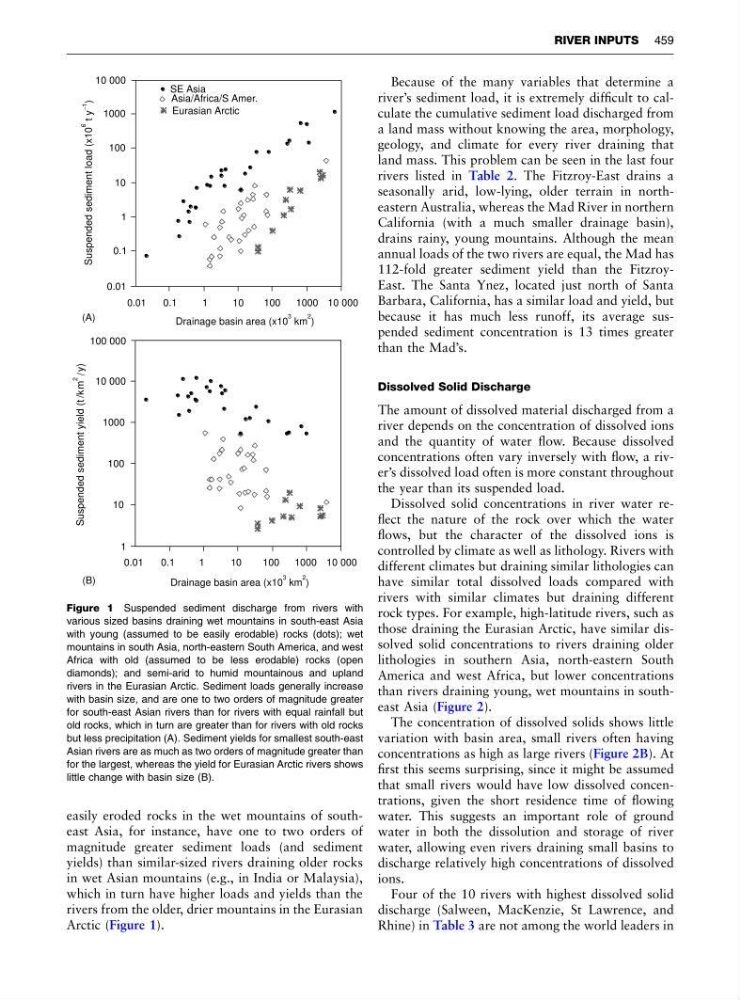
easily eroded rocks in the wet mountains of southeast Asia, for instance, have one to two orders of
magnitude greater sediment loads (and sediment
yields) than similar-sized rivers draining older rocks
in wet Asian mountains (e.g., in India or Malaysia),
which in turn have higher loads and yields than the
rivers from the older, drier mountains in the Eurasian
Arctic (Figure 1).
Because of the many variables that determine a
river’s sediment load, it is extremely difficult to calculate the cumulative sediment load discharged from
a land mass without knowing the area, morphology,
geology, and climate for every river draining that
land mass. This problem can be seen in the last four
rivers listed in Table 2. The Fitzroy-East drains a
seasonally arid, low-lying, older terrain in northeastern Australia, whereas the Mad River in northern
California (with a much smaller drainage basin),
drains rainy, young mountains. Although the mean
annual loads of the two rivers are equal, the Mad has
112-fold greater sediment yield than the FitzroyEast. The Santa Ynez, located just north of Santa
Barbara, California, has a similar load and yield, but
because it has much less runoff, its average suspended sediment concentration is 13 times greater
than the Mad’s.
Dissolved Solid Discharge
The amount of dissolved material discharged from a
river depends on the concentration of dissolved ions
and the quantity of water flow. Because dissolved
concentrations often vary inversely with flow, a river’s dissolved load often is more constant throughout
the year than its suspended load.
Dissolved solid concentrations in river water reflect the nature of the rock over which the water
flows, but the character of the dissolved ions is
controlled by climate as well as lithology. Rivers with
different climates but draining similar lithologies can
have similar total dissolved loads compared with
rivers with similar climates but draining different
rock types. For example, high-latitude rivers, such as
those draining the Eurasian Arctic, have similar dissolved solid concentrations to rivers draining older
lithologies in southern Asia, north-eastern South
America and west Africa, but lower concentrations
than rivers draining young, wet mountains in southeast Asia (Figure 2).
The concentration of dissolved solids shows little
variation with basin area, small rivers often having
concentrations as high as large rivers (Figure 2B). At
first this seems surprising, since it might be assumed
that small rivers would have low dissolved concentrations, given the short residence time of flowing
water. This suggests an important role of ground
water in both the dissolution and storage of river
water, allowing even rivers draining small basins to
discharge relatively high concentrations of dissolved
ions.
Four of the 10 rivers with highest dissolved solid
discharge (Salween, MacKenzie, St Lawrence, and
Rhine) in Table 3 are not among the world leaders in
0.01
0.1
1
10
100
1000
10 000
Suspended sediment load (x10 t y )
6
_
1
0.01
0.1
1
100
10
1000 10 000
SE Asia
Asia/Africa/S Amer.
Eurasian Arctic
1
10
100
1000
10 000
100 000
Suspended sediment yield (t /km
/ y)
2
0.01
0.1
1
10
100
1000 10 000
Drainage basin area (x10 km )
3
2
Drainage basin area (x10 km )
3
2
(A)
(B)
Figure 1 Suspended sediment discharge from rivers with
various sized basins draining wet mountains in south-east Asia
with young (assumed to be easily erodable) rocks (dots); wet
mountains in south Asia, north-eastern South America, and west
Africa with old (assumed to be less erodable) rocks (open
diamonds); and semi-arid to humid mountainous and upland
rivers in the Eurasian Arctic. Sediment loads generally increase
with basin size, and are one to two orders of magnitude greater
for south-east Asian rivers than for rivers with equal rainfall but
old rocks, which in turn are greater than for rivers with old rocks
but less precipitation (A). Sediment yields for smallest south-east
Asian rivers are as much as two orders of magnitude greater than
for the largest, whereas the yield for Eurasian Arctic rivers shows
little change with basin size (B).
RIVER INPUTS 459
magnitude greater sediment loads (and sediment
yields) than similar-sized rivers draining older rocks
in wet Asian mountains (e.g., in India or Malaysia),
which in turn have higher loads and yields than the
rivers from the older, drier mountains in the Eurasian
Arctic (Figure 1).
Because of the many variables that determine a
river’s sediment load, it is extremely difficult to calculate the cumulative sediment load discharged from
a land mass without knowing the area, morphology,
geology, and climate for every river draining that
land mass. This problem can be seen in the last four
rivers listed in Table 2. The Fitzroy-East drains a
seasonally arid, low-lying, older terrain in northeastern Australia, whereas the Mad River in northern
California (with a much smaller drainage basin),
drains rainy, young mountains. Although the mean
annual loads of the two rivers are equal, the Mad has
112-fold greater sediment yield than the FitzroyEast. The Santa Ynez, located just north of Santa
Barbara, California, has a similar load and yield, but
because it has much less runoff, its average suspended sediment concentration is 13 times greater
than the Mad’s.
Dissolved Solid Discharge
The amount of dissolved material discharged from a
river depends on the concentration of dissolved ions
and the quantity of water flow. Because dissolved
concentrations often vary inversely with flow, a river’s dissolved load often is more constant throughout
the year than its suspended load.
Dissolved solid concentrations in river water reflect the nature of the rock over which the water
flows, but the character of the dissolved ions is
controlled by climate as well as lithology. Rivers with
different climates but draining similar lithologies can
have similar total dissolved loads compared with
rivers with similar climates but draining different
rock types. For example, high-latitude rivers, such as
those draining the Eurasian Arctic, have similar dissolved solid concentrations to rivers draining older
lithologies in southern Asia, north-eastern South
America and west Africa, but lower concentrations
than rivers draining young, wet mountains in southeast Asia (Figure 2).
The concentration of dissolved solids shows little
variation with basin area, small rivers often having
concentrations as high as large rivers (Figure 2B). At
first this seems surprising, since it might be assumed
that small rivers would have low dissolved concentrations, given the short residence time of flowing
water. This suggests an important role of ground
water in both the dissolution and storage of river
water, allowing even rivers draining small basins to
discharge relatively high concentrations of dissolved
ions.
Four of the 10 rivers with highest dissolved solid
discharge (Salween, MacKenzie, St Lawrence, and
Rhine) in Table 3 are not among the world leaders in
0.01
0.1
1
10
100
1000
10 000
Suspended sediment load (x10 t y )
6
_
1
0.01
0.1
1
100
10
1000 10 000
SE Asia
Asia/Africa/S Amer.
Eurasian Arctic
1
10
100
1000
10 000
100 000
Suspended sediment yield (t /km
/ y)
2
0.01
0.1
1
10
100
1000 10 000
Drainage basin area (x10 km )
3
2
Drainage basin area (x10 km )
3
2
(A)
(B)
Figure 1 Suspended sediment discharge from rivers with
various sized basins draining wet mountains in south-east Asia
with young (assumed to be easily erodable) rocks (dots); wet
mountains in south Asia, north-eastern South America, and west
Africa with old (assumed to be less erodable) rocks (open
diamonds); and semi-arid to humid mountainous and upland
rivers in the Eurasian Arctic. Sediment loads generally increase
with basin size, and are one to two orders of magnitude greater
for south-east Asian rivers than for rivers with equal rainfall but
old rocks, which in turn are greater than for rivers with old rocks
but less precipitation (A). Sediment yields for smallest south-east
Asian rivers are as much as two orders of magnitude greater than
for the largest, whereas the yield for Eurasian Arctic rivers shows
little change with basin size (B).
RIVER INPUTS 459