

formation of solid-phase FeS. O 2 is still likely to be
of great importance, however. For instance, while the
Fe(III)/Fe(II) pathway may be used directly for organic
matter oxidation, it is the internal cycling between
Fe(III) and Fe(II) that allows this pathway to be important: the ultimate sink for electrons is likely to be
O 2 . This linking of oxidation/reduction reactions in
series is illustrated in Figure 7 using a diagram of the
sort introduced by Aller.
The Effect of Sedimentary Redox
Cycling on Nutrient Cycles
Sedimentary respiration results in the decomposition
of the majority of the organic matter that falls from
the water column to the sediments. However, sedimentary processes can result in less efficient cycling
of P and N than C, with potentially significant implications for coastal productivity.
Phosphate has a strong tendency to adsorb to Fe
oxides. Therefore, the precipitation of Fe oxides near
the interface of coastal and estuarine sediments can
impede the return of phosphate, released into solution
by the decomposition of organic matter, to the water
column. Figure 4 shows that dissolved reactive
phosphate (‘TRP’) can reach very high levels in sediments to which there is a large flux of organic matter.
In fact, the TRP level in Figure 4 is significantly
greater than would be predicted by the decomposition
of organic matter alone. This phenomenon is further
illustrated in Figure 8.
CO 2 ,
inorganic
nutrients
Mn(IV), Fe(III), SO 4
2−
Mn(II), Fe(II), S(−II)
Heterotrophic
respiration
Mn(IV),
NO 3
− , O 2
Mn(II), N 2 ,
or NH 4
+
Chemolithotrophy,
abiotic oxidation
Oxic layer
Anoxic layer
Oxic/anoxic
boundary
Sediment /water
interface
Particles
O 2
Accumulating
sediments
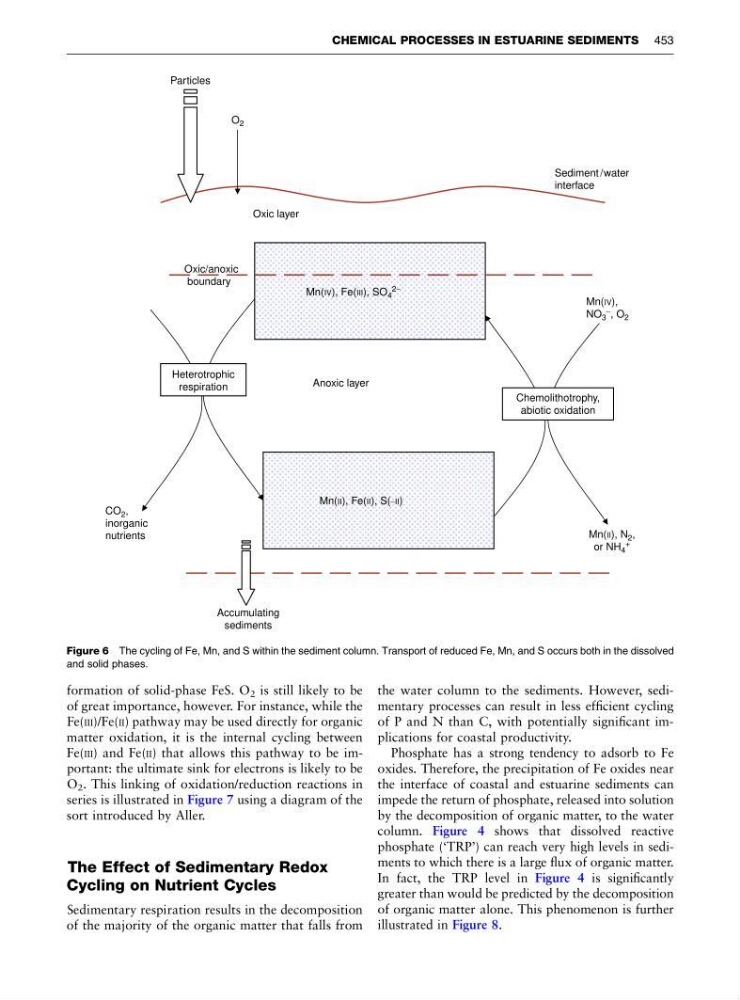
Figure 6 The cycling of Fe, Mn, and S within the sediment column. Transport of reduced Fe, Mn, and S occurs both in the dissolved
and solid phases.
CHEMICAL PROCESSES IN ESTUARINE SEDIMENTS 453
of great importance, however. For instance, while the
Fe(III)/Fe(II) pathway may be used directly for organic
matter oxidation, it is the internal cycling between
Fe(III) and Fe(II) that allows this pathway to be important: the ultimate sink for electrons is likely to be
O 2 . This linking of oxidation/reduction reactions in
series is illustrated in Figure 7 using a diagram of the
sort introduced by Aller.
The Effect of Sedimentary Redox
Cycling on Nutrient Cycles
Sedimentary respiration results in the decomposition
of the majority of the organic matter that falls from
the water column to the sediments. However, sedimentary processes can result in less efficient cycling
of P and N than C, with potentially significant implications for coastal productivity.
Phosphate has a strong tendency to adsorb to Fe
oxides. Therefore, the precipitation of Fe oxides near
the interface of coastal and estuarine sediments can
impede the return of phosphate, released into solution
by the decomposition of organic matter, to the water
column. Figure 4 shows that dissolved reactive
phosphate (‘TRP’) can reach very high levels in sediments to which there is a large flux of organic matter.
In fact, the TRP level in Figure 4 is significantly
greater than would be predicted by the decomposition
of organic matter alone. This phenomenon is further
illustrated in Figure 8.
CO 2 ,
inorganic
nutrients
Mn(IV), Fe(III), SO 4
2−
Mn(II), Fe(II), S(−II)
Heterotrophic
respiration
Mn(IV),
NO 3
− , O 2
Mn(II), N 2 ,
or NH 4
+
Chemolithotrophy,
abiotic oxidation
Oxic layer
Anoxic layer
Oxic/anoxic
boundary
Sediment /water
interface
Particles
O 2
Accumulating
sediments
Figure 6 The cycling of Fe, Mn, and S within the sediment column. Transport of reduced Fe, Mn, and S occurs both in the dissolved
and solid phases.
CHEMICAL PROCESSES IN ESTUARINE SEDIMENTS 453