

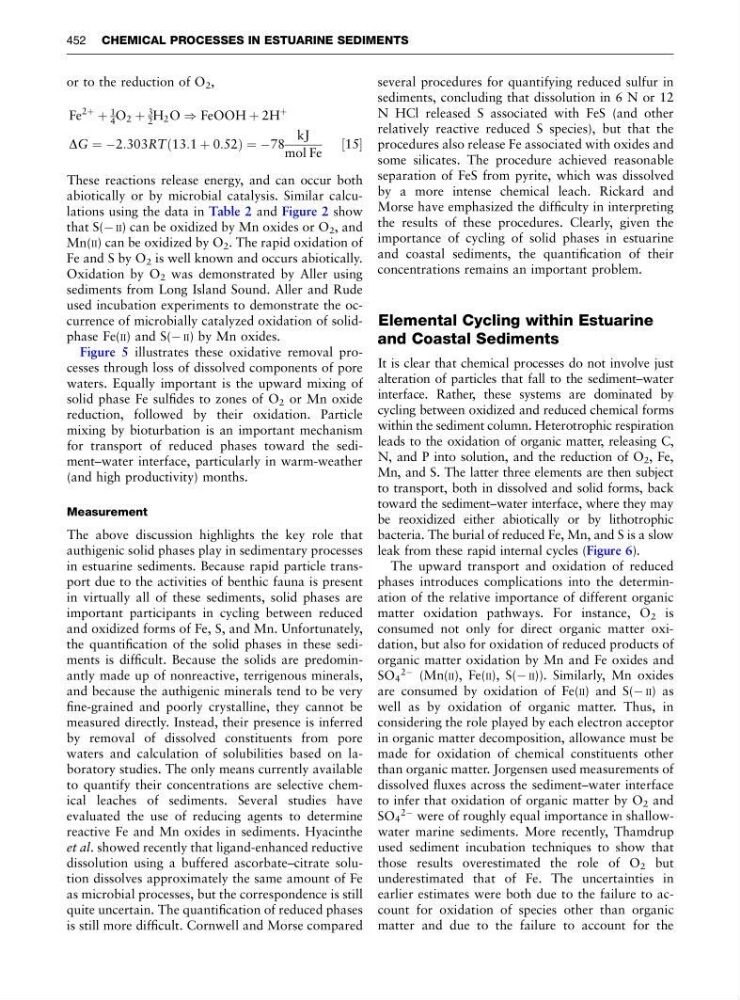
or to the reduction of O 2 ,
Fe
2þ þ
1
4 O 2 þ
3
2 H 2 O ) FeOOH þ 2H
þ
DG ¼ À2:303RTð13:1 þ 0:52Þ ¼ À78
kJ
mol Fe
½15
These reactions release energy, and can occur both
abiotically or by microbial catalysis. Similar calculations using the data in Table 2 and Figure 2 show
that S(À II) can be oxidized by Mn oxides or O 2 , and
Mn(II) can be oxidized by O 2 . The rapid oxidation of
Fe and S by O 2 is well known and occurs abiotically.
Oxidation by O 2 was demonstrated by Aller using
sediments from Long Island Sound. Aller and Rude
used incubation experiments to demonstrate the occurrence of microbially catalyzed oxidation of solidphase Fe(II) and S(À II) by Mn oxides.
Figure 5 illustrates these oxidative removal processes through loss of dissolved components of pore
waters. Equally important is the upward mixing of
solid phase Fe sulfides to zones of O 2 or Mn oxide
reduction, followed by their oxidation. Particle
mixing by bioturbation is an important mechanism
for transport of reduced phases toward the sediment–water interface, particularly in warm-weather
(and high productivity) months.
Measurement
The above discussion highlights the key role that
authigenic solid phases play in sedimentary processes
in estuarine sediments. Because rapid particle transport due to the activities of benthic fauna is present
in virtually all of these sediments, solid phases are
important participants in cycling between reduced
and oxidized forms of Fe, S, and Mn. Unfortunately,
the quantification of the solid phases in these sediments is difficult. Because the solids are predominantly made up of nonreactive, terrigenous minerals,
and because the authigenic minerals tend to be very
fine-grained and poorly crystalline, they cannot be
measured directly. Instead, their presence is inferred
by removal of dissolved constituents from pore
waters and calculation of solubilities based on laboratory studies. The only means currently available
to quantify their concentrations are selective chemical leaches of sediments. Several studies have
evaluated the use of reducing agents to determine
reactive Fe and Mn oxides in sediments. Hyacinthe
et al. showed recently that ligand-enhanced reductive
dissolution using a buffered ascorbate–citrate solution dissolves approximately the same amount of Fe
as microbial processes, but the correspondence is still
quite uncertain. The quantification of reduced phases
is still more difficult. Cornwell and Morse compared
several procedures for quantifying reduced sulfur in
sediments, concluding that dissolution in 6 N or 12
N HCl released S associated with FeS (and other
relatively reactive reduced S species), but that the
procedures also release Fe associated with oxides and
some silicates. The procedure achieved reasonable
separation of FeS from pyrite, which was dissolved
by a more intense chemical leach. Rickard and
Morse have emphasized the difficulty in interpreting
the results of these procedures. Clearly, given the
importance of cycling of solid phases in estuarine
and coastal sediments, the quantification of their
concentrations remains an important problem.
Elemental Cycling within Estuarine
and Coastal Sediments
It is clear that chemical processes do not involve just
alteration of particles that fall to the sediment–water
interface. Rather, these systems are dominated by
cycling between oxidized and reduced chemical forms
within the sediment column. Heterotrophic respiration
leads to the oxidation of organic matter, releasing C,
N, and P into solution, and the reduction of O 2 , Fe,
Mn, and S. The latter three elements are then subject
to transport, both in dissolved and solid forms, back
toward the sediment–water interface, where they may
be reoxidized either abiotically or by lithotrophic
bacteria. The burial of reduced Fe, Mn, and S is a slow
leak from these rapid internal cycles (Figure 6).
The upward transport and oxidation of reduced
phases introduces complications into the determination of the relative importance of different organic
matter oxidation pathways. For instance, O 2 is
consumed not only for direct organic matter oxidation, but also for oxidation of reduced products of
organic matter oxidation by Mn and Fe oxides and
SO 4
2À (Mn(II), Fe(II), S(À II)). Similarly, Mn oxides
are consumed by oxidation of Fe(II) and S(À II) as
well as by oxidation of organic matter. Thus, in
considering the role played by each electron acceptor
in organic matter decomposition, allowance must be
made for oxidation of chemical constituents other
than organic matter. Jorgensen used measurements of
dissolved fluxes across the sediment–water interface
to infer that oxidation of organic matter by O 2 and
SO 4
2À were of roughly equal importance in shallowwater marine sediments. More recently, Thamdrup
used sediment incubation techniques to show that
those results overestimated the role of O 2 but
underestimated that of Fe. The uncertainties in
earlier estimates were both due to the failure to account for oxidation of species other than organic
matter and due to the failure to account for the
452 CHEMICAL PROCESSES IN ESTUARINE SEDIMENTS
Fe
2þ þ
1
4 O 2 þ
3
2 H 2 O ) FeOOH þ 2H
þ
DG ¼ À2:303RTð13:1 þ 0:52Þ ¼ À78
kJ
mol Fe
½15
These reactions release energy, and can occur both
abiotically or by microbial catalysis. Similar calculations using the data in Table 2 and Figure 2 show
that S(À II) can be oxidized by Mn oxides or O 2 , and
Mn(II) can be oxidized by O 2 . The rapid oxidation of
Fe and S by O 2 is well known and occurs abiotically.
Oxidation by O 2 was demonstrated by Aller using
sediments from Long Island Sound. Aller and Rude
used incubation experiments to demonstrate the occurrence of microbially catalyzed oxidation of solidphase Fe(II) and S(À II) by Mn oxides.
Figure 5 illustrates these oxidative removal processes through loss of dissolved components of pore
waters. Equally important is the upward mixing of
solid phase Fe sulfides to zones of O 2 or Mn oxide
reduction, followed by their oxidation. Particle
mixing by bioturbation is an important mechanism
for transport of reduced phases toward the sediment–water interface, particularly in warm-weather
(and high productivity) months.
Measurement
The above discussion highlights the key role that
authigenic solid phases play in sedimentary processes
in estuarine sediments. Because rapid particle transport due to the activities of benthic fauna is present
in virtually all of these sediments, solid phases are
important participants in cycling between reduced
and oxidized forms of Fe, S, and Mn. Unfortunately,
the quantification of the solid phases in these sediments is difficult. Because the solids are predominantly made up of nonreactive, terrigenous minerals,
and because the authigenic minerals tend to be very
fine-grained and poorly crystalline, they cannot be
measured directly. Instead, their presence is inferred
by removal of dissolved constituents from pore
waters and calculation of solubilities based on laboratory studies. The only means currently available
to quantify their concentrations are selective chemical leaches of sediments. Several studies have
evaluated the use of reducing agents to determine
reactive Fe and Mn oxides in sediments. Hyacinthe
et al. showed recently that ligand-enhanced reductive
dissolution using a buffered ascorbate–citrate solution dissolves approximately the same amount of Fe
as microbial processes, but the correspondence is still
quite uncertain. The quantification of reduced phases
is still more difficult. Cornwell and Morse compared
several procedures for quantifying reduced sulfur in
sediments, concluding that dissolution in 6 N or 12
N HCl released S associated with FeS (and other
relatively reactive reduced S species), but that the
procedures also release Fe associated with oxides and
some silicates. The procedure achieved reasonable
separation of FeS from pyrite, which was dissolved
by a more intense chemical leach. Rickard and
Morse have emphasized the difficulty in interpreting
the results of these procedures. Clearly, given the
importance of cycling of solid phases in estuarine
and coastal sediments, the quantification of their
concentrations remains an important problem.
Elemental Cycling within Estuarine
and Coastal Sediments
It is clear that chemical processes do not involve just
alteration of particles that fall to the sediment–water
interface. Rather, these systems are dominated by
cycling between oxidized and reduced chemical forms
within the sediment column. Heterotrophic respiration
leads to the oxidation of organic matter, releasing C,
N, and P into solution, and the reduction of O 2 , Fe,
Mn, and S. The latter three elements are then subject
to transport, both in dissolved and solid forms, back
toward the sediment–water interface, where they may
be reoxidized either abiotically or by lithotrophic
bacteria. The burial of reduced Fe, Mn, and S is a slow
leak from these rapid internal cycles (Figure 6).
The upward transport and oxidation of reduced
phases introduces complications into the determination of the relative importance of different organic
matter oxidation pathways. For instance, O 2 is
consumed not only for direct organic matter oxidation, but also for oxidation of reduced products of
organic matter oxidation by Mn and Fe oxides and
SO 4
2À (Mn(II), Fe(II), S(À II)). Similarly, Mn oxides
are consumed by oxidation of Fe(II) and S(À II) as
well as by oxidation of organic matter. Thus, in
considering the role played by each electron acceptor
in organic matter decomposition, allowance must be
made for oxidation of chemical constituents other
than organic matter. Jorgensen used measurements of
dissolved fluxes across the sediment–water interface
to infer that oxidation of organic matter by O 2 and
SO 4
2À were of roughly equal importance in shallowwater marine sediments. More recently, Thamdrup
used sediment incubation techniques to show that
those results overestimated the role of O 2 but
underestimated that of Fe. The uncertainties in
earlier estimates were both due to the failure to account for oxidation of species other than organic
matter and due to the failure to account for the
452 CHEMICAL PROCESSES IN ESTUARINE SEDIMENTS