

H 2 S levels in pore waters. In these locations, Fe
phosphate minerals may control Fe solubility. The
combination of laboratory equilibration studies and
pore water solute concentration measurements led
Martens et al., for example, to conclude that deep
pore waters were in equilibrium with vivianite –
Fe 3 PO 4 Á 8H 2 O – in a coastal sediment. Hyacinthe
et al. found that iron was sequestered as an Fe(III)
phosphate in low-salinity, estuarine sediments. This
ferric phosphate may have been formed in surface
sediments (see below) or in the water column.
Figure 4 also shows the removal of Mn
2 þ from
pore waters below the zone where it is added by
reductive dissolution of Mn oxides. Equilibrium
calculations have been used to infer that the mineral
controlling Mn solubility in coastal and estuarine
sediments is most likely to be a mixed Mn, Ca
carbonate,
xMn
2þ þ ð1 À xÞCa
2þ þ CO 3
2À
) Mn x Ca ð1ÀxÞ CO 3
½12
with a solubility product between those of calcite
(CaCO 3 ) and rhodochrosite (MnCO 3 ):
log K Mn x Ca ð1ÀxÞ CO 3 ¼ x log K MnCO 3
þ ð1 À xÞlog K CaCO 3
½13
Oxidized Phases
The removal of reduced Fe, Mn, and S to solid
phases is readily apparent from the pore water solute
profiles in Figure 4. Close inspection shows that
dissolved Fe
2 þ is also removed from solution above
its pore water maximum, as dissolved [Fe
2 þ ] drops
to near zero before Fe
2 þ reaches the sediment–water
interface by diffusion. In addition, there is a small
maximum in dissolved [SO 4
2À ] just below the sediment–water interface, indicating its addition by
oxidation of S( À II). Finally, although the pore water
Mn
2 þ profile does not clearly show its removal,
direct measurement of the Mn
2 þ flux across the
sediment–water interface at this site (using in situ
benthic flux chambers) showed that the actual flux is
significantly smaller than is calculated by diffusion
driven by the pore water concentration gradient:
Mn
2 þ must be removed in a thin layer at the sediment–water interface.
These Fe and Mn removal processes are shown
more clearly by pore water profiles at a site with a
lower organic matter oxidation rate than the Figure 4
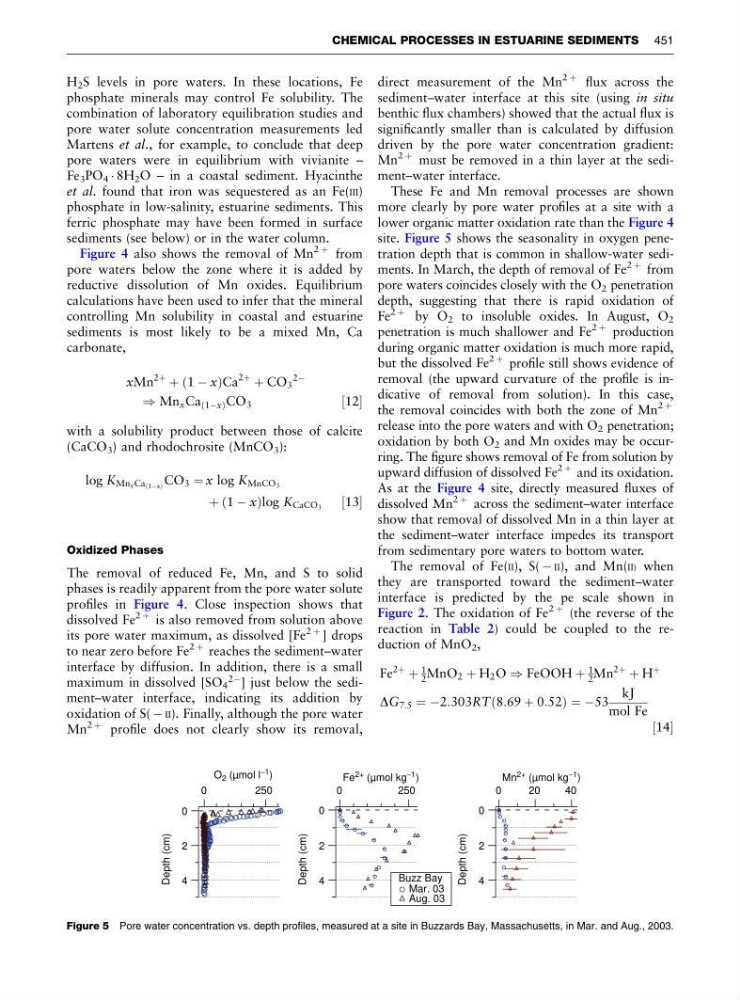
site. Figure 5 shows the seasonality in oxygen penetration depth that is common in shallow-water sediments. In March, the depth of removal of Fe
2 þ from
pore waters coincides closely with the O 2 penetration
depth, suggesting that there is rapid oxidation of
Fe
2 þ by O 2 to insoluble oxides. In August, O 2
penetration is much shallower and Fe
2 þ production
during organic matter oxidation is much more rapid,
but the dissolved Fe
2 þ profile still shows evidence of
removal (the upward curvature of the profile is indicative of removal from solution). In this case,
the removal coincides with both the zone of Mn
2 þ
release into the pore waters and with O 2 penetration;
oxidation by both O 2 and Mn oxides may be occurring. The figure shows removal of Fe from solution by
upward diffusion of dissolved Fe
2 þ and its oxidation.
As at the Figure 4 site, directly measured fluxes of
dissolved Mn
2 þ across the sediment–water interface
show that removal of dissolved Mn in a thin layer at
the sediment–water interface impedes its transport
from sedimentary pore waters to bottom water.
The removal of Fe(II), S( À II), and Mn(II) when
they are transported toward the sediment–water
interface is predicted by the pe scale shown in
Figure 2. The oxidation of Fe
2 þ (the reverse of the
reaction in Table 2) could be coupled to the reduction of MnO 2 ,
Fe
2þ þ
1
2 MnO 2 þ H 2 O ) FeOOH þ
1
2 Mn
2þ þ H
þ
DG 7:5 ¼ À2:303RTð8:69 þ 0:52Þ ¼ À53
kJ
mol Fe
½14
4
2
0
Depth (cm)
250
0
O 2 (µmol l
−1 )
4
2
0
Depth (cm)
250
0
Fe 2+ (µmol kg
−1 )
4
2
0
Depth (cm)
40
20
0
Mn 2+ (µmol kg
−1 )
Buzz Bay
Mar. 03
Aug. 03
Figure 5 Pore water concentration vs. depth profiles, measured at a site in Buzzards Bay, Massachusetts, in Mar. and Aug., 2003.
CHEMICAL PROCESSES IN ESTUARINE SEDIMENTS 451
phosphate minerals may control Fe solubility. The
combination of laboratory equilibration studies and
pore water solute concentration measurements led
Martens et al., for example, to conclude that deep
pore waters were in equilibrium with vivianite –
Fe 3 PO 4 Á 8H 2 O – in a coastal sediment. Hyacinthe
et al. found that iron was sequestered as an Fe(III)
phosphate in low-salinity, estuarine sediments. This
ferric phosphate may have been formed in surface
sediments (see below) or in the water column.
Figure 4 also shows the removal of Mn
2 þ from
pore waters below the zone where it is added by
reductive dissolution of Mn oxides. Equilibrium
calculations have been used to infer that the mineral
controlling Mn solubility in coastal and estuarine
sediments is most likely to be a mixed Mn, Ca
carbonate,
xMn
2þ þ ð1 À xÞCa
2þ þ CO 3
2À
) Mn x Ca ð1ÀxÞ CO 3
½12
with a solubility product between those of calcite
(CaCO 3 ) and rhodochrosite (MnCO 3 ):
log K Mn x Ca ð1ÀxÞ CO 3 ¼ x log K MnCO 3
þ ð1 À xÞlog K CaCO 3
½13
Oxidized Phases
The removal of reduced Fe, Mn, and S to solid
phases is readily apparent from the pore water solute
profiles in Figure 4. Close inspection shows that
dissolved Fe
2 þ is also removed from solution above
its pore water maximum, as dissolved [Fe
2 þ ] drops
to near zero before Fe
2 þ reaches the sediment–water
interface by diffusion. In addition, there is a small
maximum in dissolved [SO 4
2À ] just below the sediment–water interface, indicating its addition by
oxidation of S( À II). Finally, although the pore water
Mn
2 þ profile does not clearly show its removal,
direct measurement of the Mn
2 þ flux across the
sediment–water interface at this site (using in situ
benthic flux chambers) showed that the actual flux is
significantly smaller than is calculated by diffusion
driven by the pore water concentration gradient:
Mn
2 þ must be removed in a thin layer at the sediment–water interface.
These Fe and Mn removal processes are shown
more clearly by pore water profiles at a site with a
lower organic matter oxidation rate than the Figure 4
site. Figure 5 shows the seasonality in oxygen penetration depth that is common in shallow-water sediments. In March, the depth of removal of Fe
2 þ from
pore waters coincides closely with the O 2 penetration
depth, suggesting that there is rapid oxidation of
Fe
2 þ by O 2 to insoluble oxides. In August, O 2
penetration is much shallower and Fe
2 þ production
during organic matter oxidation is much more rapid,
but the dissolved Fe
2 þ profile still shows evidence of
removal (the upward curvature of the profile is indicative of removal from solution). In this case,
the removal coincides with both the zone of Mn
2 þ
release into the pore waters and with O 2 penetration;
oxidation by both O 2 and Mn oxides may be occurring. The figure shows removal of Fe from solution by
upward diffusion of dissolved Fe
2 þ and its oxidation.
As at the Figure 4 site, directly measured fluxes of
dissolved Mn
2 þ across the sediment–water interface
show that removal of dissolved Mn in a thin layer at
the sediment–water interface impedes its transport
from sedimentary pore waters to bottom water.
The removal of Fe(II), S( À II), and Mn(II) when
they are transported toward the sediment–water
interface is predicted by the pe scale shown in
Figure 2. The oxidation of Fe
2 þ (the reverse of the
reaction in Table 2) could be coupled to the reduction of MnO 2 ,
Fe
2þ þ
1
2 MnO 2 þ H 2 O ) FeOOH þ
1
2 Mn
2þ þ H
þ
DG 7:5 ¼ À2:303RTð8:69 þ 0:52Þ ¼ À53
kJ
mol Fe
½14
4
2
0
Depth (cm)
250
0
O 2 (µmol l
−1 )
4
2
0
Depth (cm)
250
0
Fe 2+ (µmol kg
−1 )
4
2
0
Depth (cm)
40
20
0
Mn 2+ (µmol kg
−1 )
Buzz Bay
Mar. 03
Aug. 03
Figure 5 Pore water concentration vs. depth profiles, measured at a site in Buzzards Bay, Massachusetts, in Mar. and Aug., 2003.
CHEMICAL PROCESSES IN ESTUARINE SEDIMENTS 451