

formed is a fine-grained, poorly crystalline form of
mackinawite (which we will call FeS m ). Studies of the
dissolution of mackinawite have shown that, in alkaline solutions (such as seawater), FeS m may be in
equilibrium with either dissolved Fe
2 þ and HS
À or
with the uncharged species, FeS
0
aq . In either case, the
total dissolved Fe
2 þ is expected to be B1 mM. Thus,
the relationship between [Fe
2 þ ], [SO 4
2À ], and total
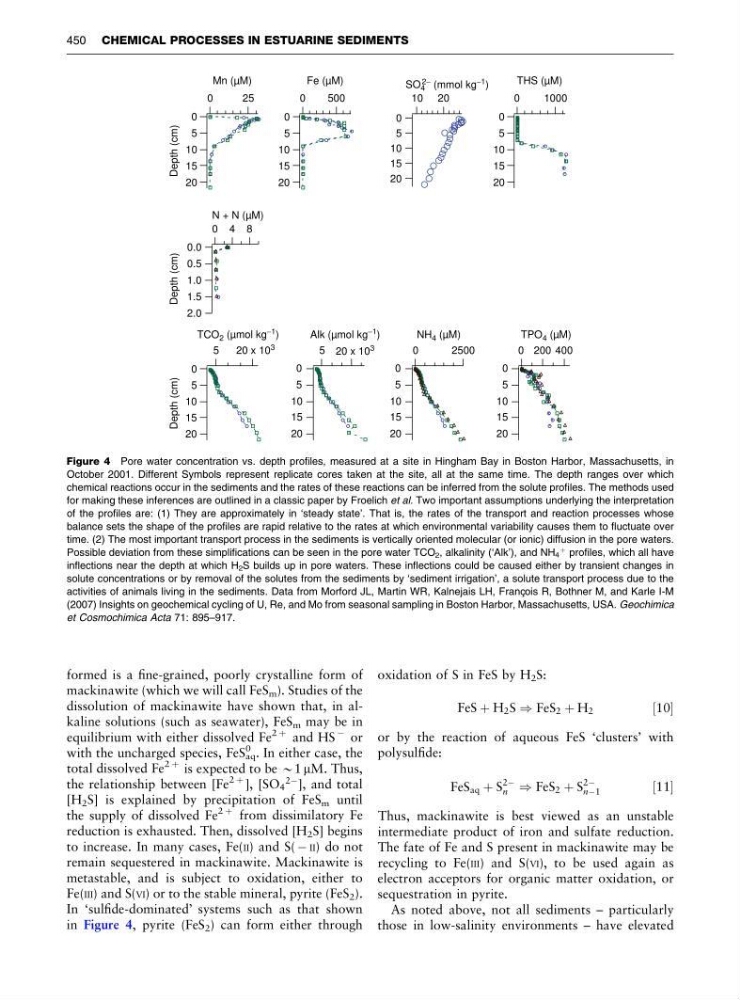
[H 2 S] is explained by precipitation of FeS m until
the supply of dissolved Fe
2 þ from dissimilatory Fe
reduction is exhausted. Then, dissolved [H 2 S] begins
to increase. In many cases, Fe(II) and S( À II) do not
remain sequestered in mackinawite. Mackinawite is
metastable, and is subject to oxidation, either to
Fe(III) and S(VI) or to the stable mineral, pyrite (FeS 2 ).
In ‘sulfide-dominated’ systems such as that shown
in Figure 4, pyrite (FeS 2 ) can form either through
oxidation of S in FeS by H 2 S:
FeS þ H 2 S ) FeS 2 þ H 2
½10
or by the reaction of aqueous FeS ‘clusters’ with
polysulfide:
FeS aq þ S
2À
n ) FeS 2 þ S
2À
nÀ1
½11
Thus, mackinawite is best viewed as an unstable
intermediate product of iron and sulfate reduction.
The fate of Fe and S present in mackinawite may be
recycling to Fe(III) and S(VI), to be used again as
electron acceptors for organic matter oxidation, or
sequestration in pyrite.
As noted above, not all sediments – particularly
those in low-salinity environments – have elevated
20
15
10
5
0
2500
0
NH 4 (µM)
20
15
10
5
0
Depth (cm)
20 x 10
3
20 x 10
3
5
TCO 2 (µmol kg
−1 )
20
15
10
5
0
5
Alk (µmol kg
−1 )
20
15
10
5
0
400
200
0
TPO 4 (µM)
2.0
1.5
1.0
0.5
0.0
Depth (cm)
8
4
0
N + N (µM)
20
15
10
5
0
1000
0
THS (µM)
20
15
10
5
0
500
0
Fe (µM)
20
15
10
5
0
Depth (cm)
25
0
Mn (µM)
20
15
10
5
0
20
10
SO 4
2− (mmol kg
−1 )
Figure 4 Pore water concentration vs. depth profiles, measured at a site in Hingham Bay in Boston Harbor, Massachusetts, in
October 2001. Different Symbols represent replicate cores taken at the site, all at the same time. The depth ranges over which
chemical reactions occur in the sediments and the rates of these reactions can be inferred from the solute profiles. The methods used
for making these inferences are outlined in a classic paper by Froelich et al. Two important assumptions underlying the interpretation
of the profiles are: (1) They are approximately in ‘steady state’. That is, the rates of the transport and reaction processes whose
balance sets the shape of the profiles are rapid relative to the rates at which environmental variability causes them to fluctuate over
time. (2) The most important transport process in the sediments is vertically oriented molecular (or ionic) diffusion in the pore waters.
Possible deviation from these simplifications can be seen in the pore water TCO 2 , alkalinity (‘Alk’), and NH 4
þ profiles, which all have
inflections near the depth at which H 2 S builds up in pore waters. These inflections could be caused either by transient changes in
solute concentrations or by removal of the solutes from the sediments by ‘sediment irrigation’, a solute transport process due to the
activities of animals living in the sediments. Data from Morford JL, Martin WR, Kalnejais LH, Franc¸ ois R, Bothner M, and Karle I-M
(2007) Insights on geochemical cycling of U, Re, and Mo from seasonal sampling in Boston Harbor, Massachusetts, USA. Geochimica
et Cosmochimica Acta 71: 895–917.
450 CHEMICAL PROCESSES IN ESTUARINE SEDIMENTS
mackinawite (which we will call FeS m ). Studies of the
dissolution of mackinawite have shown that, in alkaline solutions (such as seawater), FeS m may be in
equilibrium with either dissolved Fe
2 þ and HS
À or
with the uncharged species, FeS
0
aq . In either case, the
total dissolved Fe
2 þ is expected to be B1 mM. Thus,
the relationship between [Fe
2 þ ], [SO 4
2À ], and total
[H 2 S] is explained by precipitation of FeS m until
the supply of dissolved Fe
2 þ from dissimilatory Fe
reduction is exhausted. Then, dissolved [H 2 S] begins
to increase. In many cases, Fe(II) and S( À II) do not
remain sequestered in mackinawite. Mackinawite is
metastable, and is subject to oxidation, either to
Fe(III) and S(VI) or to the stable mineral, pyrite (FeS 2 ).
In ‘sulfide-dominated’ systems such as that shown
in Figure 4, pyrite (FeS 2 ) can form either through
oxidation of S in FeS by H 2 S:
FeS þ H 2 S ) FeS 2 þ H 2
½10
or by the reaction of aqueous FeS ‘clusters’ with
polysulfide:
FeS aq þ S
2À
n ) FeS 2 þ S
2À
nÀ1
½11
Thus, mackinawite is best viewed as an unstable
intermediate product of iron and sulfate reduction.
The fate of Fe and S present in mackinawite may be
recycling to Fe(III) and S(VI), to be used again as
electron acceptors for organic matter oxidation, or
sequestration in pyrite.
As noted above, not all sediments – particularly
those in low-salinity environments – have elevated
20
15
10
5
0
2500
0
NH 4 (µM)
20
15
10
5
0
Depth (cm)
20 x 10
3
20 x 10
3
5
TCO 2 (µmol kg
−1 )
20
15
10
5
0
5
Alk (µmol kg
−1 )
20
15
10
5
0
400
200
0
TPO 4 (µM)
2.0
1.5
1.0
0.5
0.0
Depth (cm)
8
4
0
N + N (µM)
20
15
10
5
0
1000
0
THS (µM)
20
15
10
5
0
500
0
Fe (µM)
20
15
10
5
0
Depth (cm)
25
0
Mn (µM)
20
15
10
5
0
20
10
SO 4
2− (mmol kg
−1 )
Figure 4 Pore water concentration vs. depth profiles, measured at a site in Hingham Bay in Boston Harbor, Massachusetts, in
October 2001. Different Symbols represent replicate cores taken at the site, all at the same time. The depth ranges over which
chemical reactions occur in the sediments and the rates of these reactions can be inferred from the solute profiles. The methods used
for making these inferences are outlined in a classic paper by Froelich et al. Two important assumptions underlying the interpretation
of the profiles are: (1) They are approximately in ‘steady state’. That is, the rates of the transport and reaction processes whose
balance sets the shape of the profiles are rapid relative to the rates at which environmental variability causes them to fluctuate over
time. (2) The most important transport process in the sediments is vertically oriented molecular (or ionic) diffusion in the pore waters.
Possible deviation from these simplifications can be seen in the pore water TCO 2 , alkalinity (‘Alk’), and NH 4
þ profiles, which all have
inflections near the depth at which H 2 S builds up in pore waters. These inflections could be caused either by transient changes in
solute concentrations or by removal of the solutes from the sediments by ‘sediment irrigation’, a solute transport process due to the
activities of animals living in the sediments. Data from Morford JL, Martin WR, Kalnejais LH, Franc¸ ois R, Bothner M, and Karle I-M
(2007) Insights on geochemical cycling of U, Re, and Mo from seasonal sampling in Boston Harbor, Massachusetts, USA. Geochimica
et Cosmochimica Acta 71: 895–917.
450 CHEMICAL PROCESSES IN ESTUARINE SEDIMENTS