

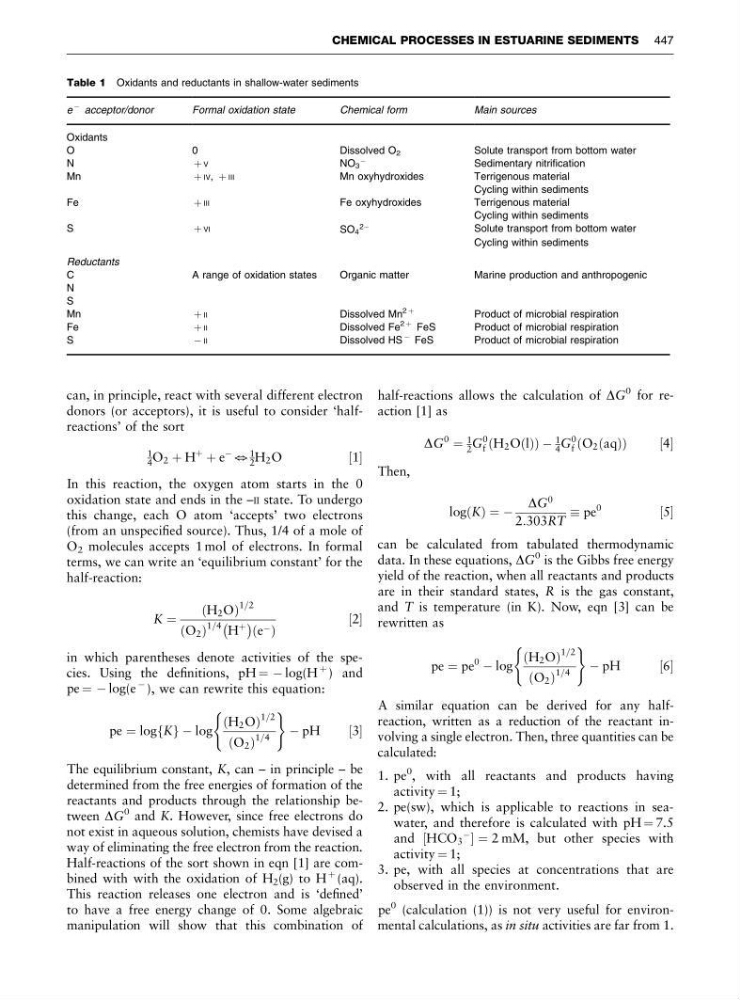
can, in principle, react with several different electron
donors (or acceptors), it is useful to consider ‘halfreactions’ of the sort
1
4 O 2 þ H
þ þ e
À
3
1
2 H 2 O
½1
In this reaction, the oxygen atom starts in the 0
oxidation state and ends in the –II state. To undergo
this change, each O atom ‘accepts’ two electrons
(from an unspecified source). Thus, 1/4 of a mole of
O 2 molecules accepts 1 mol of electrons. In formal
terms, we can write an ‘equilibrium constant’ for the
half-reaction:
K ¼
H 2 O
ð
Þ
1=2
O 2
ð Þ
1=4 H
þ
À Á
e À
ð Þ
½2
in which parentheses denote activities of the species. Using the definitions, pH ¼ À log(H
þ ) and
pe ¼ À log(e
À ), we can rewrite this equation:
pe ¼ logfKg À log
H 2 O
ð
Þ
1=2
O 2
ð Þ
1=4
(
)
À pH
½3
The equilibrium constant, K, can – in principle – be
determined from the free energies of formation of the
reactants and products through the relationship between DG
0 and K. However, since free electrons do
not exist in aqueous solution, chemists have devised a
way of eliminating the free electron from the reaction.
Half-reactions of the sort shown in eqn [1] are combined with with the oxidation of H 2 (g) to H
þ (aq).
This reaction releases one electron and is ‘defined’
to have a free energy change of 0. Some algebraic
manipulation will show that this combination of
half-reactions allows the calculation of DG
0 for reaction [1] as
DG
0 ¼
1
2 G
0
f H 2 OðlÞ
ð
ÞÀ
1
4 G
0
f O 2 ðaqÞ
ð
Þ
½ 4
Then,
log K
ð Þ ¼ À
DG
0
2:303RT
pe
0
½5
can be calculated from tabulated thermodynamic
data. In these equations, DG
0 is the Gibbs free energy
yield of the reaction, when all reactants and products
are in their standard states, R is the gas constant,
and T is temperature (in K). Now, eqn [3] can be
rewritten as
pe ¼ pe
0 À log
H 2 O
ð
Þ
1=2
O 2
ð Þ
1=4
(
)
À pH
½6
A similar equation can be derived for any halfreaction, written as a reduction of the reactant involving a single electron. Then, three quantities can be
calculated:
1. pe
0
, with all reactants and products having
activity ¼ 1;
2. pe(sw), which is applicable to reactions in seawater, and therefore is calculated with pH ¼ 7.5
and ½HCO 3
À ¼ 2 mM, but other species with
activity ¼ 1;
3. pe, with all species at concentrations that are
observed in the environment.
pe
0 (calculation (1)) is not very useful for environmental calculations, as in situ activities are far from 1.
Table 1 Oxidants and reductants in shallow-water sediments
e
À acceptor/donor
Formal oxidation state
Chemical form
Main sources
Oxidants
O
0
Dissolved O 2
Solute transport from bottom water
N
þ V
NO 3
À
Sedimentary nitrification
Mn
þ IV, þ III
Mn oxyhydroxides
Terrigenous material
Cycling within sediments
Fe
þ III
Fe oxyhydroxides
Terrigenous material
Cycling within sediments
S
þ VI
SO 4
2À
Solute transport from bottom water
Cycling within sediments
Reductants
C
A range of oxidation states
Organic matter
Marine production and anthropogenic
N
S
Mn
þ II
Dissolved Mn
2 þ
Product of microbial respiration
Fe
þ II
Dissolved Fe
2 þ FeS
Product of microbial respiration
S
À II
Dissolved HS
À FeS
Product of microbial respiration
CHEMICAL PROCESSES IN ESTUARINE SEDIMENTS 447
donors (or acceptors), it is useful to consider ‘halfreactions’ of the sort
1
4 O 2 þ H
þ þ e
À
3
1
2 H 2 O
½1
In this reaction, the oxygen atom starts in the 0
oxidation state and ends in the –II state. To undergo
this change, each O atom ‘accepts’ two electrons
(from an unspecified source). Thus, 1/4 of a mole of
O 2 molecules accepts 1 mol of electrons. In formal
terms, we can write an ‘equilibrium constant’ for the
half-reaction:
K ¼
H 2 O
ð
Þ
1=2
O 2
ð Þ
1=4 H
þ
À Á
e À
ð Þ
½2
in which parentheses denote activities of the species. Using the definitions, pH ¼ À log(H
þ ) and
pe ¼ À log(e
À ), we can rewrite this equation:
pe ¼ logfKg À log
H 2 O
ð
Þ
1=2
O 2
ð Þ
1=4
(
)
À pH
½3
The equilibrium constant, K, can – in principle – be
determined from the free energies of formation of the
reactants and products through the relationship between DG
0 and K. However, since free electrons do
not exist in aqueous solution, chemists have devised a
way of eliminating the free electron from the reaction.
Half-reactions of the sort shown in eqn [1] are combined with with the oxidation of H 2 (g) to H
þ (aq).
This reaction releases one electron and is ‘defined’
to have a free energy change of 0. Some algebraic
manipulation will show that this combination of
half-reactions allows the calculation of DG
0 for reaction [1] as
DG
0 ¼
1
2 G
0
f H 2 OðlÞ
ð
ÞÀ
1
4 G
0
f O 2 ðaqÞ
ð
Þ
½ 4
Then,
log K
ð Þ ¼ À
DG
0
2:303RT
pe
0
½5
can be calculated from tabulated thermodynamic
data. In these equations, DG
0 is the Gibbs free energy
yield of the reaction, when all reactants and products
are in their standard states, R is the gas constant,
and T is temperature (in K). Now, eqn [3] can be
rewritten as
pe ¼ pe
0 À log
H 2 O
ð
Þ
1=2
O 2
ð Þ
1=4
(
)
À pH
½6
A similar equation can be derived for any halfreaction, written as a reduction of the reactant involving a single electron. Then, three quantities can be
calculated:
1. pe
0
, with all reactants and products having
activity ¼ 1;
2. pe(sw), which is applicable to reactions in seawater, and therefore is calculated with pH ¼ 7.5
and ½HCO 3
À ¼ 2 mM, but other species with
activity ¼ 1;
3. pe, with all species at concentrations that are
observed in the environment.
pe
0 (calculation (1)) is not very useful for environmental calculations, as in situ activities are far from 1.
Table 1 Oxidants and reductants in shallow-water sediments
e
À acceptor/donor
Formal oxidation state
Chemical form
Main sources
Oxidants
O
0
Dissolved O 2
Solute transport from bottom water
N
þ V
NO 3
À
Sedimentary nitrification
Mn
þ IV, þ III
Mn oxyhydroxides
Terrigenous material
Cycling within sediments
Fe
þ III
Fe oxyhydroxides
Terrigenous material
Cycling within sediments
S
þ VI
SO 4
2À
Solute transport from bottom water
Cycling within sediments
Reductants
C
A range of oxidation states
Organic matter
Marine production and anthropogenic
N
S
Mn
þ II
Dissolved Mn
2 þ
Product of microbial respiration
Fe
þ II
Dissolved Fe
2 þ FeS
Product of microbial respiration
S
À II
Dissolved HS
À FeS
Product of microbial respiration
CHEMICAL PROCESSES IN ESTUARINE SEDIMENTS 447