

oscillations in d
18 O increases, implying growth of
larger ice sheets.
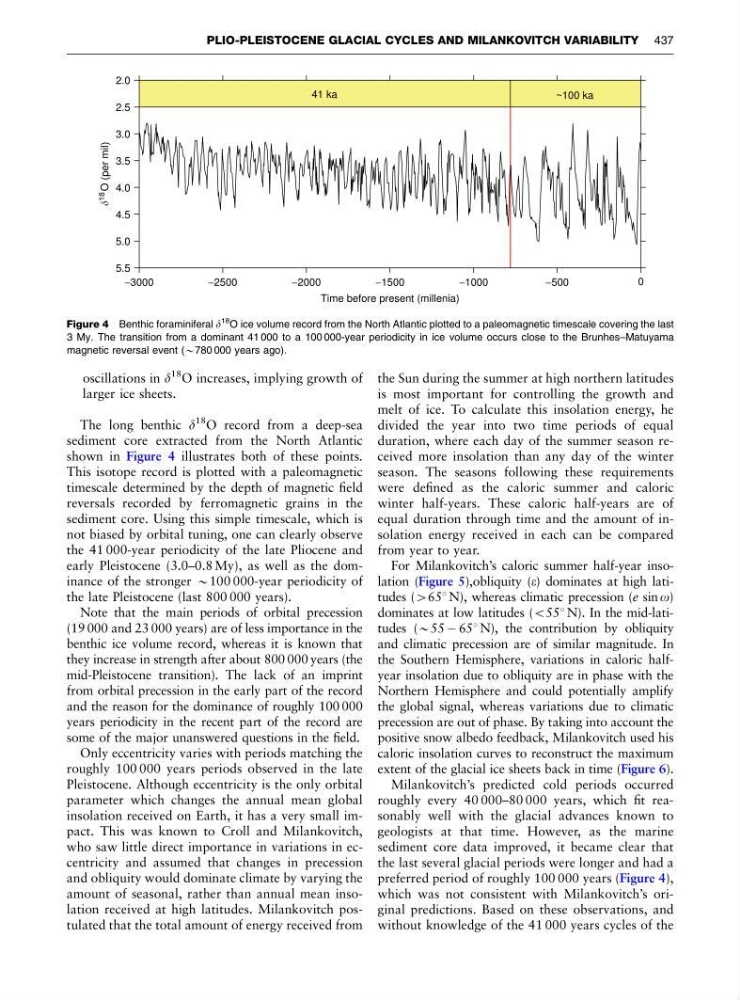
The long benthic d
18
O record from a deep-sea
sediment core extracted from the North Atlantic
shown in Figure 4 illustrates both of these points.
This isotope record is plotted with a paleomagnetic
timescale determined by the depth of magnetic field
reversals recorded by ferromagnetic grains in the
sediment core. Using this simple timescale, which is
not biased by orbital tuning, one can clearly observe
the 41 000-year periodicity of the late Pliocene and
early Pleistocene (3.0–0.8 My), as well as the dominance of the stronger B100 000-year periodicity of
the late Pleistocene (last 800 000 years).
Note that the main periods of orbital precession
(19 000 and 23 000 years) are of less importance in the
benthic ice volume record, whereas it is known that
they increase in strength after about 800 000 years (the
mid-Pleistocene transition). The lack of an imprint
from orbital precession in the early part of the record
and the reason for the dominance of roughly 100 000
years periodicity in the recent part of the record are
some of the major unanswered questions in the field.
Only eccentricity varies with periods matching the
roughly 100 000 years periods observed in the late
Pleistocene. Although eccentricity is the only orbital
parameter which changes the annual mean global
insolation received on Earth, it has a very small impact. This was known to Croll and Milankovitch,
who saw little direct importance in variations in eccentricity and assumed that changes in precession
and obliquity would dominate climate by varying the
amount of seasonal, rather than annual mean insolation received at high latitudes. Milankovitch postulated that the total amount of energy received from
the Sun during the summer at high northern latitudes
is most important for controlling the growth and
melt of ice. To calculate this insolation energy, he
divided the year into two time periods of equal
duration, where each day of the summer season received more insolation than any day of the winter
season. The seasons following these requirements
were defined as the caloric summer and caloric
winter half-years. These caloric half-years are of
equal duration through time and the amount of insolation energy received in each can be compared
from year to year.
For Milankovitch’s caloric summer half-year insolation (Figure 5),obliquity (e) dominates at high latitudes (4651 N), whereas climatic precession (e sin o)
dominates at low latitudes (o551 N). In the mid-latitudes (B55 À 651 N), the contribution by obliquity
and climatic precession are of similar magnitude. In
the Southern Hemisphere, variations in caloric halfyear insolation due to obliquity are in phase with the
Northern Hemisphere and could potentially amplify
the global signal, whereas variations due to climatic
precession are out of phase. By taking into account the
positive snow albedo feedback, Milankovitch used his
caloric insolation curves to reconstruct the maximum
extent of the glacial ice sheets back in time (Figure 6).
Milankovitch’s predicted cold periods occurred
roughly every 40 000–80 000 years, which fit reasonably well with the glacial advances known to
geologists at that time. However, as the marine
sediment core data improved, it became clear that
the last several glacial periods were longer and had a
preferred period of roughly 100 000 years (Figure 4),
which was not consistent with Milankovitch’s original predictions. Based on these observations, and
without knowledge of the 41 000 years cycles of the
−3000
−2500
−2000
−1500
−1000
−500
0
2.0
2.5
3.0
3.5
4.0
4.5
5.0
5.5
18
O (per mil)
Time before present (millenia)
41 ka
~100 ka
Figure 4 Benthic foraminiferal d
18 O ice volume record from the North Atlantic plotted to a paleomagnetic timescale covering the last
3 My. The transition from a dominant 41 000 to a 100 000-year periodicity in ice volume occurs close to the Brunhes–Matuyama
magnetic reversal event (B780 000 years ago).
PLIO-PLEISTOCENE GLACIAL CYCLES AND MILANKOVITCH VARIABILITY 437
18 O increases, implying growth of
larger ice sheets.
The long benthic d
18
O record from a deep-sea
sediment core extracted from the North Atlantic
shown in Figure 4 illustrates both of these points.
This isotope record is plotted with a paleomagnetic
timescale determined by the depth of magnetic field
reversals recorded by ferromagnetic grains in the
sediment core. Using this simple timescale, which is
not biased by orbital tuning, one can clearly observe
the 41 000-year periodicity of the late Pliocene and
early Pleistocene (3.0–0.8 My), as well as the dominance of the stronger B100 000-year periodicity of
the late Pleistocene (last 800 000 years).
Note that the main periods of orbital precession
(19 000 and 23 000 years) are of less importance in the
benthic ice volume record, whereas it is known that
they increase in strength after about 800 000 years (the
mid-Pleistocene transition). The lack of an imprint
from orbital precession in the early part of the record
and the reason for the dominance of roughly 100 000
years periodicity in the recent part of the record are
some of the major unanswered questions in the field.
Only eccentricity varies with periods matching the
roughly 100 000 years periods observed in the late
Pleistocene. Although eccentricity is the only orbital
parameter which changes the annual mean global
insolation received on Earth, it has a very small impact. This was known to Croll and Milankovitch,
who saw little direct importance in variations in eccentricity and assumed that changes in precession
and obliquity would dominate climate by varying the
amount of seasonal, rather than annual mean insolation received at high latitudes. Milankovitch postulated that the total amount of energy received from
the Sun during the summer at high northern latitudes
is most important for controlling the growth and
melt of ice. To calculate this insolation energy, he
divided the year into two time periods of equal
duration, where each day of the summer season received more insolation than any day of the winter
season. The seasons following these requirements
were defined as the caloric summer and caloric
winter half-years. These caloric half-years are of
equal duration through time and the amount of insolation energy received in each can be compared
from year to year.
For Milankovitch’s caloric summer half-year insolation (Figure 5),obliquity (e) dominates at high latitudes (4651 N), whereas climatic precession (e sin o)
dominates at low latitudes (o551 N). In the mid-latitudes (B55 À 651 N), the contribution by obliquity
and climatic precession are of similar magnitude. In
the Southern Hemisphere, variations in caloric halfyear insolation due to obliquity are in phase with the
Northern Hemisphere and could potentially amplify
the global signal, whereas variations due to climatic
precession are out of phase. By taking into account the
positive snow albedo feedback, Milankovitch used his
caloric insolation curves to reconstruct the maximum
extent of the glacial ice sheets back in time (Figure 6).
Milankovitch’s predicted cold periods occurred
roughly every 40 000–80 000 years, which fit reasonably well with the glacial advances known to
geologists at that time. However, as the marine
sediment core data improved, it became clear that
the last several glacial periods were longer and had a
preferred period of roughly 100 000 years (Figure 4),
which was not consistent with Milankovitch’s original predictions. Based on these observations, and
without knowledge of the 41 000 years cycles of the
−3000
−2500
−2000
−1500
−1000
−500
0
2.0
2.5
3.0
3.5
4.0
4.5
5.0
5.5
18
O (per mil)
Time before present (millenia)
41 ka
~100 ka
Figure 4 Benthic foraminiferal d
18 O ice volume record from the North Atlantic plotted to a paleomagnetic timescale covering the last
3 My. The transition from a dominant 41 000 to a 100 000-year periodicity in ice volume occurs close to the Brunhes–Matuyama
magnetic reversal event (B780 000 years ago).
PLIO-PLEISTOCENE GLACIAL CYCLES AND MILANKOVITCH VARIABILITY 437