

the precession parameter (e sin o). The combined effect of eccentricity and longitude of perihelion can
give changes in high-latitude summer insolation on
the order of 15% and varies with periods of 19 000
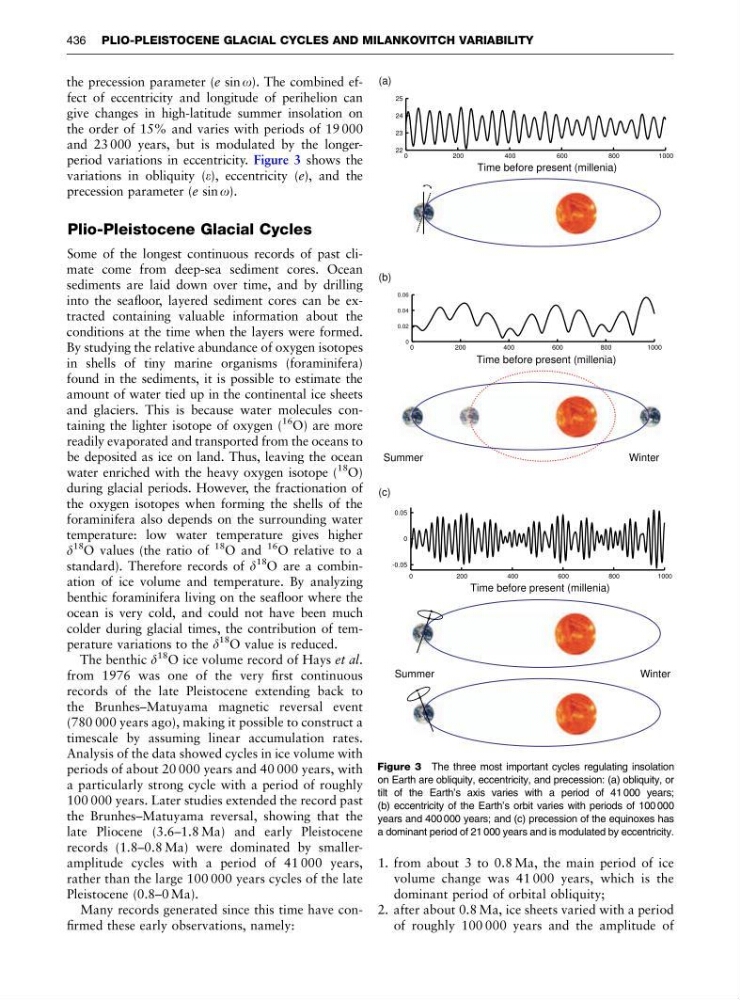
and 23 000 years, but is modulated by the longerperiod variations in eccentricity. Figure 3 shows the
variations in obliquity (e), eccentricity (e), and the
precession parameter (e sin o).
Plio-Pleistocene Glacial Cycles
Some of the longest continuous records of past climate come from deep-sea sediment cores. Ocean
sediments are laid down over time, and by drilling
into the seafloor, layered sediment cores can be extracted containing valuable information about the
conditions at the time when the layers were formed.
By studying the relative abundance of oxygen isotopes
in shells of tiny marine organisms (foraminifera)
found in the sediments, it is possible to estimate the
amount of water tied up in the continental ice sheets
and glaciers. This is because water molecules containing the lighter isotope of oxygen (
16
O) are more
readily evaporated and transported from the oceans to
be deposited as ice on land. Thus, leaving the ocean
water enriched with the heavy oxygen isotope (
18
O)
during glacial periods. However, the fractionation of
the oxygen isotopes when forming the shells of the
foraminifera also depends on the surrounding water
temperature: low water temperature gives higher
d
18
O values (the ratio of
18
O and
16
O relative to a
standard). Therefore records of d
18
O are a combination of ice volume and temperature. By analyzing
benthic foraminifera living on the seafloor where the
ocean is very cold, and could not have been much
colder during glacial times, the contribution of temperature variations to the d
18
O value is reduced.
The benthic d
18 O ice volume record of Hays et al.
from 1976 was one of the very first continuous
records of the late Pleistocene extending back to
the Brunhes–Matuyama magnetic reversal event
(780 000 years ago), making it possible to construct a
timescale by assuming linear accumulation rates.
Analysis of the data showed cycles in ice volume with
periods of about 20 000 years and 40 000 years, with
a particularly strong cycle with a period of roughly
100 000 years. Later studies extended the record past
the Brunhes–Matuyama reversal, showing that the
late Pliocene (3.6–1.8 Ma) and early Pleistocene
records (1.8–0.8 Ma) were dominated by smalleramplitude cycles with a period of 41 000 years,
rather than the large 100 000 years cycles of the late
Pleistocene (0.8–0 Ma).
Many records generated since this time have confirmed these early observations, namely:
1. from about 3 to 0.8 Ma, the main period of ice
volume change was 41 000 years, which is the
dominant period of orbital obliquity;
2. after about 0.8 Ma, ice sheets varied with a period
of roughly 100 000 years and the amplitude of
(a)
0
200
400
600
800
1000
22
23
24
25
Time before present (millenia)
(b)
Summer
Winter
(c)
Summer
Winter
0
200
400
600
800
1000
0
0.02
0.04
0.06
0
200
400
600
800
1000
-0.05
0
0.05
Time before present (millenia)
Time before present (millenia)
Figure 3 The three most important cycles regulating insolation
on Earth are obliquity, eccentricity, and precession: (a) obliquity, or
tilt of the Earth’s axis varies with a period of 41 000 years;
(b) eccentricity of the Earth’s orbit varies with periods of 100 000
years and 400 000 years; and (c) precession of the equinoxes has
a dominant period of 21 000 years and is modulated by eccentricity.
436 PLIO-PLEISTOCENE GLACIAL CYCLES AND MILANKOVITCH VARIABILITY
give changes in high-latitude summer insolation on
the order of 15% and varies with periods of 19 000
and 23 000 years, but is modulated by the longerperiod variations in eccentricity. Figure 3 shows the
variations in obliquity (e), eccentricity (e), and the
precession parameter (e sin o).
Plio-Pleistocene Glacial Cycles
Some of the longest continuous records of past climate come from deep-sea sediment cores. Ocean
sediments are laid down over time, and by drilling
into the seafloor, layered sediment cores can be extracted containing valuable information about the
conditions at the time when the layers were formed.
By studying the relative abundance of oxygen isotopes
in shells of tiny marine organisms (foraminifera)
found in the sediments, it is possible to estimate the
amount of water tied up in the continental ice sheets
and glaciers. This is because water molecules containing the lighter isotope of oxygen (
16
O) are more
readily evaporated and transported from the oceans to
be deposited as ice on land. Thus, leaving the ocean
water enriched with the heavy oxygen isotope (
18
O)
during glacial periods. However, the fractionation of
the oxygen isotopes when forming the shells of the
foraminifera also depends on the surrounding water
temperature: low water temperature gives higher
d
18
O values (the ratio of
18
O and
16
O relative to a
standard). Therefore records of d
18
O are a combination of ice volume and temperature. By analyzing
benthic foraminifera living on the seafloor where the
ocean is very cold, and could not have been much
colder during glacial times, the contribution of temperature variations to the d
18
O value is reduced.
The benthic d
18 O ice volume record of Hays et al.
from 1976 was one of the very first continuous
records of the late Pleistocene extending back to
the Brunhes–Matuyama magnetic reversal event
(780 000 years ago), making it possible to construct a
timescale by assuming linear accumulation rates.
Analysis of the data showed cycles in ice volume with
periods of about 20 000 years and 40 000 years, with
a particularly strong cycle with a period of roughly
100 000 years. Later studies extended the record past
the Brunhes–Matuyama reversal, showing that the
late Pliocene (3.6–1.8 Ma) and early Pleistocene
records (1.8–0.8 Ma) were dominated by smalleramplitude cycles with a period of 41 000 years,
rather than the large 100 000 years cycles of the late
Pleistocene (0.8–0 Ma).
Many records generated since this time have confirmed these early observations, namely:
1. from about 3 to 0.8 Ma, the main period of ice
volume change was 41 000 years, which is the
dominant period of orbital obliquity;
2. after about 0.8 Ma, ice sheets varied with a period
of roughly 100 000 years and the amplitude of
(a)
0
200
400
600
800
1000
22
23
24
25
Time before present (millenia)
(b)
Summer
Winter
(c)
Summer
Winter
0
200
400
600
800
1000
0
0.02
0.04
0.06
0
200
400
600
800
1000
-0.05
0
0.05
Time before present (millenia)
Time before present (millenia)
Figure 3 The three most important cycles regulating insolation
on Earth are obliquity, eccentricity, and precession: (a) obliquity, or
tilt of the Earth’s axis varies with a period of 41 000 years;
(b) eccentricity of the Earth’s orbit varies with periods of 100 000
years and 400 000 years; and (c) precession of the equinoxes has
a dominant period of 21 000 years and is modulated by eccentricity.
436 PLIO-PLEISTOCENE GLACIAL CYCLES AND MILANKOVITCH VARIABILITY