

Variations in the eccentricity of the Earth’s orbit follow cycles of 100 000 and 400 000 years giving a
change in annual mean insolation on the order of
0.2% or less. This change in insolation is believed to
be too small to produce any notable effect on climate.
A more significant change in insolation is caused
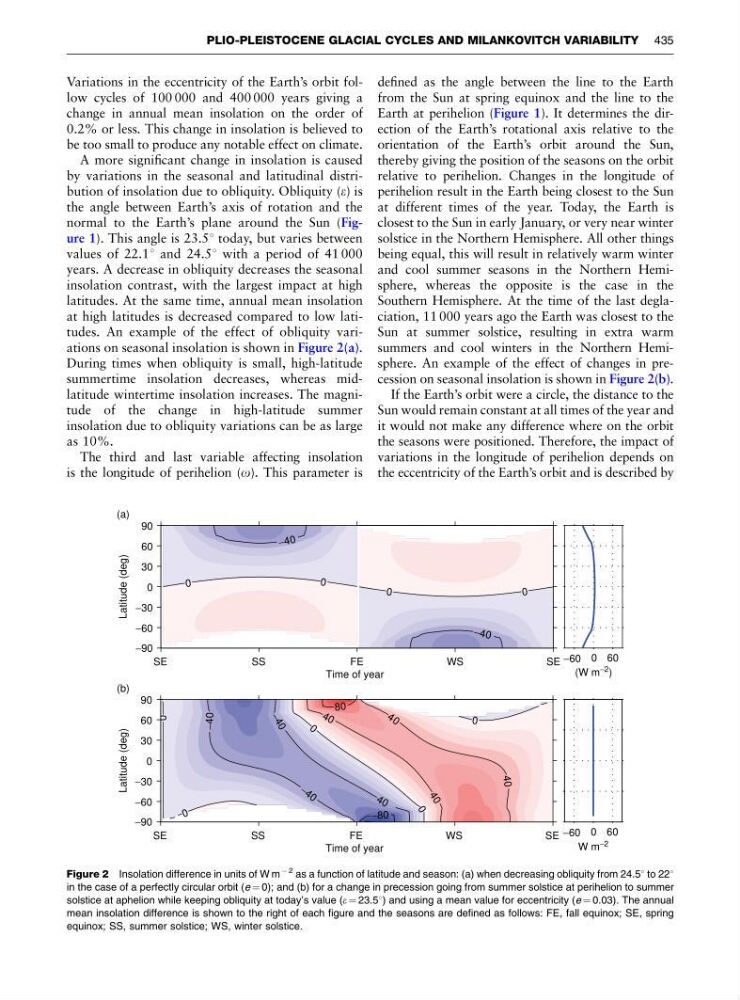
by variations in the seasonal and latitudinal distribution of insolation due to obliquity. Obliquity (e) is
the angle between Earth’s axis of rotation and the
normal to the Earth’s plane around the Sun (Figure 1). This angle is 23.51 today, but varies between
values of 22.11 and 24.51 with a period of 41 000
years. A decrease in obliquity decreases the seasonal
insolation contrast, with the largest impact at high
latitudes. At the same time, annual mean insolation
at high latitudes is decreased compared to low latitudes. An example of the effect of obliquity variations on seasonal insolation is shown in Figure 2(a).
During times when obliquity is small, high-latitude
summertime insolation decreases, whereas midlatitude wintertime insolation increases. The magnitude of the change in high-latitude summer
insolation due to obliquity variations can be as large
as 10%.
The third and last variable affecting insolation
is the longitude of perihelion (o). This parameter is
defined as the angle between the line to the Earth
from the Sun at spring equinox and the line to the
Earth at perihelion (Figure 1). It determines the direction of the Earth’s rotational axis relative to the
orientation of the Earth’s orbit around the Sun,
thereby giving the position of the seasons on the orbit
relative to perihelion. Changes in the longitude of
perihelion result in the Earth being closest to the Sun
at different times of the year. Today, the Earth is
closest to the Sun in early January, or very near winter
solstice in the Northern Hemisphere. All other things
being equal, this will result in relatively warm winter
and cool summer seasons in the Northern Hemisphere, whereas the opposite is the case in the
Southern Hemisphere. At the time of the last deglaciation, 11 000 years ago the Earth was closest to the
Sun at summer solstice, resulting in extra warm
summers and cool winters in the Northern Hemisphere. An example of the effect of changes in precession on seasonal insolation is shown in Figure 2(b).
If the Earth’s orbit were a circle, the distance to the
Sun would remain constant at all times of the year and
it would not make any difference where on the orbit
the seasons were positioned. Therefore, the impact of
variations in the longitude of perihelion depends on
the eccentricity of the Earth’s orbit and is described by
(a)
(b)
−80
− 4 0
−40
−
4
0
4 0
0
0
0
0
0
4 0
40
4 0
4
0
80
Latitude (deg)
Time of year
SE
SS
FE
WS
SE
0
30
60
90
−60 0 60
−60 0 60
W m
−2
(W m
−2 )
−4 0
−4 0
0
0
0
0
Latitude (deg)
Time of year
SE
SS
FE
WS
SE
−90
−60
−30
0
30
60
90
−90
−60
−30
Figure 2 Insolation difference in units of W m
À 2 as a function of latitude and season: (a) when decreasing obliquity from 24.51 to 221
in the case of a perfectly circular orbit (e ¼ 0); and (b) for a change in precession going from summer solstice at perihelion to summer
solstice at aphelion while keeping obliquity at today’s value (e ¼ 23.51) and using a mean value for eccentricity (e ¼ 0.03). The annual
mean insolation difference is shown to the right of each figure and the seasons are defined as follows: FE, fall equinox; SE, spring
equinox; SS, summer solstice; WS, winter solstice.
PLIO-PLEISTOCENE GLACIAL CYCLES AND MILANKOVITCH VARIABILITY 435
change in annual mean insolation on the order of
0.2% or less. This change in insolation is believed to
be too small to produce any notable effect on climate.
A more significant change in insolation is caused
by variations in the seasonal and latitudinal distribution of insolation due to obliquity. Obliquity (e) is
the angle between Earth’s axis of rotation and the
normal to the Earth’s plane around the Sun (Figure 1). This angle is 23.51 today, but varies between
values of 22.11 and 24.51 with a period of 41 000
years. A decrease in obliquity decreases the seasonal
insolation contrast, with the largest impact at high
latitudes. At the same time, annual mean insolation
at high latitudes is decreased compared to low latitudes. An example of the effect of obliquity variations on seasonal insolation is shown in Figure 2(a).
During times when obliquity is small, high-latitude
summertime insolation decreases, whereas midlatitude wintertime insolation increases. The magnitude of the change in high-latitude summer
insolation due to obliquity variations can be as large
as 10%.
The third and last variable affecting insolation
is the longitude of perihelion (o). This parameter is
defined as the angle between the line to the Earth
from the Sun at spring equinox and the line to the
Earth at perihelion (Figure 1). It determines the direction of the Earth’s rotational axis relative to the
orientation of the Earth’s orbit around the Sun,
thereby giving the position of the seasons on the orbit
relative to perihelion. Changes in the longitude of
perihelion result in the Earth being closest to the Sun
at different times of the year. Today, the Earth is
closest to the Sun in early January, or very near winter
solstice in the Northern Hemisphere. All other things
being equal, this will result in relatively warm winter
and cool summer seasons in the Northern Hemisphere, whereas the opposite is the case in the
Southern Hemisphere. At the time of the last deglaciation, 11 000 years ago the Earth was closest to the
Sun at summer solstice, resulting in extra warm
summers and cool winters in the Northern Hemisphere. An example of the effect of changes in precession on seasonal insolation is shown in Figure 2(b).
If the Earth’s orbit were a circle, the distance to the
Sun would remain constant at all times of the year and
it would not make any difference where on the orbit
the seasons were positioned. Therefore, the impact of
variations in the longitude of perihelion depends on
the eccentricity of the Earth’s orbit and is described by
(a)
(b)
−80
− 4 0
−40
−
4
0
4 0
0
0
0
0
0
4 0
40
4 0
4
0
80
Latitude (deg)
Time of year
SE
SS
FE
WS
SE
0
30
60
90
−60 0 60
−60 0 60
W m
−2
(W m
−2 )
−4 0
−4 0
0
0
0
0
Latitude (deg)
Time of year
SE
SS
FE
WS
SE
−90
−60
−30
0
30
60
90
−90
−60
−30
Figure 2 Insolation difference in units of W m
À 2 as a function of latitude and season: (a) when decreasing obliquity from 24.51 to 221
in the case of a perfectly circular orbit (e ¼ 0); and (b) for a change in precession going from summer solstice at perihelion to summer
solstice at aphelion while keeping obliquity at today’s value (e ¼ 23.51) and using a mean value for eccentricity (e ¼ 0.03). The annual
mean insolation difference is shown to the right of each figure and the seasons are defined as follows: FE, fall equinox; SE, spring
equinox; SS, summer solstice; WS, winter solstice.
PLIO-PLEISTOCENE GLACIAL CYCLES AND MILANKOVITCH VARIABILITY 435