

was later appointed Professor of Applied Mathematics at the University of Belgrade. He was captured during World War I, but allowed to work at the
Hungarian Academy of Sciences, where he completed his calculation of the variations of the orbital
parameters of the Earth and their impact on insolation and climate. Milankovitch’s basic idea was
that at times of reduced summer insolation, snow
and ice could persist at high latitudes through
the summer melt season. At the same time, the cool
summer seasons were accompanied by mild winter
seasons leading to enhanced winter accumulation
of snow. When combined, reduced summer melt and
a slight increase in winter accumulation, enhanced
by a positive snow albedo feedback, could eventually
lead to full glacial conditions.
During World War II, Milankovitch worked on a
complete revision of his astronomical theory which
was published as the Kanon der Erdbestrahlung in
1941. However, the scientific establishment was critical
of Milankovitch, and his theory was largely rejected
until the early 1970s. By this time, great advances
in sediment coring, deep-sea drilling, and dating
techniques had made it possible to recover climate records covering the last 500 000 years. By studying the
variations in oxygen isotopes of foraminifera in deepsea sediment cores as well as by reconstructing past sea
level from terraces of fossil coral reefs, new support
was emerging for an astronomical phasing of the glacial cycles. The oxygen isotope data from the long
deep-sea cores presented in a paper in 1976 by Hays
et al. were considered as proof of the Milankovitch
theory, as they showed cycles with lengths of roughly
20 000 and 40 000 years as well as 100 000 years in
agreement with Milankovitch’s original calculations.
Orbital Parameters and Insolation
The Earth’s orbit around the Sun is an ellipse where
the degree to which the orbit departs from a circle is
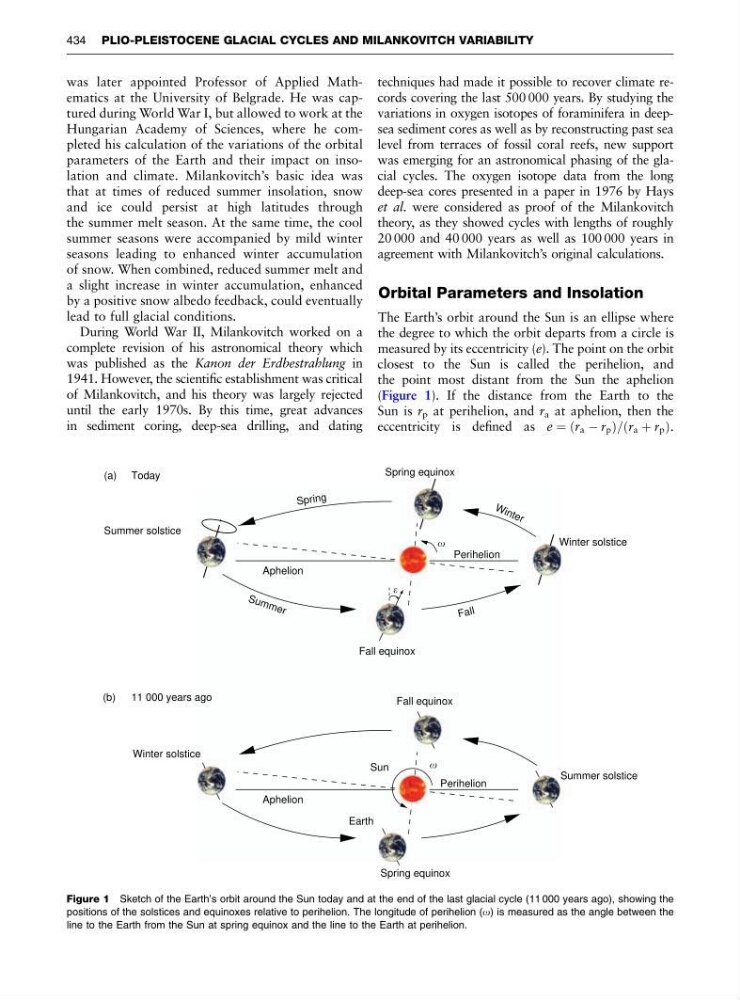
measured by its eccentricity (e). The point on the orbit
closest to the Sun is called the perihelion, and
the point most distant from the Sun the aphelion
(Figure 1). If the distance from the Earth to the
Sun is r p at perihelion, and r a at aphelion, then the
eccentricity is defined as e ¼ ðr a À r p Þ=ðr a þ r p Þ.
Fall equinox
Spring equinox
Earth
Aphelion
Perihelion
Sun
Perihelion
Aphelion
(a) Today
(b)
11 000 years ago
Winter solstice
Summer solstice
Spring equinox
Winter solstice
Fall equinox
Sp rin g
W in te r
F al l
S u m m e r
Summer solstice
Figure 1 Sketch of the Earth’s orbit around the Sun today and at the end of the last glacial cycle (11 000 years ago), showing the
positions of the solstices and equinoxes relative to perihelion. The longitude of perihelion (o) is measured as the angle between the
line to the Earth from the Sun at spring equinox and the line to the Earth at perihelion.
434 PLIO-PLEISTOCENE GLACIAL CYCLES AND MILANKOVITCH VARIABILITY
Hungarian Academy of Sciences, where he completed his calculation of the variations of the orbital
parameters of the Earth and their impact on insolation and climate. Milankovitch’s basic idea was
that at times of reduced summer insolation, snow
and ice could persist at high latitudes through
the summer melt season. At the same time, the cool
summer seasons were accompanied by mild winter
seasons leading to enhanced winter accumulation
of snow. When combined, reduced summer melt and
a slight increase in winter accumulation, enhanced
by a positive snow albedo feedback, could eventually
lead to full glacial conditions.
During World War II, Milankovitch worked on a
complete revision of his astronomical theory which
was published as the Kanon der Erdbestrahlung in
1941. However, the scientific establishment was critical
of Milankovitch, and his theory was largely rejected
until the early 1970s. By this time, great advances
in sediment coring, deep-sea drilling, and dating
techniques had made it possible to recover climate records covering the last 500 000 years. By studying the
variations in oxygen isotopes of foraminifera in deepsea sediment cores as well as by reconstructing past sea
level from terraces of fossil coral reefs, new support
was emerging for an astronomical phasing of the glacial cycles. The oxygen isotope data from the long
deep-sea cores presented in a paper in 1976 by Hays
et al. were considered as proof of the Milankovitch
theory, as they showed cycles with lengths of roughly
20 000 and 40 000 years as well as 100 000 years in
agreement with Milankovitch’s original calculations.
Orbital Parameters and Insolation
The Earth’s orbit around the Sun is an ellipse where
the degree to which the orbit departs from a circle is
measured by its eccentricity (e). The point on the orbit
closest to the Sun is called the perihelion, and
the point most distant from the Sun the aphelion
(Figure 1). If the distance from the Earth to the
Sun is r p at perihelion, and r a at aphelion, then the
eccentricity is defined as e ¼ ðr a À r p Þ=ðr a þ r p Þ.
Fall equinox
Spring equinox
Earth
Aphelion
Perihelion
Sun
Perihelion
Aphelion
(a) Today
(b)
11 000 years ago
Winter solstice
Summer solstice
Spring equinox
Winter solstice
Fall equinox
Sp rin g
W in te r
F al l
S u m m e r
Summer solstice
Figure 1 Sketch of the Earth’s orbit around the Sun today and at the end of the last glacial cycle (11 000 years ago), showing the
positions of the solstices and equinoxes relative to perihelion. The longitude of perihelion (o) is measured as the angle between the
line to the Earth from the Sun at spring equinox and the line to the Earth at perihelion.
434 PLIO-PLEISTOCENE GLACIAL CYCLES AND MILANKOVITCH VARIABILITY